


Our thanks to our friends and colleagues at the ABA Section of Real Property, Probate & Trust Section’s Land Use and Environmental Group for inviting us to a discussion of the latest and greatest decisions of interest.

We only had an hour together, so naturally could not cover everything of interest (indeed, we reserved a big discussion of the biggest item, the Supreme Court’s decision in Cedar Point, assuming that the Group will schedule a full session on that decision alone). So here is our curated list of what we think are the most interesting recent decisions in areas of interest to the Group:


Continue Reading Links From Today’s ABA RPTE Session

When the relief sought in a lawsuit is to compel the State to enact legislation a particular way, you have to know that in most courts that dog won’t hunt. Separation of powers, political question, et cetera, et cetera

So even though it isn’t about takings or compensation, you should check out the Iowa Supreme Court’s opinion in Iowa Citizens for Community Improvement v. State of Iowa, No. 19-1644 (June 18, 2021), because in that case, the court rejected the claims of “[t]wo social justice organizations” in a lawsuit that asked the court to order the legislature “to enact legislation that will compel Iowa farmers to take steps that will have the effect of significantly reducing levels of nitrogen and phosphorus in the Raccoon River.” Slip op. at 4.

Hold on, you say, on what basis might a court order another co-equal branch to do something like this?

Continue Reading Iowa: No Standing To Ask Court To Rule That Public Trust Doctrine Requires Legislation To Regulate Farmers
In which we join the Pendulum Land Podcast (again, thank you hosts!) to talk about the Virginia Supreme Court’s recent opinion in Johnson v. City of Suffolk, the case we label the “oyster takings” case in which Hampton Roads oystermen claimed that their property was taken when the City of Suffolk and the Sanitation District dumped sewage into the river and declared a “condemnation zone” (i.e., no oyster harvesting).

Short story: the court concluded that the leases of Commonwealth-owned bottomlands in the Nansemond River did not confer a property interest. Or at least not a property interest worthy of constitutional protection. Thus, no takings claim when Suffolk and the Sanitation District dumped sewage into the river and pretty plainly interfered with some kind of right the plaintiffs owned in the lease. Just not enough of a right to require compensation.  

Our thoughts on the court’s decision

Continue Reading We Join Pendulum Podcast To Debate Oysters, Property Rights, Takings

You remember that Seventh Circuit case challenging (as, inter alia, a no-public-use taking) the location of the Obama Center in Chicago’s Jackson Park under the public trust (from the home of the American public trust doctrine, Chicago)? We wrote about it in “Friends Without Benefits: CA7 Rejects Takings Claim For Obama Center Because Citizen’s Group Lacks Property Interest In Public Park.”

This was then-Seventh Circuit Judge Amy Barrett’s first (and only) takings or property rights opinion she authored prior to her promotion to the Supreme Court.

A citizen’s group asserted it has a property interest in Jackson Park by virtue of being the beneficiary of the public trust, and that the handing over of the Park to the Obama Foundation was a private benefit regulatory taking. The plaintiff sought an injunction stopping the transfer, and did not seek just compensation.

The district court and the

Continue Reading New Cert Petition: Judge Barrett’s (Sole) CA7 Takings Opinion Is Wrong

Goofus-gallant

Yes, it starts tomorrow, Thursday, January 28, 2021, but we’re “remote” this year, so it is not too late to register to join us for the 38th Annual ALI-CLE Eminent Domain & Land Valuation Litigation Conference. This is the “big one” where the nation’s best practitioners, scholars, jurists, and other industry professionals gather to talk shop about the subjects we know and love.

Details here (ALI-CLE’s page with faculty, agenda, and times), or here (a recent episode of Clint Schumacher’s Eminent Domain Podcast, where we preview the Conference). Here’s your chance to be a part of what is the best conference on these topics.

We have set it up to take advantage of the remote format, and tuition has been reduced (thank you to ALI-CLE for recognizing this, and for our sponsors for being so generous). We’re seeing a lot of first-time registrations, and this is a great opportunity

Continue Reading Still Time To Join Us: ALI-CLE Eminent Domain & Land Valuation Litigation Conference (Online!) This Thursday & Friday. Tuition Deals! #EminentDomain2021

25 Years of PASH_Schedule

Mention the term “PASH” to any dirt lawyer in the 50th State, and they’ll nod in understanding. It’s an 808 shibboleth — a kind of local property password — that signals that you’ve been around the block and know your stuff.

On one hand, it is simply an acronym for Public Access Shoreline Hawaii, the plaintiff/petitioner in the (in)famous case Public Access Shoreline Hawaii v. Hawaii Cnty. Planning Comm’n, 903 P.2d 1246 (Haw. 1995). On the other, however, it has evolved into shorthand for a number of things: from the technically accurate – native Hawaiian customary and traditional rights and practices under the Hawaii Constitution (“I was chasing a pua’a on private property, so I cannot be convicted of trespass because I was exercising my PASH rights”); to generically and cheekily – the ability to access the beach and shoreline (“Surf’s up today, let’s go practice some PASH rights!”)

Continue Reading PASH Bash: U. Hawaii Law Review Symposium – “25 Years of PASH” (Feb. 5, 2021)

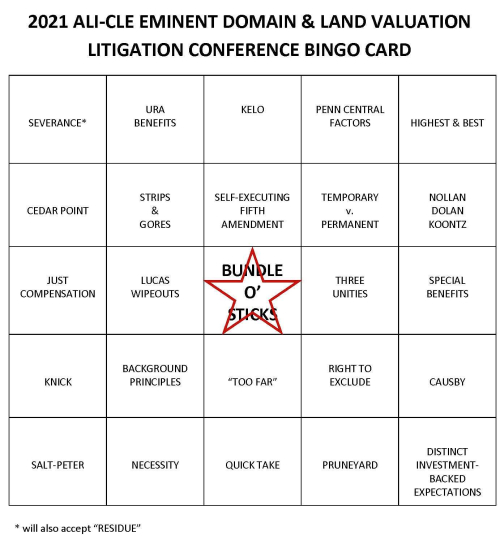
ALI-CLE 2021 Bingo card

If you “get” this, you should be registered for the 38th Annual Eminent Domain & Land Valuation Litigation Conference, to be held remotely on Thursday and Friday, January 28-29, 2021.

The list is growing rapidly, and you need to join us!

This is the “big one” where the nation’s best practitioners, scholars, jurists, and other industry professionals gather to talk shop about the subjects we know and love. We’re having programs with intriguing subjects such as “Planning to Win: Practical Strategies for a Successful Inverse Condemnation Case,” “How Do I Keep My Firm’s Doors Open When the Courthouse Doors Are Closed? Making Your Practice More Efficient When You Can’t Try Cases,” “Where Is the Supreme Court Headed on Takings Cases? Regulatory Takings Update and Cedar Point Preview,” “No Show and All Tell: Breaking News in Property Rights and Takings,” “More Than the Fifth Amendment: Other Tools for Upholding

Continue Reading Your 2021 ALI-CLE Eminent Domain & Land Valuation Litigation Conference (Jan 28-29, Remote) BINGO Card

Our thanks to Clint Schumacher for having us on his program to talk about the upcoming Conference. We’re “remote” this year, but that means a different approach to our presentations (and a very modest tuition!).

We’re having programs with intriguing subjects such as “Planning to Win: Practical Strategies for a Successful Inverse Condemnation Case,” “How Do I Keep My Firm’s Doors Open When the Courthouse Doors Are Closed? Making Your Practice More Efficient When You Can’t Try Cases,” “Where Is the Supreme Court Headed on Takings Cases? Regulatory Takings Update and Cedar Point Preview,” “No Show and All Tell: Breaking News in Property Rights and Takings,” “More Than the Fifth Amendment: Other Tools for Upholding Property Rights,” “Evaluating Lockdown, Moratorium, and Emergency Claims,” and more (including Ethics for those of you in MCLE jurisdictions). We’ll have a post with more details. 

Register now!Continue Reading Eminent Domain Podcast’s Preview Of The Upcoming ALI-CLE Eminent Domain & Land Valuation Litigation Conference

Often, the dispositive question in many takings cases tuns on whether the plaintiff owns “property,” and if so, what rights does that recognize. If you define the property in such a way that ipse dixit excludes the “stick” the owner claims was taken, then the answer is always going to be no property, no taking. To us, this is largely a question of definitions and policy: is this interest, in a judge’s view, worthy of constitutional protection?

And that’s the wrong approach, because this analysis often seems more like a semantic exercise, undertaken by the wrong party. Instead of concluding, for example, that the property in a case is a lease (a recognized property interest) and then going on to ask whether there’s been a sufficient interference with an owner’s distinct investment-backed expectations, the question shifts from what we think is the proper focus (a fact question of the impact

Continue Reading Surf And Turf (Our Beef With The Virginia Oyster Takings Case): Although Leases Are “Property,” They Don’t Confer A Right To Exclude Government Sewage

We listened live last week, but the court has now made the recording available in Johnson v. City of Suffolk.

This is what we call the “oyster takings” case in which Nansemond River oystermen claim that their property was taken when the City of Suffolk and the Sanitation District dumped sewage into the river and declared a “condemnation zone” (i.e., no oyster harvesting).

This is a case at the intersection of property and takings law, and environmental protection. And the public trust concept of jus publicum. The oystermen own a lease from the State of Virginia for the riverbed, which among other things, allows them to harvest some of the oysters that Virginia is so well known for. But they were forced to bring an inverse condemnation claim in state court, asserting that the City’s dumping of wastewater in the river — and prohibiting the

Continue Reading Recording Now Available In Virginia Supreme Court Oral Arguments In Takings, Property, And Public Trust Case