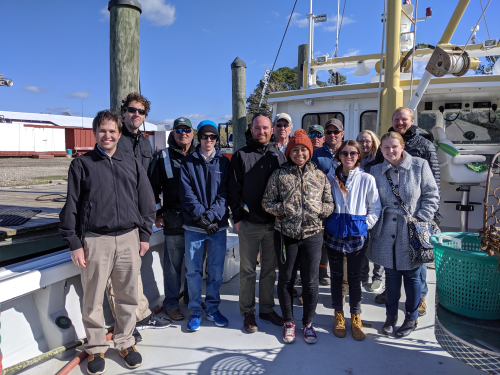
Here’s the latest in a case we’ve been following even before its inception (last semester, our William and Mary class visited the site and witnessed the oyster operation affected – see video above), Johnson v. City of Suffolk.

This morning, the Virginia Supreme Court heard oral arguments in the case, and we livestreamed it during our class. (We can’t post the audio recording just yet; those are released on Fridays, so hold on just a bit longer if you missed the live event.)

This is what we call the “oyster takings” case in which Nansemond River oystermen claim that their property was taken when the City of Suffolk and the Sanitation District dumped sewage into the river and declared a “condemnation zone” (i.e., no oyster harvesting).

This is a case at the intersection of property and takings law, and environmental protection. And the public trust concept of

Continue Reading Virginia Supreme Court Oral Arguments In Takings, Property, And Public Trust Case
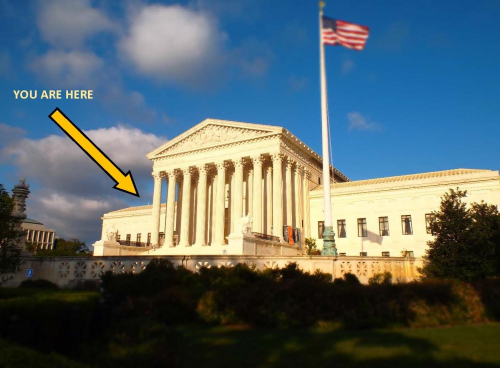
You are here

We have looked through the entire judicial and scholarly oeuvre of SCOTUS nominee Judge Amy Barrett, who today is continuing to run the gauntlet of the Senate Judiciary Committee. Naturally, our scanners were searching for any of her decisions or writings that might give us some clue how a “Justice Barrett” might treat takings and property cases, should she make the squad.

Frankly, however, there isn’t much to hold onto. As our colleagues Bryan Wenter (“What Might Supreme Court Nominee Amy Coney Barrett Mean to Property Rights?“) and Mike Ryan (“7th Circuit Rules Construction of the Obama Presidential Center Is Not A Taking Under The Fifth Amendment“) have covered, there’s just one opinion she authored or joined in which takings was on the docket: a recent decision about the challenge to the Obama Center being erected in a Chicago public park, Protect Our Parks, Inc v.

Continue Reading “Fidelity to the law means going where it leads, and sometimes it leads to the conclusion that a law is unconstitutional.” What Might A “Justice Barrett” Portend For Property Cases?

We’ve been meaning to write up the U.S. Court of Appeals’ decision in a case we’ve been followingProtect Our Parks, Inc v. Chicago Park District, No. 19-2308 (Aug. 231, 2020), but our Illinois colleague Mike Ryan was quicker on the draw.

Rather than summarize Mike’s write up, we simply suggest you go to his firm’s blog and read “7th Circuit Rules Construction of the Obama Presidential Center Is Not A Taking Under The Fifth Amendment.”

Short story: the citizen’s group plaintiff doesn’t have a property interest in Grant Park, notwithstanding its argument that the public’s status as the beneficiary of the public trust (the real public trust, not, you know, the other things that get labeled “public trust” but really aren’t the thing you think about when you think “public trust”), is enough of a property interest to come under the Fifth Amendment’s protections (or

Continue Reading Friends Without Benefits: CA7 Rejects Takings Claim For Obama Center Because Citizen’s Group Lacks Property Interest In Public Park

News just in: we’ve just received confirmation that the Conference will not be in-person in Scottsdale in January 2021, and we’re going online.

Not a big surprise, but still a bit disappointing, and it’s a shame that the circumstances won’t allow us to meet in-person to talk shop and to renew our friendships like we do every year. 

But rest assured we’re making lemonade out of these lemons, and we’d appreciate everyone holding the dates on your calendars to join your colleagues from across the nation for the online Conference. And no, we’re not going to do two-and-a-half-days remotely, we’re paring down the agenda and will be focusing on hot topics, and great presenters. The remote format has some advantages, and we’re taking advantage of the circumstances to plan a conference more interactive and a bit different than usual.

This will also be a great program for first-time Conference participants.

Continue Reading Breaking: News About The 2021 ALI-CLE Eminent Domain & Land Valuation Litigation Conference (Jan. 28-29, 2021)

Here’s the amicus brief filed yesterday in a Virginia Supreme Court case we’ve been following.

This is a case at the intersection of property and takings law, and environmental protection. Several Nansemond River oystermen own a lease from the state for the riverbed, which among other things, allows them to harvest some of the oysters that Virginia is so well known for. But they were forced to bring an inverse condemnation claim in state court, asserting that the City’s dumping of wastewater in the river — and prohibiting the harvesting of oysters during those times — was a taking under the Virginia Constitution’s taking or damaging clause (article I, § 11).

The trial court sustained the City’s demurrer, accepting the City’s argument that it has the right to pollute the river, based in part on the U.S. Supreme Court’s decision in Darling v. City of Newport News, 249

Continue Reading Amicus Brief In Virginia Oyster Takings Case: City’s Purposeful Pollution Of River Is A Taking Under The Virginia Constitution

A long opinion, but a short post. In Stanford Vina Ranch Irrigation Co. v. California, No. C085762 (June 18, 2020), the California Court of Appeal held that water rights are not really property rights.

That’s a bit of an overstatement, of course. But not a huge one.

In an inverse condemnation case, the court held that the owner of riparian rights did not have a protectable property interest in any amount of water, because riparian use, by definition, must always be reasonable. And the state gets to define what use is “reasonable.” Thus, the logic goes, because the State Water Resources Control Board determined by emergency regulation that any uses which might jeopardize the flow of water into a creek (to protect fish) were unreasonable, there’s no takings claim for an owner who claimed a vested right to the water. No property, no taking:

We have already explained the

Continue Reading Cal App Backs Into The Question: Riparian Rights Are Limited To Reasonable Use, So No Property Right In What Agency Deems Unreasonable Use

MVIMG_20191108_125325

Here’s the latest in a case we’ve been following (we visited the site last November with our William and Mary class), the property owners’ Opening Brief in  a case being considered by the Virginia Supreme Court.

This is a case at the intersection of property and takings law, and environmental protection. Several Nansemond River oystermen own a lease from the state for the riverbed, which among other things, allows them to harvest some of the oysters that Virginia is so well known for. But they were forced to bring an inverse condemnation claim in state court, asserting that the City’s dumping of wastewater in the river — and prohibiting the harvesting of oysters during those times — was a taking under the Virginia Constitution’s taking or damaging clause (article I, § 11).

The trial court sustained the City’s demurrer, accepting the City’s argument that it has the right to

Continue Reading Property Owners’ Brief In Virginia Supreme Court “Oyster Takings” Case

There’s a lot of opinion in the U.S. Court’s of Appeals’ opinion in Stratta v. Roe, No. 18-50994 (May 29, 2020). Yes, the court reversed the district court’s dismissal of a takings claim. But most of the opinion is devoted to the question of whether a Texas water conservation board — an agency whose mission is to regulate surface water uses — may take advantage of the State of Texas’s 11th Amendment immunity (no, held the court). We recommend that part of the opinion to you, federal courts junkies.

But there’s a couple of takings gems in there also. The case involved a challenge by a property owner who was (allegedly) treated by the water conservation board less generously than an (allegedly) similarly-situated municipality, resulting in the owner’s inability to make use of its groundwater rights. (In short, a Pennsylvania Coal claim, where instead of coal being required to

Continue Reading Fifth Circuit: Texas Groundwater Rights Are Takings Clause “Property”

WMdoor2

This fall, we’ll be back at the William and Mary Law School (hopefully in-person, depending on the circumstances and the yet-to-be-announced approach to be taken by the College of William and Mary), teaching two of our favorite subjects.

Not only will this be the third time leading Eminent Domain and Property Rights (Law 608), but we’ll also be undertaking another subject, Land Use Control (Law 425). This semester, we’re stepping into the (big, figuratively speaking) shoes of Professor Lynda Butler who recently retired after a stellar and trailblazing career. Thankfully, Lynda is continuing to lead the Brigham-Kanner Property Rights Project and is underway with planning October’s Brigham-Kanner Conference, honoring Harvard lawprof Henry Smith.

Land Use is, of course, related to Eminent Domain and Property Rights, but the law school understands that they are each worthy of separate study, and they should not be folded into a single course (or

Continue Reading Land Use Also On The Fall Semester Agenda At William And Mary Law

A development in the “oyster takings” case that we’ve been following as it has worked its way up to the Virginia Supreme court: that court today issued this Order, in which it awarded an appeal by Nansemond River oystermen (and the City of Suffolk’s cross-appeal) who claim that their property was taken when the City dumped sewage into the river and declared a “condemnation zone” (i.e., no oyster harvesting). Along with our William and Mary Law class, we took a field trip to the site last year (video above).

Some background, since this is a case at the intersection of property and takings law, and environmental protection. The oystermen own a lease from the state for the riverbed, which among other things, allows them to harvest some of the oysters that Virginia is so well known for. But they were forced to bring an inverse condemnation claim

Continue Reading Virginia Supreme Court To Consider Whether City Has The Right To Pollute Chesapeake Bay