
Details soon. In the meantime, get your earlier registration discount.Continue Reading Get Ready – ALI-CLE Eminent Domain And Land Valuation Litigation Conference, Nashville Jan. 23-25, 2020


Remember that Christopher Nolan movie from a few years ago, “Inception,” with its dream-within-a-dream storyline?
Well, that’s what a recently-filed cert petition which asks the U.S. Supreme Court to jump into California’s inverse-condemnation-liability-for-wildfires issue reminds us of with its taking-within-a-taking argument, as detailed in the Question Presented:
Whether it is an uncompensated taking for public use in violation of the Fifth and Fourteenth Amendments for a State to impose strict liability for inverse condemnation on a privately owned utility without ensuring that the cost of that liability is spread to the benefitted ratepayers.
Let’s see if we are keeping the argument straight: it’s a taking to hold a private entity which possesses the delegated power of eminent domain liable for a taking for burning down private property unless the utility is also entitled to pass the cost of any taking judgment on to those who benefit from
Later today (starting at 1pm ET), our colleague Edward Thomas is chairing an ABA-produced webinar on “Low Income Populations: Underrepresented Socially, Overrepresented as Victims of Natural Disasters: Using the Law to Solve a Serious Problem.”
As in other areas of life, when natural disasters strike, it is often the owners of modest means who are the hardest hit. Floods, wildfires, sea level rise, you name it. And Ed has been there: he’s a former FEMA guy, and currently the President of the Natural Hazard Mitigation Association who understands that property rights have to be respected in these situations.
Find out more information about the program and register here. Continue Reading Webinar Today – Low Income Populations: Underrepresented Socially, Overrepresented as Victims of Natural Disasters
JD Morris has the story at the San Francisco Chronicle, “California’s strict wildfire liability rule hangs over bankrupt PG&E.”
The story is about inverse condemnation of course, and how California law applies that doctrine in cases involving what look like natural disasters, most notably the state’s recent experiences with major wildfires.
We provided comments on whether an insurance fund might make some sense (because isn’t the mail goal of inverse liability to spread the economic burden of public benefits?). And the story also picks up on the recent 2-1 Ninth Circuit decision on how inverse claims which have not been reduced to judgment get treated in bankruptcy:
The wildfire fund alternative Paulo identified could be evaluated by a new committee focused on wildfires and utilities that was authorized by Dodd’s bill, SB901. Gov. Gavin Newsom appointed his three members to the committee just last
A short update from the west coast: the California Supreme Court late last week denied discretionary review in the case in which a California utility was arguing that it cannot be liable under that state’s version of inverse condemnation because the utility, unlike a governmental entity, cannot automatically spread the cost of any judgment to all members of its constituency.
We posted the utility’s petition here (“Electric Company: We Can’t Be Liable For Inverse Condemnation For Cal Wildfires Unless We Can ‘Unilaterally Recoup Costs From The Benefited Public Through Taxation Or Rate Increases‘”).
There are other cases raising the same issue coming up the pipeline, so stay tuned for more. Continue Reading Cal Supreme Court Denies Review Of Wildfire Inverse Petition
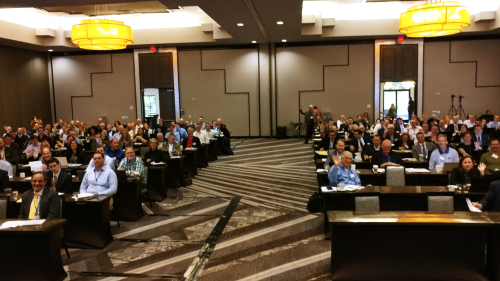
Here is our annual “proof of life” photo, taken from the dais during the opening session, to prove that all 250 of us were in the room for the ALI-CLE Eminent Domain Conference, and not out on a Palm Springs golf course (it is 72º and sunny, so a golf course would not be a bad place to be).
Here are the links from our talk this morning (along with Amy Boulris) about the latest issues to watch in eminent domain:
Here’s the Petition for Review we’ve been waiting to drop since last week’s ruling by a California Court of Appeal declining to review the California PUC’s decision to turn down the electric company’s request for a rate increase to cover the compensation and damages that it must pay as the result of a southern California wildfire.
Recall that under California law, a utility company with the power of eminent domain (such as San Diego Gas & Electric) can be liable under an inverse condemnation theory if it can be shown that “any actual physical injury to real property” was “proximately caused by [a public] improvement as deliberately designed and constructed” by the utilty, whether or not foreseeable.
Two California intermediate appellate courts have applied that general rule to wildfires, even though that state’s Supreme Court has not.
The petition argues that the two court of appeal opinions turn on the