We won’t go into the details of the Court of Federal Claims’ opinion and order in In re Upstream Addicks and Barker (Texas) Flood Control Reservoirs, No. 17-9001L (Dec. 17, 2019), since it is 46 single-spaced pages long. You can (and should) read the entire thing. But we shall highlight of a few of the highlights, since this is definitely a case to watch, especially as it progresses to the (inevitable) appeal to the Federal Circuit. 

This is the case in which Texas owners whose property upstream of two government created and maintained dams was intentionally flooded by the Corps of Engineers after Hurricane Harvey sued the feds for just compensation for a taking. The government sought dismissal, but after a 10-day trial, the CFC held the government is “liable for a taking on a flowage easement on the [thirteen test] properties.” Slip op. at 3. 

The court summarized

Continue Reading CFC: “Calculated” Hurricane Harvey Flooding Is A Taking – But Will Decision Survive Federal Circuit Review?

Here’s decision we’ve been anticipating in a case and issue we’ve been following for a while, the question of whether private utilities can be held liable under an inverse condemnation theory for much of the damages caused by the recent California wildfires. 

Short story from the Northern District of California Bankruptcy Court: yes, private utilities can be liable in inverse condemnation:

What Debtors advocate here is to set aside a well-seasoned principle of strict liability. Failing that, they are seeking a solution, fire cost reimbursement, in search of a problem, CPUC’s refusal or unwillingness to allow recovery by a blameless (prudent) investor-owned utility. As noted, they cite no instance when the CPUC denied inverse condemnation cost reimbursement to a prudent operator. And it is the role of the legislative branch, not the judicial branch, to fix problems in advance. As recently as this past July, the California legislature refused

Continue Reading California’s “Well-Seasoned” Inverse Condemnation Strict Liability Principle Not Set Aside By PG&E’s Bankruptcy Court

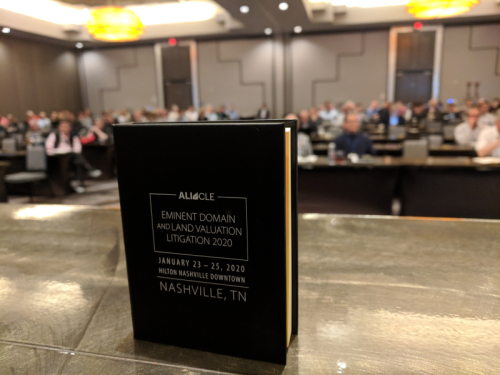
We were not as creative as our colleague Paul Henry (see below), but our Planning Co-Chair Joe Waldo and I wanted to personally invite you to join the “big guns” in our area of law at the 37th Annual ALI-CLE Eminent Domain and Land Valuation Litigation Conference, January 23-25, 2020, in Nashville, Tennessee.

We’ve assembled an excellent faculty, and an agenda that covers the hot topics of the day. Go here to view the complete faculty list and agenda. Water rights, Knick, appraisal, ethics, civil rights, and a whole lot more in three days of the longest (and we think best) conference in our area of law. Also, for those new to the field, Andy Brigham and Jack Sperber are again leading their “Eminent Domain 101” program. A great way to learn the topic, or for experienced lawyers to get a quick refresher on the basics. Your registration

Continue Reading Don’t Miss Out: Join The “Big Guns” And Secure Your Space At ALI-CLE’s Upcoming Eminent Domain & Land Valuation Litigation Conference (Jan 23-25, 2020, Nashville)

We contributed to Marketplace‘s Morning Report (stream above, or visit this link), and its brief discussion of the California wildfire and inverse condemnation situation, “PG&E tries to get out of its financial responsibility to those affected by west coast fires.” That portion of the broadcast begins at the 1:57 mark. 

Today’s the day that a U.S. Bankruptcy judge will hear arguments about whether holding PG&E and other private utilities which possess the power of eminent domain potentially liable under California’s version of inverse condemnation, itself is a taking under the Fifth Amendment because the utilities do not have the ability to spread the costs of any such judgments to their ratepayers automatically. More on the argument (including the brief) here. The claim is made that the purpose of condemnation is to make sure that the costs of public projects are not borne by individual property (correct

Continue Reading Marketplace Morning Report On Today’s Bankruptcy Court Arguments: Is California’s Inverse Condemnation Rule Itself An Inverse Condemnation Of PG&E’s Property?

Registration underway, so come join us! Agenda full of hot topics in takings and appraisal law! The best national faculty! Renew friendships, and make new colleagues! And Nashville! 

Download the brochure and make your plans for January. (Don’t wait, we’ve sold out the past three years.)Continue Reading Register Now! ALI-CLE Eminent Domain And Land Valuation Litigation Conference (Nashville, Jan 23-25, 2020)

6a00d83451707369e2022ad3b86fce200d-800wi

You overwhelmingly asked for Nashville, and we’re bringing it to you!

Get ready, and hold your place now: here’s the list of programs and speakers for the 36th Annual ALI-CLE Eminent Domain and Land Valuation Litigation Conference, to be held at the Downtown Nashville Hilton, January 23,- 25, 2020. Two-and-a-half days with top-notch national faculty (lawyers from both sides, judges, legal scholars, appraisers, relocation experts, and others).  

Early registration and group rates are available now

Here are just some of the programs:

  • Featured Presentation: Property Rights as Civil Rights: Seeking Justice Though the Fourth and Fifth Amendments. Hon. Jonathan Apgar, Jamila Johnson, Alan Ackerman. Moderator: Leslie Fields.
  • Making Sense of the New Rules After Knick v. Township of Scott: Where Do I Go, What Do I Do? David Breemer, Smitha Chintamaneni, Professor Bethany Berger. Moderator: Professor Steven Eagle.
  • When A River Runs Thought It: Water Rights and


Continue Reading Here’s The Agenda And Faculty For The 2020 ALI-CLE Eminent Domain And Land Valuation Litigation Conference, Nashville, Jan 23-25, 2020

ALI Nashville 2020

The final agenda and faculty list will soon be officially published, but we wanted to give you a preview of what is in store at the ALI-CLE Eminent Domain and Land Valuation Litigation Conference, January 23-25, 2020, at the Nashville Hilton (downtown, just a few steps away from everything that Nashville has to offer). 

Don’t miss out: in recent years, we’ve been at-or-near capacity, and the conference hotel has even sold out a couple of times. Visit the ALI-CLE website to register and hold your space

Here are some of the things we’ll be discussing: 

  • Making Sense of the New Rules After Knick v. Township of Scott: Where Do I Go, What Do I Do?
  • The Missing Link in Valuing Fixtures
  • When a River Runs Through it: Water Rights and Takings
  • Responding to Project Changes: Valuation When Government Action is Ongoing
  • Property Rights as Civil Rights: Seeking Justice Through


Continue Reading Get Ready: The 2020 ALI-CLE Eminent Domain And Land Valuation Litigation Conference Agenda Coming Soon

The California Supreme Court’s relatively short unanimous opinion yesterday in City of Oroville v. Superior Court, No. S243247 (Aug. 15, 2019) may have a bigger impact outside of that case than within in.

While that is undoubtedly true in many decisions by a precedential court of last resort, we highlight that here because inverse condemnation is a trending topic in California right now due to the multiple litigations spawned by a series of wildfires, and the City of Oroville case is all about the details of California’s somewhat unique inverse condemnation doctrine.  

Short story is that a dentist’s office flooded with you-know-what when the municipal sewer backed up. Dentists said the City didn’t maintain the sewer (sewer systems are supposed to take crap away in a one-way direction, not return it into habitable spaces). The City for its part argued that if the dentists had only installed the

Continue Reading Cal Supreme Court: Stop Saying Inverse Condemnation Is “Strict Liability”

Mark your calendars for Thursday, August 22, 2019, 2 – 3pm ET, for a free ABA program, “When the Floods and Fires Come: Landowner’s Property Damage Claims.” This session, produced by the Section of Litigation and organized by our Damon Key colleague Mark Murakami. Featured speakers are our colleagues Anthony Della Pelle (NJ), Kristen Renfro (CA), and Pepperdine lawprof Shelley Saxer (CA).

Here’s the description:

In the wake of the Superstorm Sandy, the 2017 hurricanes, and the California wildfires, landowners damaged by the disasters are faced with a confusing array of potential recovery options. This program is designed to assist small and general practice attorneys whose clients are harmed by these disasters. Anthony Della Pelle, Esq. of New Jersey and Kristen Renfro, Esq. of California will discuss the practitioner’s views and Professor Shelley Saxer of Pepperdine Law School will discuss the legal theories relating to governmental

Continue Reading Upcoming Free Program: “When the Floods and Fires Come: Landowner’s Property Damage Claims”