When we last visited Sheetz v. El Dorado County, we finished with “stay tuned” because we suspected that the California Court of Appeal’s opinion concluding that the County’s traffic mitigation fee is immune from Nollan/Dolan nexus-and-rough-proportionality review because the legislature imposed the fee on everyone (and Sheetz was not subject to paying it because of an ad hoc agency decision) was not going to be the last word, either in the case or on the legislative exactions issue.

Well, now the predicted other shoe drop: the property owner has filed this cert petition, with this Question Presented:

George Sheetz applied to the County of El Dorado, California, for a permit to build a modest manufactured house on his property. Pursuant to legislation enacted by the County, and as the condition of obtaining the permit, Mr. Sheetz was required to pay a monetary exaction of $23,420 to help finance

Continue Reading New Cert Petition: The Supreme Court Should Resolve The Legislatively-vs-Administratively Imposed Exactions Issue

1992 Aerial Photo Island2
Shands Key, with the City of Marathon in the background

This just in: in Shands v. City of Marathon, No. 3D21-1987 (May 3, 2023), Florida’s Third District Court of Appeals held that the city’s downzoning the property (Shands Key, shown above in an exhibit from the Key West trial we participated in in June 2021) from General Use (density: one home per acre) to Conservation Offshore Island (one home per 10 acres; Shands Key is just under 8 acres) effected a Lucas taking.

We’re not going to go into too much detail, because this case is one of ours. Our Pacific Legal Foundation colleague Jeremy Talcott was the lead trial and appellate counsel, backed by Kady Valois.

Shandstrialteam_after
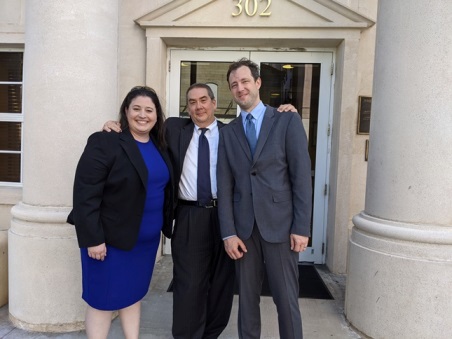
Trial (and appeal) team after closing arguments in Key West:
Valois, inversecondemnation.com, Talcott

But we’re not going to let you go without noting a few highlights from the Court of

Continue Reading This Just In – Florida Appeals Court: TDRs, Beekeeping, And Camping Are Not Economically-Beneficial Uses, So Downzoning Is A Lucas Taking

If everything the Ninth Circuit says in its unpublished memorandum opinion in Craneveyor Corp. v. City of Rancho Cucamonga, No. 22-55435 (Apr. 20, 2023) is accurate, there’s no way to ever draft a complaint alleging a facial Penn Central regulatory taking that will survive a 12(b)(6) motion to dismiss for failure to state a claim.

From what we can gather (this is an unpublished memorandum opinion, after all), the property owner asserted a facial takings challenge to some sort of zoning regulations that restrict its use of two parcels it owns. We’re not sure what restrictions. See slip op. at 2 (“The complaint asserts a facial takings challenge under 42 U.S.C. § 1983 to a city zoning plan that allegedly restricts development on two parcels of land owned by CraneVeyor.”).

Two theories: Lucas and Penn Central.

The court made short work on the facial Lucas claim, concluding that

Continue Reading CA9 (unpub.): You Can Never Adequately Plead A Facial Penn Central Taking For City Zoning Restrictions

Alex Boone note

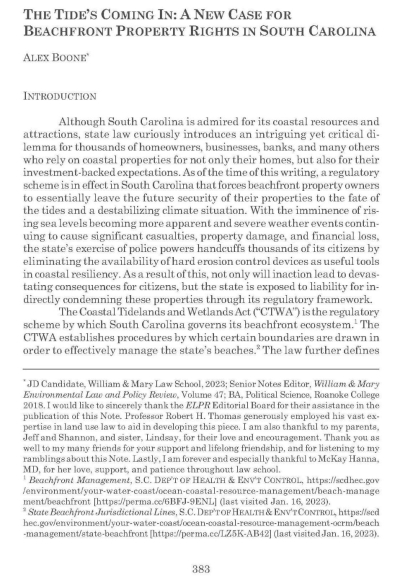
Check this out, a new student-authored note from William and Mary third-year law student Alex Boone, “The Tide’s Coming In: A New Case for Beachfront Property Rights in South Carolina,” 47 Wm. & Mary Envtl. L. & Pol’y Rev. 383 (2023).

Here’s the Abstract:

Part I of this Note explores the scientific data as it relates to the impending consequences of climate change on South Carolina’s coast and will introduce the disastrous scenarios that are predicted to arise as a result of rising sea levels and the accelerating strength and severity of extreme weather events. Part II compares the effectiveness of various coastal resiliency tools and highlights the regulatory framework that prohibits their use by beachfront property owners. Part III explores the topic of regulatory takings and their indirect prophylactic nature of protecting citizens from regulatory overreach and offers a case for a South Carolina court to find

Continue Reading New Article: Alex Boone, “The Tide’s Coming In: A New Case for Beachfront Property Rights in South Carolina” (Wm & Mary Envt’ L & Pol’y Rev)

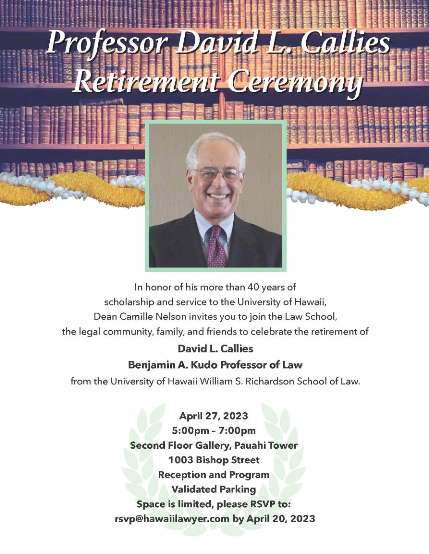
D Callies Retirement Celebration Invite 4-27-2023.f

Come join us on Thursday, April 27, 2023, from 5-7pm, downtown Honolulu, to celebrate the retirement of Professor David L. Callies from the University of Hawaii Law School.

Join U.H. Law School Dean Camille Nelson, Professor Callies’ colleagues, his students (present and former), the Hawaii legal community, and family and friends as we honor 43 years of scholarship, teaching, service, and practice.

Professor Callies is a prolific scholar and author, and has mentored generations of lawyers. Known especially for his work in property, land use, takings, administrative law, and state and local government law, he has also been presented with numerous awards including William and Mary’s Brigham-Kanner Property Rights Prize, and the Owner’s Counsel of America’s Crystal Eagle

Invitation and how to RSVP (or click below). Space is limited, so please let us know you are attending as soon as you can.

Details:

Thursday,

Continue Reading April 27, 2023, 5-7pm, Honolulu: Join Us To Celebrate The Work And Career Of Professor David Callies

There’s a lot going on in the U.S. Court of Appeals for the Fifth Circuit’s opinion in Tejas Motel, L.L.C. v. City of Mesquite, No. 22-10321 (Mar. 22, 2023), but that’s mostly because it’s a procedural decision resolving a question of whether a Texas court’s federal takings judgment was res judicata, and therefore prohibited a federal takings complaint filed later in federal court .

As you might surmise from the above summary, the Fifth Circuit indeed concluded that the second (federal) takings lawsuit was precluded by the judgment in the first (Texas), because the Texas court issued a final judgment on the merits of Tejas Motel’s federal takings claim.

Short story: the city doesn’t really care for operations like the Tejas Motel. Back in 1997, the city amended its zoning code to effectively outlaw these types of motels, rendering Tejas a nonconforming use. Later, after “local residents

Continue Reading Instead Of Being The First Case To Take Advantage Of Knick, This One Was The Last Victim Of Williamson County

As most of you probably already know, there’s a demon lurking out there in takings claims. Not of the Levon Helm-narrated The Right Stuff variety, but maybe just as deadly in litigation.

That’s right, the too-early-or-too-late thing (or in some cases, the too-early-and-too-late argument). Getting caught between arguments that a takings claim isn’t ripe, and arguments that it is too late (statutes of limitation).

The U.S. Court of Appeals for the Fourth Circuit was dealing with the latter (a statute of limitations) in Epcon Homestead, LLC v. Town of Chapel Hill, No. 21-1713 (Mar. 20, 2023), but there are lessons in the case for the other side of the issue, ripeness.

The facts are pretty straightforward. If you are going to build at least five single-family units, the town’s zoning ordinance contains a requirement of “inclusionary zoning” (aka affordable housing; aka below-market units. Or if

Continue Reading CA4: Exactions Takings Claim Accrues When Owner Knows Of The Demand, Not When It Paid

There’s a lot to digest in the 36-page Order of the U.S. District Court for the Southern District of Florida in case that mostly concerns the validity of an exaction a small property owner was required to pony up in order to tear down and replace an old home on its land.

Megladon bought the residentially-zoned property in 2016 to tear down the existing building and build a new one. Simple enough, right? It demolished the old house, and applied to the Village to build a new one. But the Village also needed a road, and began making noise about a “possible road dedication.” And sure enough, eventually the Village notified Megladon that “a certificate of occupancy will not be issued until dedication of the right-of-way is complete.” Slip op. at 4. There’s a dispute over exactly whose law requires such a dedication — Village or County? — but

Continue Reading Exactions, Takings, And Ripeness…Oh My! When Planning Officials Say “No,” That’s Enough (Even If They Might Have Said “Yes” Some Other Way)

If a zoning statute or ordinance sets out the uses permitted in a zone, and the uses not permitted in the zone, and a property owner wants to make a use not permitted in the zone, all she needs to do is apply for a variance, or a Conditional Use Permit, or a nonconforming use permit, or a Special Use Permit, right? After all, isn’t the point of these exceptions to bright-line use prohibitions to build in a large degree of flexibility and afford front-line regulators in the right circumstances the discretion to grant a use the legislature prohibited? One size does not fit all, does it? 

That was the issue that closely divided the Hawaii Supreme Court in Hoomoana Foundation v. Land Use Comm’n, No. SCWC-17-181 (Mar. 10, 2023). In a 3-2 opinion, the court concluded that when a use is expressly barred by a zoning statute (and

Continue Reading Denying Uses (But Allowing Discretionary Ad Hoc Exceptions) Isn’t A Recipe For Rational Land Use

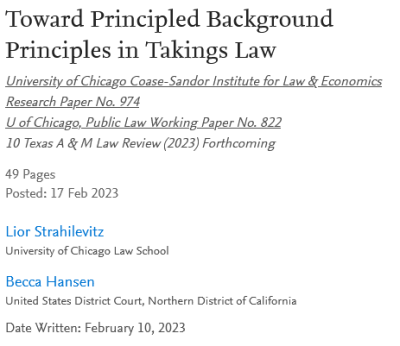
Screenshot 2023-02-23 at 11-13-54 Toward Principled Background Principles in Takings Law

Check this out, a new article co-authored by a federal judge’s law clerk and lawprof Lior Strahilevitz (Chicago). With the title, “Toward Principled Background Principles in Takings Law” are we going to read it? You bet. (Unlike a lot of new scholarship that we post here, we read this one immediately.)

Here’s the Abstract:

Blunders made by lawyers, judges, and scholars have caused the Supreme Court’s recent opinion in Cedar Point Nursery v. Hassid to be deeply misunderstood. In Cedar Point, the Court re-wrote takings law by treating temporary and part-time entries onto private property as per se takings. Prior to Cedar Point these sorts of government-authorized physical entries would have been evaluated under a balancing framework that almost invariably enabled the government to prevail. As it happens, there were two well-established rules of black letter law that California’s lawyers and amici mistakenly failed to invoke in defending

Continue Reading New Article: “Toward Principled Background Principles in Takings Law” (Strahilevitz & Hansen)