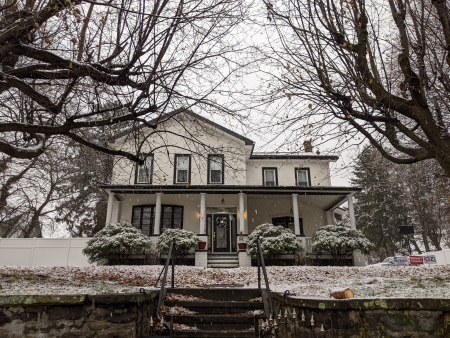
You know the “amortization” doctrine: when an existing legal use is declared illegal, the government can avoid a takings claim by slowly phasing out the use, supposedly to allow the owner to recoup investment. The doctrine is established in Maryland by Grant v. Mayor and City Council of Baltimore, 129 A.2d 363 (Md. 1957), where the court held that amortization works if the time and uses allowed are reasonable.

Not all jurisdictions take that approach, however. For example, in Pennsylvania Northwest Distributors, Inc. v. Zoning Hearing Bd., 583 A.2d 1372 (Pa. 1991), the Pennsylvania court held “[a] lawful nonconforming use establishes in the property owner a vested property right which cannot be abrogated or destroyed, unless it is a nuisance, it is abandoned, or it is extinguished by eminent domain.”

In In re Mangisteab, No. 2022-93 (Dec. 20, 2022) (unpub.), the Appellate Court of Maryland (fka

Continue Reading Md App: If You Want To Overturn The Amortization Doctrine, Take It Upstairs

Screenshot 2022-12-29 at 16-48-24 il buono brutto il cattivo poster at DuckDuckGo

Here’s the latest from a case we’ve featured here before.

There’s something for everyone in the Florida District Court of Appeal (Second District)’s opinion in Jamieson v. Town of Fort Myers Beach, No. 2D21-2722 (Dec. 29, 2022).

Let’s start with the outcome: the court reversed the trial court’s summary judgment in a wetlands takings case, sending the matter back for a trial. Sounds good.

But let’s back up a sec. The case started a long time ago, when Jamieson’s seven-acre residentially-zoned property was designated as a wetland, resulting in a use density decline from 40 buildable lots to zero (wetlands density is one residence per 20 acres). For a decade, Jamieson tried to “change and/or correct the wetlands designation[.]” Slip op. at 3. The opinion lists out his efforts. He tried for

an application for boundary clarification regarding the extent of the wetlands, a request to transfer the

Continue Reading The Good The Bad And The Ugly: There’s Something For Everyone In This Florida Takings Opinion

This week is light for many of you, so instead of the deep and insightful analysis of recent decisions that we’re known for (ha), we instead recommend to you two podcasts to warm the chilly nights.

So fire up the hearth, strap on those earbuds, and listen away.

First up, what is quickly becoming a December tradition: Clint Schumacher’s Holiday Special, in which he asks past guests for their holiday traditions and memories.

Next, the American Planning Association’s talk with Nolan Gray, whose book, “Arbitrary Lines:How Zoning Broke the American City and How to Fix It” is on our Dirt Lawyer Holiday Gift List this year. Find out more by listening in.

Continue Reading Fireside Podcasts: Eminent Domain Podcast’s Holiday Special 2022, And APA’s Talk With Nolan Gray

Here’s another one from the Ninth Circuit, argued on what one advocate called “land use day at the Ninth Circuit” (except, unlike the other two cases argued that day, the decision in this one gets published). 

In Gearing v. City of Half Moon Bay, No. 21-16688 (Dec. 8, 2022), the panel upheld the dismissal of a takings case, holding that federal courts should abstain from considering regulatory takings cases in favor of pending state court eminent domain actions, even when the condemnor instituted the state court action in response to the federal takings claim (and even though, unlike the other two cases argued that day, the federal takings claim is ripe).

This one started in federal court, where the property owner asserted the city’s rejection of its development application worked a taking. In response, the city ran to state court and filed an eminent domain action

Continue Reading CA9: Land Use Is A “Sensitive Area Of Social Policy” So We’re Gonna Let A Local Govt Bleed The Property Owner Out

PXL_20221211_185826126

This story might be said to have had its roots millions of years ago.

It is about coal, after all. Anthracite coal, to be exact.

But that — and today’s date — should give you a clue that, as we teased in this post a mere 28 days ago (the Supreme Court worked hard and fast in those days), today, Sunday, December 11, 2022, is the 100th birthday of the U.S. Supreme Court’s opinion in Pennsylvania Coal Co. v. Mahon, 260 U.S. 393 (Dec. 11, 1922).

True, what became known as the “regulatory takings” doctrine did not spring from whole cloth on December 11, 1922, but had been bouncing around in the common law for quite a while (see here and here for example).

But if you want to mark and official birthday for regulatory takings, you could not do better than Pennsylvania Coal (aka Mahon).

The

Continue Reading Happy Birthday, Regulatory Takings – Pennsylvania Coal Co. v. Mahon, 260 U.S. 393 (Dec. 11,1922)

Here’s your must-read for today, the latest journal article from Michael Berger, “Theft, Extortion, and the Constitution: Land Use Practice Needs an Ethical Infusion,” 38 Touro L. Rev. 755 (2022).

Here’s the Abstract:

There are many ways in which property owners/developers interact with regulators. To the extent that texts and articles deal with the ethical duties of the regulators, they tend to focus on things like conflicts of interest. But there is more. This article will examine numerous other ways in which regulators may run afoul of ethical practice in dealing with those whom they regulate.

And if that isn’t enough to grab you, there’s this:

There may be more to the issue than how to act in narrow circumstances. For one thing, there is the idea that government and the governed need to deal with each other on a level playing field. As one court put

Continue Reading New Article: “Theft, Extortion, and the Constitution: Land Use Practice Needs an Ethical Infusion” (Michael Berger)

The Supreme Court of Montana’s opinion in Tai Tam, LLC v. Missoula County, No. DA21-0660 (Nov. 15, 2022) starts off like a somewhat typical land use dispute turned into a constitutional fight. The property owner sought subdivision approvals for a 28-acre parcel to allow residential development, and the County denied the applications because “the proposal failure to adequately mitigate the loss of agricultural soils.” Slip op. at 2.(Oh, and “bird habitat.” Slip op. at 3.)

Next, the complaint, alleging some of the usual claims: due process, equal protection, and takings, and a statutory claim under Montana law. The trial court dismissed all claims: the statutory claims for failure to get in before the 30-day limitations period, and the constitutional property claims based on the court’s conclusion that the plaintiff lacked a “property” interest.

We’ll let you read the part of the opinion in which the court reversed the dismissal

Continue Reading Montana: Owning The Land Is Enough To Plead A Property Interest: Property Means “Rights Inherent In Ownership,” Not Extent Of Govt Discretion

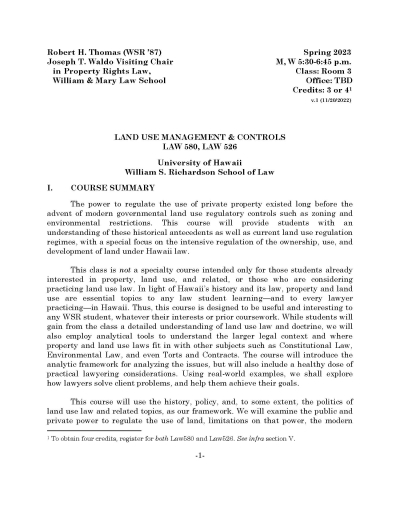
Syllabus

Starting in January, we’ll be teaching the venerated, and oh-so-important Land Use course (Law 580) at the University of Hawaii’s Law School.

We’re at least temporarily stepping into some mighty big slippers (this is Hawaii, so we don’t always wear shoes), as this is the course that our mentor Professor David Callies taught for decades. And is there a better venue in which to teach and study land use law and regulation, and its limits? After all, Hawaii may be the most heavily-regulated land on the planet, and is a focal point for every issue you can think of, from zoning to environmental restrictions to takings to public trust to subdivision to admin law to … well, you get the drift.

We’ll cover those topics, as well as the fundamentals. And we have a few surprises up our sleeve – some impressive guest lecturers, explorations of dirt law careers

Continue Reading Hawaii 5-80: Land Use Law At The University Of Hawaii

Here it is, the official agenda and program for the 40th ALI-CLE Eminent Domain & Land Valuation Litigation Conference, February 2-4, 2023 (with a special event the evening of Wednesday, February 1, 2023 to entice you to arrive early).

Screenshot 2022-11-18 at 13-35-13 ALI CLE PA NY VA TX FL Continuing Legal Education

Here’s the brochure with the complete agenda, schedule, and faculty listing. But to tempt you, here are some of the highlights of the program:

  • Everything Old is New Again: Why Today’s Practitioners Need to Understand the Original Meaning of the Takings and Just Compensation Clauses
  • Private Utility Takeovers – Lessons From a 67 Day Trial

  • Valuation Issues When Billboards and Signs are Condemned

  • Setting Client Expectations and Identifying Red Flags

  • Developing Property Right Issues in Texas – Questions and Answers from the Bench: A View From the Bench (with Texas Supreme Court Justice Jimmy Blacklock)

  • Eminent Domain and Regulatory Takings Updates: Important Decisions You Need to Know

  • Ethics:


Continue Reading Here’s The Program For The 40th ALI-CLE Eminent Domain & Land Valuation Litigation Conference, Feb 1-4, 2023, Austin

Well, that was quick. As we noted here, we recently argued a case in the Ninth Circuit (October 20, 2022) about whether a regulatory takings claim is ripe

Not long after we posted the argument recording, the Ninth Circuit panel issued a short memorandum opinion rejecting our arguments wholesale (November 1, 2022).

So earlier this week, we asked the entire Ninth Circuit to take a look. Here’s our en banc petition.

We’ll leave it to you to read it and see why we think this one is ripe.

Appellants’ Petition for Rehearing En Banc, Ralston v. San Mateo Cnty., No 21-16489 (9th Cir. Nov. 15, 2022…

Continue Reading Let’s Take A Deeper Look At Takings Ripeness, Ninth Circuit