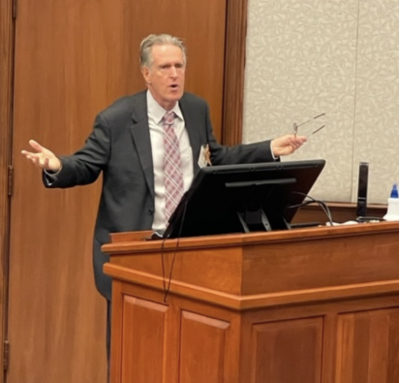
Check it out: our Pacific Legal Foundation colleagues Jim Burling, Jon Houghton, and Jeff McCoy, along with Jeremy Hopkins (Cranfill & Sumner, North Carolina), share with us the latest on property rights, Sackett, takings, the future of Penn Central, and the upcoming SCOTUS arguments in Wilkins v. United States (is the Federal Quiet Title’s statute of limitations jurisdictional?).

Don’t miss it.Continue Reading Video: “The Future of Private Property Regulation in America”
The County of El Dorado requires everyone seeking a building permit for new development to pay a fee to mitigate the additional traffic that the proposed development is predicted to cause. But the County doesn’t calculate the fee by actually looking at a proposed development and predicting what traffic impacts in may be responsible for. Rather, it has a generic fee schedule that applies to all proposed developments broken down by location and type (residential, commercial, etc.). We don’t care whether your development actually causes more traffic (or if it does, the extent of the increase), we’re hitting you all up.

Or as the California Court of Appeal put it in Sheetz v. County of El Dorado, No. C093682 (Oct. 19, 2022), “[i]n assessing the fee, the County does not make any ‘individualized determinations’ as to the nature and extent of the traffic impacts caused by a particular project

Continue Reading Whether $23K Traffic Fee Is Proportional To One Single-Family Home Is Beyond The Ken Of Judges

Earlier this month, the U.S. District Court invalidated Honolulu’s stretching of the minimum term for a residential rental from 30 days to three months, concluding that the ordinance likely violates the state Zoning Enabling Act, and also would be a taking if implemented. The court issued a preliminary injunction.

The lawyers repping the plaintiffs in that case — our former law partner Greg Kugle — appeared on Kelii Akina’s Hawaii Together (Think Tech) program to talk about it more. Check it out.Continue Reading More On Federal Court Invalidating Honolulu’s 3-Month Minimum Rental Term

October 20, 2022 was what one advocate noted was “land use day at the Ninth Circuit,” because three out of the four cases being argued in Courtroom 3 of the San Francisco courthouse were indeed land use — or perhaps more accurately, regulatory takings — cases.

Ours was one of those cases, Ralston v. San Mateo County.

Without going into too much detail, this is an appeal from the district court’s 12(b)(6) dismissal of our regulatory takings complaint. The crux of the claim is that Ralston’s R-1 zoned property is subject to an “overlay” district called the Montecito Riparian Corridor, a highly-restricted zone that allows only 5 environmental uses of land within the zone (none of which are consistent with the R-1 zoning). (Ralston’s property is labeled “076-19” on the County’s MRC map.)

Montecito Riparian Corridor

Absent some kind of special dispensation — what the County calls an “override” —

Continue Reading CA9 Takings Ripeness Oral Arguments: Must Property Owners Secure Govt’s Agreement That Property Is Subject To Challenged Regulations Before A Court Can Review?

Many Honolulu residents don’t like short-term (less than 30 day) rentals. Whether fueled by NIMBY-ism, a genuine belief that tourists should stay out of residents’ neighborhoods and be limited to accommodations built for transients, or the belief that long-term rentals to locals somehow promote more affordable housing, the anti-transient renter vibe is most definitely there.

The no-less-than-thirty-days restriction wasn’t enough, however, and recently the City and County of Honolulu made it illegal to rent for less than three months (90 days). The ordinance stated the reasons:

Short-term rentals are disruptive to the character and fabric of our residential neighborhoods; they are inconsistent with the land uses that are intended for our residential zoned areas and increase the price of housing for O‘ahu’s resident population by removing housing stock from the for-sale and long-term rental markets. The City Council finds that any economic benefits of opening up our residential areas

Continue Reading Federal Court: Honolulu’s 3-Month Minimum Rental Term Preempted By State Law (And Would Be A Taking Of Vested Rights)

PXL_20220927_164202969

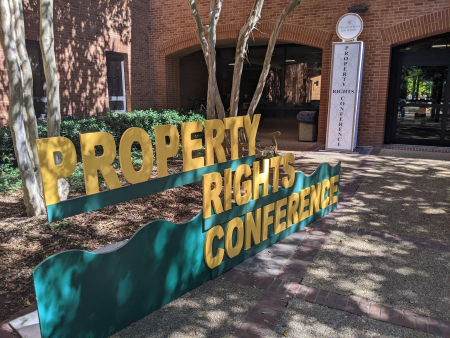
We spoke on the second panel of the day at the 2022 Brigham-Kanner Property Rights Conference at the William and Mary Law School. The subject of our panel — which included Professors David Callies, Tim Mulvaney, and Dave Owen — was “Reshaping the Framework Protecting Property Under the Roberts Court.

Here’s a rough transcript of my remarks.

————————————–

President Reveley, Professor Butler, distinguished Brigham-Kanner Prizewinners (present and future), mentors, colleagues, family and friends: thank you for the opportunity to speak today.

The story goes that when asked what it was like to be a part of the “Rat Pack,*” that Dean Martin responded “It’s Frank’s world, we just live in it.”

Fd5_62PUoAEo-y8

When I first heard the title of this portion of the program and the discussion of how and if the Roberts Court is reshaping property, my first reaction was a paraphrase of Dean

Continue Reading Brigham-Kanner Property Rights Conference 2022 Report: It’s Chief Justice Roberts’ Property World, We Just Live In It

Clint Schumacher’s Eminent Domain podcast is one of those things that we almost shouldn’t post about. After all, every episode is worth your time. But this one is especially good. After all, it features our law firm colleague and friend Jon Houghton, discussing what you all know is one of our fave topics, regulatory takings.

As Clint describes it:

Jon Houghton of Pacific Legal Foundation joins the podcast today to talk about regulatory takings. This is a complex area of the law, but Jon is a true expert and breaks it down into understandable pieces. He discusses how practitioners can assess when a regulation has risen to the level of a taking. He also discusses regulatory taking issues and cases that are current.

So even though we always say “check out the Eminent Domain Podcast,” we’re saying it again. Check it out.Continue Reading Jon Houghton On Regulatory Takings – Eminent Domain Podcast

Screenshot 2022-09-13 at 14-12-11 Feed LinkedIn

One last reminder that there’ still time to register for the upcoming Brigham-Kanner Property Rights Conference at the William and Mary Law School in Williamsburg, Virginia, September 29-30, 2022. If you can’t make it to the historic campus, there’s an option to attend remotely.

In our opinion, the Conference is the best of its kind because it brings together legal scholars and the practicing bar to talk dirt law theory and practice. We also a have a full supplemental program for law students, that covers property law and careers in eminent domain law, a recruiting session, a program on international property rights, and a program on land use law.

Registration for the Conference is ongoing, and you can sign up here.

Here is the full agenda. (We’ll be speaking on Panel #2, “Reshaping the Framework Protecting Property Under the Roberts Court.”)

Come on, join us!

Continue Reading Still Time To Join Us (In-Person Or Remote) For The 19th Annual Brigham-Kanner Property Rights Conference

In Hignell-Stark v. City of New Orleans, No. 21-30643 (Aug. 22, 2022), the U.S. Court of Appeals for the Fifth Circuit, like a lot of other courts, reached an unsurprising conclusion: New Orleans’ restrictions on short-term rental of residential properties isn’t a taking. But there are parts of the opinion that are definitely worth your time to check out. Read on.

The city had gone back-and-forth on whether renting for less than thirty days was a good thing. Originally barring STRs, then in 2016 offering city licenses, and then when the inevitable flood of STRs resulted, retrenching and substantially revising the licensing program:

One year into the initial regime, the City commissioned a study from its Planning Commission to reevaluate the STR policies. The study found that the rapid proliferation of STRs had brought nuisances to the City. Specifically, it discovered that STRs in residential neighborhoods had lowered

Continue Reading CA5: “But there’s a big difference between saying that something is property for purposes of procedural due process and saying that it is property for purposes of the Takings Clause”

We recommend you review the North Carolina Supreme Court’s opinion in Anderson Creek Partners, L.P. v. County of Harnett, No. 63PA21-1 (Aug. 19, 2022). It’s long (70 page majority, plus 19 pages of concurring and dissenting opinions), but worth your time because the majority concludes that legislatively-imposed fees, applicable to all, are “exactions” that are subject to the nexus/rough proportionality requirements of Nollan/Dolan/Koontz.

The county adopted a requirement that residential property developers pay a per-lot, one-time water and sewer capacity use fee as a condition of the county accepting applications for a water or sewer permit. The details:

Section 28(h) of the ordinance provides for the collection of “capacity use” fees for the purpose of “partially recover[ing] directly from new customers the costs of capacity of the utility system to serve them.” More specifically, the ordinance provides that, for each new residential connection to

Continue Reading NC: Generally-Applicable Impact Fee Is Subject To Nollan/Dolan/Koontz