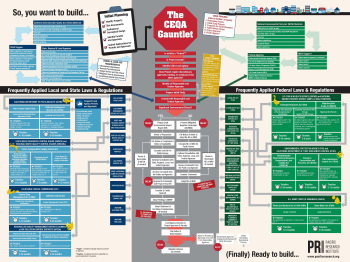
CEQAflowchartSee if you can navigate this maze.

Even if you are not in California, this thing called “CEQA” (the California Environmental Quality Act) is something you might have heard of. An environmental reporting statute on steroids, CEQA is, according to this new report from the Pacific Research Institute, the main reason why California is home to the unbeatable combination of sky-high home prices and nation-leading poverty rate, and has become as famous for its homeless problem as its beaches

In “The CEQA Gauntlet,” the authors report that the above problems are products of the fact that it is “very, very hard to build homes in California.” And the reason it is hard to build homes in California? That’s right, CEQA.

What started off as a data-gathering and informational requirement (so that the decision makers could incorporate environmental considerations) has become the tail that wags the dog

Continue Reading Death By A Thousand Days: Presenting “The CEQA Gauntlet” Report
IMG_20170323_142813

Sorry about the headline, but come on, man! We have to use clickbaity headlines every now and then to get your attention. Here’s the latest in a case we’ve been following.

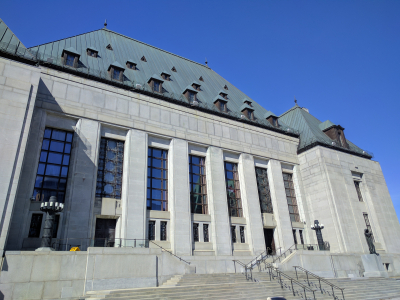
Yesterday, the Supreme Court of Canada heard oral arguments in Annapolis Group Inc v. Halifax Regional Municipality, a case involving “de facto expropriation,” or what we in the U.S. might think of as a regulatory taking.

We watched the livestream (along with a few of our northern colleagues), and if you missed it, the recording of the (2-hours and 30-minutes!) arguments can be found here — in English, with simultaneous French translation, if you want to have some extra fun.

Screenshot 2022-02-17 at 07-50-43 Supreme Court of Canada - SCC Case Information - Webcast of the Hearing on 2022-02-16 - 3[...]

Yes, there really are that many Justices
and lawyers on the argument

The Supreme Court is considering whether Halifax’s refusal to approve Annapolis Group’s development applications (consistent with its residential zoning, more specifically “future serviced development”) on

Continue Reading Important Developments In Canada (No, Not That!): Supreme Court Hears Argument In “Takings” Case

PXL_20220127_144224442

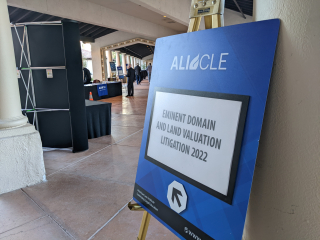
After a two-year absence in which we went remote, in the last week of last month (our usual spot on the calendar, between the playoffs and Super Bowl), we once again met in-person for the American Law Institute-CLE Eminent Domain and Land Valuation Litigation Conference.

Approximately 200 lawyers, judges, legal scholars, appraisers, law students, right-of-way agents, relocation experts, property owners, and other related professionals gathered in-person–yes, in-person–at the Scottsdale (Arizona) Resort at McCormick Ranch, to get reacquainted, learn stuff, and renew ties last made in-person in Nashville in 2020. In addition to the live attendance, we also welcomed about 50 remote colleagues, who joined the live webstream.

This was the 39th edition of the Conference, one of the most-established and successful conferences in the ALI-CLE stable of programs.

To those who joined us – thank you. This conference reminded us of why this program is so

Continue Reading 2022 ALI-CLE Eminent Domain And Land Valuation Litigation Conference, Scottsdale: You Should Have Been There!

If you ever get the opportunity to teach in a law school — either as a full-time legal scholar, or part-time as an expert adjunct practitioner — take it if you can. You might think you know a lot about a particular subject, but there’s nothing like spending time at the lectern in a law classroom in front of sharp and eager lawyers-in-training to sharpen your thoughts, and get you to truly understand a subject.

And folks calling you “professor” can evoke a smile.

Sensei

But if there’s one downside to the law school experience from the teacher’s side of the lectern, it’s grading. Especially at a law school like William and Mary that has a pretty strict mandatory curve. In upper-division courses that we handle like Eminent Domain and Property Rights Law and Land Use — where we’re dealing with some very high-level stuff and the quality of the

Continue Reading The Circle Is Now Complete: A Sampling Of Final Paper Topics From William and Mary Law’s Eminent Domain & Property Rights, And Land Use Courses

Here’s a must-read from the Texas Court of Appeals (Second District).

In City of Grapevine v. Muns, No. 02-19-00257 (Dec. 23, 2021), 

Before 2018, the city’s 1982 zoning ordinance authorized “single-family detached dwellings” and didn’t say anything about short-term renting (short-term being defined as less than 30 days). The ordinance didn’t expressly authorize it, but it didn’t prohibit it either. The ordinance was one of those that say anything not expressly authorized is prohibited. Bed and breakfast operations were recognized in a 2000 amendment, but these operations require, among other things, that the owner live on-site.

But after the introduction of platforms such as AirBnB and VRBO, the short-term market “exploded” and the usual complaints from neighborhood residents followed. Slip op. at 6 (“criminal mischief, domestic disputes, parking violations, alarm calls, and noise disturbances”). Next came studies, public hearings, and the city’s assertion that it didn’t really need to

Continue Reading Tex App: “Property” Includes Right To Rent It Out – City’s Short-Term Ban May Be A Taking

Check this out, the latest episode of Clint Schumacher’s Eminent Domain Podcast, where his guest is Judge Andrew Edison (who may be familiar to many of you for his ALI-CLE presentation a couple of years ago about the eminent domain angle in the JFK assassination film).

Today, the topic is Robert Moses, NYC taker and redeveloper extraordinaire. We’ve been waiting a long time for this episode, and you won’t be disappointed. 

Here are the liner notes:

U.S. Magistrate Judge Andrew Edison has devoted much time and research to the life and legacy of Robert Moses, a former Parks Commissioner who had a broad and deep impact on the development of New York City’s infrastructure over a period of 50 years. Moses’ career in many ways provides a study of the human cost of eminent domain for different socio-economic communities. Judge Edison’s insight into Moses’ legacy is relevant to

Continue Reading Latest Ep, Eminent Domain Podcast: The Legacy Of Robert Moses (Judge Andrew Edison)

Screenshot 2021-12-12 at 09-10-29 Event Registration

This Wednesday, December 15, 2021, at 1pm ET (10am PT) our PLF colleague Chris Kieser will be presenting an American Bar Association webinar, produced by the Real Property, Probate, and Trust Section, “Cedar Point Nursery v. Hassid: Supreme Court Weighs in on Definition of ‘Private Property’ and Implications for the Future.”

Register here. Here’s the details:

Chris Kieser, one of the attorneys representing Cedar Point Nursery in the recent Supreme Court case, will discuss the Court’s ruling as to what constitutes a physical taking of “Real Property” under the 5th Amendment and its potential applications in other contexts. He will be supported in the discussion by moderator, Nick Laurent, the chair of Land Use and Environmental Group – Condemnation Committee.

Chris is one of the lawyers representing the prevailing property owners in Cedar Point (our own look at the decision here), so he has a very

Continue Reading Wed, Dec. 15, 1pm ET: “Cedar Point Nursery v. Hassid: Supreme Court Weighs in on Definition of “Private Property” and Implications for the Future” ABA RPTE Webinar

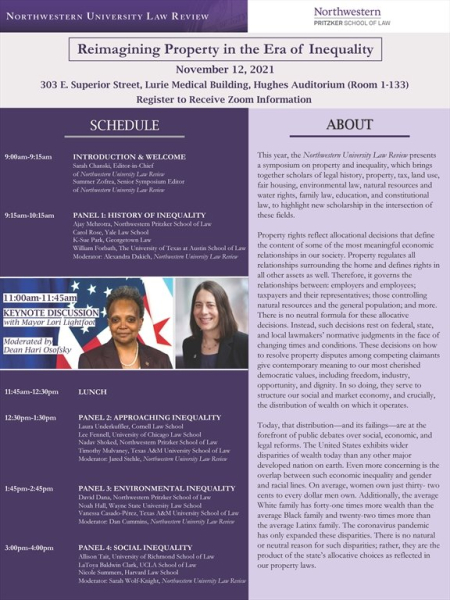
“This year, the Northwestern University Law Review presents a symposium on property and inequality, which brings together scholars of legal history, property, tax, land use, fair housing, environmental law, natural resources and water rights, family law, education, and constitutional law, to highlight new scholarship at the intersection of these fields.”

More information, as well as registration to attend remotely, here.

Nulr_symposium_posterContinue Reading Still Time To Sign Up For Northwestern L. Rev.’s Symposium: “Reimagining Property Rights in the Era of Inequality” (Friday, Nov. 12, 2021)

21a0226p-06

We thought we posted the U.S. Court of Appeals for the Sixth Circuit’s recent opinion in a takings case,  Golf Village North, LLC v. City of Powell, No. 20-4177 (Sep. 23, 2021), earlier, but a search of the blog reveals we did not, so here we go.

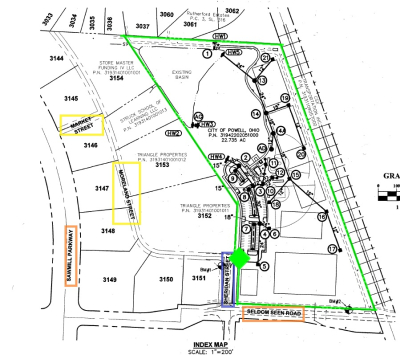
The City built a new 23-acre public park (highlighted in green on the map above), which had been dedicated by the developer, Golf Village North, as a condition of subdivision. A road that led to the one of the park entrances was to be made a public road (blue highlighted). The City’s plans noted that approval of the park construction and opening the blue road to the public were contingent on the City securing easements from Golf Village for public access to the private streets.

The city tried to obtain these easements but Golf Village declined. Notwithstanding the city’s plans required

Continue Reading CA6: City Park Causing Public To Use Private Roads Not A Taking Because Owner Can Erect Roadblock

FrankLUI Co-Chair Prof. Frank Schnidman introducing the faculty

Here are the links to the cases and issues that we just finished speaking about at the 35th Annual Land Use Institute (more information on the LUI here). Today was day 1 of a multi-day remote program and the sessions are available ala carte, so there’s still time to join in and learn.

Supreme Court

  • Cedar Point Nursery: the Supreme Court affirms the “keep out” vibe in property law. Yes, there are three “exceptions” to the presumption that any physical intrusion into property is a taking (torts, entries allowed under “background principles,” and legal exactions), but overall a very strong affirmation of property rights.
  • Pakdel v. San Francisco: the “final decision” ripeness requirement in takings cases is “relatively modest” and turns on “de facto” readiness. Yes, it’s a technical requirement, but let’s not get too technical about it.
  • PennEast Pipeline


Continue Reading Links And Materials From Today’s Land Use Institute Takings/Eminent Domain Session