


In case you missed it live, here’s the recording of the recent one-hour program on “The Future of Regulatory Takings at the Supreme Court,” featuring our colleagues Joshua Thompson (Pacific Legal Foundation) and Paul Utrecht (Utrecht & Lenvin, LLP), with Jim Burling (PLF) moderating.

The program discussed Cedar Point Nursery v. Hassid, Knick v. Township of Scott, and Pakdel v. City and County of San Francisco and what might be on the horizon.

If you are a takings nerd, a must-listen.Continue Reading Watch: “The Future of Regulatory Takings at the Supreme Court”
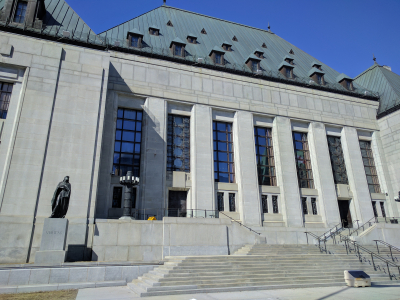
Check out the U.S. Court of Appeals’ opinion in Andrews v. Mentor, No. 20-4030 (Aug. 25, 2021).

Property owners sought rezoning of their land from R-4 to “Village Green – RVG,” a higher density zone, so that the owners could build single-family homes. Under R-4, the maximum number of homes was 13 and had to leave 9 acres open. The city’s comprehensive plan expresses a preference for Village Green zoning.

But the city denied the application,despite having approved 9 other applications since 2004, and the owners’ application being “materially identical to a plan the City approved for rezoning and development in 2017.” Slip op. at 3.

So off to federal court they went, filing (Lucas and Penn Central) takings, due process, and class-of-one equal protection claims. [Disclosure: the property owners are represented by my law firm colleague Dave Breemer; we didn’t have anything to do with this

Continue Reading CA6: There’s A Difference Between Due Process “Property” And Takings Clause “Property”

All the topics you want to know about, presented by top-notch faculty from across the nation. Sessions include:

  • Keynote: Do Animals Have Property Rights?
  • Did the Supreme Court Signal a New Direction in Property Rights in Cedar Point Nursery?
  • Maximizing Relocation Benefits: Understanding the Law and Regulations to Ensure Fairness
  • Challenging Public Use: Lessons From a 67-Day Trial
  • COVID Takings
  • Property Rights as Civil Rights
  • Eminent Domain National Update
  • Federal Court and the Daubert Challenge: How to Prepare
  • How to Position Your Client for the Fallout When Projects Don’t Get Built
  • Rural Broadband and the Emerging Constitutional Challenges
  • Are Precondemnation Entry Statutes Still Valid After Cedar Point Nursery?
  • How Condemnor and Property Owners’ Counsel Prepare the Battlefield
  • How Will the Trillion Dollar Infrastructure Bill Impact Your Practice?
  • Ethics
  • …and more, including a full slate of networking and social events!

We’ve sold out the last few years, so don’t Continue Reading Registration Open Now: ALI-CLE Eminent Domain & Land Valuation Litigation Conference, Jan 26-29, 2022, Scottsdale

All the topics you want to know about, presented by top-notch faculty from across the nation. Sessions include:

  • Property Rights as Civil Rights
  • Eminent Domain National Update
  • Just Relocation: Understanding the Law and Regulations to Ensure Fairness
  • Challenging Public Use: Lessons From a 67-Day Trial
  • COVID Takings
  • Federal Court and the Daubert Challenge: How to Prepare
  • Did the Supreme Court Signal a New Direction in Property Rights in Cedar Point Nursery?
  • How to Position Your Client for the Fallout When Projects Don’t Get Built
  • Rural Broadband and the Emerging Constitutional Challenges
  • Are Precondemnation Entry Statutes Still Valid After Cedar Point Nursery?
  • How Condemnor and Property Owners’ Counsel Prepare the Battlefield
  • How Will the Trillion Dollar Infrastructure Bill Impact Your Practice?
  • Ethics
  • …and more, including a full slate of networking and social events!

We’ve sold out the last few years, so don’t miss out. Room block now taking reservations. Continue Reading Join Us For The 39th Annual ALI-CLE Eminent Domain & Land Valuation Litigation Conference, Jan 26-29, 2022 (Scottsdale, AZ)


Talk amongst yourselves.

We’ve had our say, so in this post — the sixth and final post in a series of deeper dives about June’s U.S. Supreme Court opinion in Cedar Point Nursery v. Hassid , No. 20-107 (June 23, 2021) — we’re linking to what others are saying about the case.

Here are all of the posts in our Cedar Point series:

And in case you missed the live webcast on Friday, July 16, 2021 that featured expert analysis of the case, please don’t miss listening to the recording of ALI-CLE’s “Takings and Eminent Domain After Cedar Point: What Practitioners

Continue Reading Cedar Point Part VI: What Others Are Saying

In this post — the fifth and penultimate post in a series of deeper dives that we’re posting about June’s U.S. Supreme Court opinion in Cedar Point Nursery v. Hassid, No. 20-107 (June 23, 2021) — we’ll be trying to take some educated guesses about what the decision means for the future.

Here are all of the posts in our Cedar Point series:

And in case you missed the live webcast on Friday, July 16, 2021 that featured expert analysis of the case, please don’t miss listening to the recording of ALI-CLE’s “Takings and Eminent Domain After Cedar Point: What

Continue Reading Cedar Point Part V: Help Us Help You

IMG_20170323_142808

Here’s one we’re now following, thanks to a heads-up from a northern colleague.

The Supreme Court of Canada has granted leave to appeal in a case involving what Canadian law calls “de facto expropriation” (what we’d call “regulatory takings”).

Before you review the Application for Leave to Appeal by the property owner, and the responsive memorandum for the government, recall that even though Canada’s approach to “takings” is not a constitutional question, but nonetheless like the southern version of the doctrine, focuses on whether some government act has the effect of acquiring from the owner a beneficial interest, or removed all reasonable uses. See Canadian Pacific Railway v. Vancouver (City), 1 S.C.R. 227, 2006 SCC 5 (2006).

In Annapolis Group Inc v. Halifax Regional Municipality, the Supreme Court will consider whether Halifax’s refusal to approve Annapolis’ development applications (consistent with its residential zoning, more specifically “future serviced

Continue Reading Canada Supreme Court To Review De Facto Expropriation (aka Regulatory Takings) Case

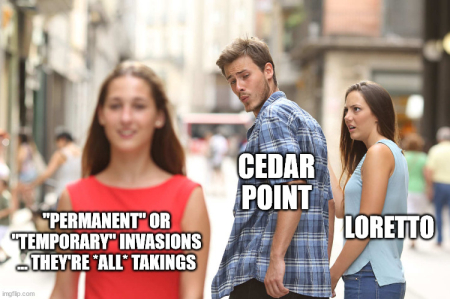
Permanentortemporary

In this post — the fourth in a series of deeper dives that we’re posting about June’s U.S. Supreme Court opinion in Cedar Point Nursery v. Hassid, No. 20-107 (June 23, 2021) — we’ll be discussing the two separate opinions, Justice Kavanaugh’s concurrence, and the Justice Breyer-authored dissent.

Here are all of the posts in our Cedar Point series:

And in case you missed the live webcast on Friday, July 16, 2021 that featured expert analysis of the case, please don’t miss listening to the recording of ALI-CLE’s “Takings and Eminent Domain After Cedar Point: What Practitioners Need to Know

Continue Reading Cedar Point Part IV: The Other Opinions

Our thanks to our friends and colleagues at the ABA Section of Real Property, Probate & Trust Section’s Land Use and Environmental Group for inviting us to a discussion of the latest and greatest decisions of interest.

We only had an hour together, so naturally could not cover everything of interest (indeed, we reserved a big discussion of the biggest item, the Supreme Court’s decision in Cedar Point, assuming that the Group will schedule a full session on that decision alone). So here is our curated list of what we think are the most interesting recent decisions in areas of interest to the Group:


Continue Reading Links From Today’s ABA RPTE Session

In this post — the third in a series of deeper dives that we’ll be posting about last week’s U.S. Supreme Court opinion in Cedar Point Nursery v. Hassid, No. 20-107 (June 23, 2021) — we’ll be discussing whether the “right to exclude” is absolute, what exceptions the Court laid out, and how it responded to the arguments that the ruling will bring the system crashing down.

Here are all of the posts in our Cedar Point series:

And in case you missed the live webcast on Friday, July 16, 2021 that featured expert analysis of the case, please don’t miss

Continue Reading Cedar Point Part III: No, Chicken Little, The Sky Isn’t Falling