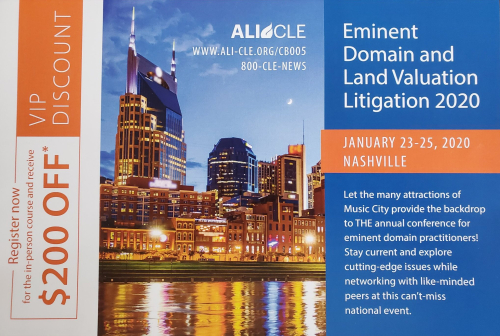
Details soon. In the meantime, get your earlier registration discount.Continue Reading Get Ready – ALI-CLE Eminent Domain And Land Valuation Litigation Conference, Nashville Jan. 23-25, 2020


The Land Use Committee of the ABA’s Section of State and Local Government Law is sponsoring a free (for Section members) informal webinar about the latest in takings law:
Knick Picking Regulatory Takings: Did the Court Right a Wrong, or Wrong a Right?
Friday, July 26 | 2 – 2:30pm ET
Here’s hoping you can join us for a half hour on the 5-4 SCOTUS decision in Knick v. Township of Scott (June 21, 2019). Knick overruled the 34-year-old precedent in Williamson County requiring that federal takings claimants seek compensation in state court before being allowed to proceed in federal court.
Presenters Dwight Merriam and Robert Thomas will discuss reaction to the decision — which has been as divided as the Court. Was this the conservative justices having their way? Is it a right versus left issue? Did that baby, stare decisis, get thrown out with the old ripeness bathwater?
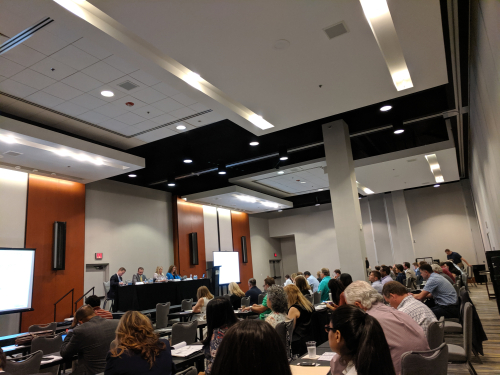
I am grateful that planning chairs Justin Hodge and Jeremy Baker invited me to their conference. A room full of experts. Here are the links to the cases and other items I spoke about:
Continue Reading Cases And Links From Today’s Eminent Domain And Pipelines Conference (Houston)
Looking for something to do this Tuesday? How about reading a 120-page federal court complaint challenging New York’s recently-adopted rent control/stabilization statute as a taking?
Thank you, Knick.
Continue Reading New (Federal Court!) Complaint: NY’s New Rent Laws Are Takings
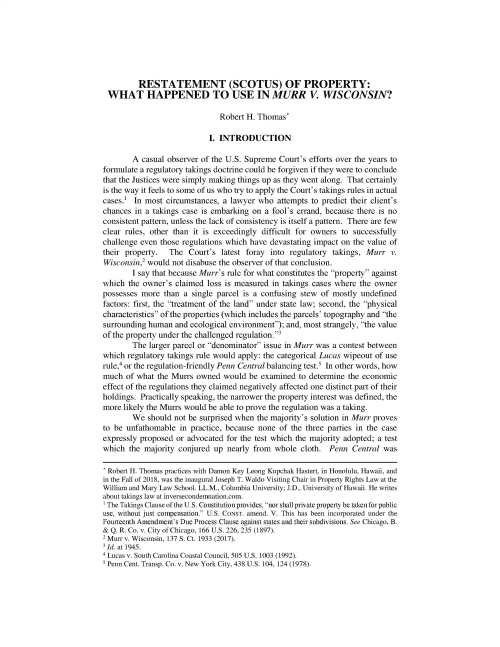
Here’s the article, recently published in the UMKC Law Review with thoughts on Murr v. Wisconsin, the case about the “denominator” issue in regulatory takings cases.
We won’t get into it in detail (if you are interested, you can read the article yourself), except to say that therein we offer views of what test the Court should have adopted to analyze whether the Murr family’s two parcels should be considered as one parcel for purposes of whether they were denied productive use of their property by Wisconsin’s environmental regulations. As you recall the Justice Kennedy authored Murr majority adopted a test with a mishmash of factors (what we waggishly labeled his “social justice warrior” test). The article argues that the Court should have instead applied the old “three unities” test from larger parcel questions in eminent domain. That test focuses on the owner’s joint use of the property.
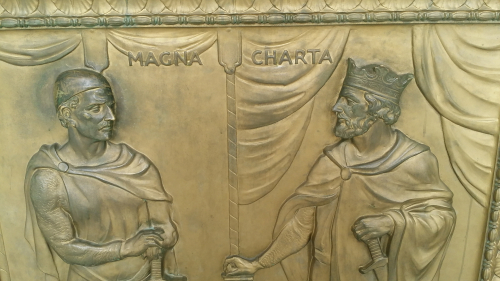
Yes, this is detail from the Supreme Court’s front door.
This is the first in what will be a short series of five posts with thoughts on the landmark decision in Knick. In this installment, a crash course in the extensive doctrinal background necessary to understand why the Knick Court did what it did. Here are the related posts:
* * * *
The opinions in last week’s ruling by a sharply-divided Supreme Court, Knick v. Township of Scott, No. 17-647 (June 21, 2019) employed a lot of very evocative language: “aborning,” “Catch-22,” “loot,” “shaky,” “sue me,” “overthrows,” “smashes,” “smithereens” “first crack,” “points for creativity.” But ultimately, the most important
This is the second in a series of five posts taking a look at last week’s landmark ruling by a sharply-divided Supreme Court, Knick v. Township of Scott, No. 17-647 (June 21, 2019). Here are the related posts:
In this post, we’ll take a look at the case which finally convinced the Supreme Court that it was time to revisit the Williamson County state-litigation ripeness rule, Knick v. Township of Scott, 862 F.3d 310 (3d Cir. 2017). What we call the Case of the Zombie Zoning Inspectors.
* * * *
The Township of Scott, Pennsylvania, apparently
Continue Reading Knick Analysis, Part II: The Court Finds A Vehicle In A Zombie-Zoning Case
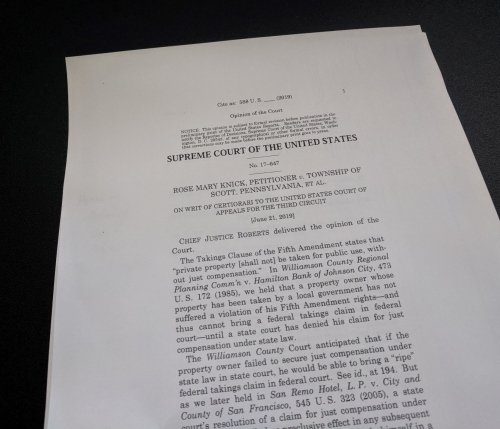
This is the third in a series of five posts taking a look at last week’s landmark ruling by a sharply-divided Supreme Court, Knick v. Township of Scott, No. 17-647 (June 21, 2019). Here are the related posts:
In this post, we’ll take a deeper dive into the three opinions: Chief Justice Roberts for the five-Justice majority (Roberts, Thomas, Alito, Gorsuch, Kavanagh), Justice Thomas’ short stand-alone concurring opinion, and Justice Kagan’s dissent (joined by Justices Ginsburg, Breyer, Sotomayor, and Kagan).
* * * *
BLUFs
Here are the bottom lines up front, the lenses though which we think you should read each of
This is the fourth in our series of five posts with thoughts on the landmark decision in Knick. In this installment, the dissent. Related posts:
* * * *
We cannot mask our disappointment with the dissenting opinion. We usually appreciate Justice Kagan’s opinions and measured approach, even while dissenting. And after the first oral arguments in October, we thought there was a chance, albeit slim, that she might see things Ms. Knick’s way.
But even though we were pretty sure she would rule for the government, we didn’t anticipate as vehement a defense of Williamson County‘s “no violation until you sue the government for
This is the fifth and last in our series of posts with thoughts on the landmark decision in Knick. In this post, we’ll be puling out our crystal balls, and doing a bit of forecasting. Here are the related posts:
* * * *
The execrable state-litigation ripeness requirement is overruled. Ding-dong, the wicked witch is dead. No longer will our only federal review of a federal constitutional issue be limited to petitions for cert at SCOTUS. We can “simply” go to federal court.
So now what?