A lot is being written about Friday’s Supreme Court opinions in Knick v. Township of Scott, No. 17-647 (U.S. June 21, 2019) (including us). Here’s a sampling. 


Continue Reading Knick Round-Up

Kungfu

We’ll be doing a longer post with our thoughts on the U.S. Supreme Court’s landmark ruling in Knick v. Township of Scott, No. 17-647 (June 21, 2019). But here’s the big picture.

It appears that at least five Justices finally seem to understand what we in the property bar have been saying for decades – that the essence of a federal “takings” claim against a local or municipal government is that “by regulation, you have deprived my property of ‘productive use’ [as Chief Justice Roberts noted on page 14 of the slip opinion], and you have not compensated me.” So it is enough that the government hasn’t paid me, and I have no obligation to “ripen” my federal claim by chasing down the local government for compensation in state court.

So nearly 100 years after Justice Holmes famously opined for the Court in Pennsylvania Coal Co. v. Mahon,

Continue Reading Williamson County Overruled: After Nearly A Century, Supreme Court Finally Has Figured Out What A Regulatory Takings Claim Looks Like

One does knick meme

Property lawyers, dust off your Federal Rules of Civil Procedure, and federal judges your long vacay from dealing with regulatory takings and inverse condemnation cases is over, because this just in: by a 5-4 margin (Chief Justice Roberts authored the majority opinion, with Justice Kagan writing the dissent), the U.S. Supreme Court today finally (finally!) overruled the state-litigation prong of the Williamson County ripeness doctrine. Knick v. Township of Scott, No. 17-647 (June 21, 2019).

Yes, overruled. Not trimmed around the edges. Overruled. 

Here’s what our quick skim turns up as a critical passage:

The Court in Williamson County relied on statements in our prior opinions that the Clause “does not provide or require that compensation shall be actually paid in advance of the occupancy of the land to be taken. But the owner is entitled to reasonable, certain and adequate provision for obtaining compensation” after a taking.

Continue Reading “The state-litigation requirement of Williamson County is overruled.”

Here’s what we’re reading today:

  • New Ruling In Maui Water Case Still Doesn’t Resolve Old Dispute (Honolulu Civil Beat) – about the Hawaii Intermediate Court of Appeals’ recent unpublished memorandum opinion in a long-ongoing water law fight on Maui. The long and the short of it is the court held that whether a short-term license from the State to use water (month-to-month, max one-year as the statute requires) is “temporary” or not (these licenses have been renewed for 18 years to allow the administrative process to be completed) is a factual question that can be resolved by summary judgment. Court held no. In our view, these things operate much like preliminary injunctions, which although they are temporary in nature, can stretch out for quite a long time while the wheels of justice grind. Cert application to the Hawaii SCT coming, for sure. Any guesses on which way this will come


Continue Reading Thursday Round Up: Hawaii Water Law, “New” Property, The Edge Denied!

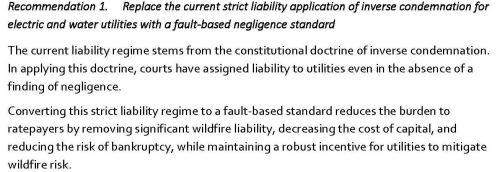
Inverse_excerpt

There’s a lot to digest in the draft workgroup reports of the California Commission on Catastrophic Wildfire Cost and Recovery, which were released yesterday.

But the bottom line stands out: California’s version of inverse condemnation liability — which holds a private utility liable for just compensation and damages if its activity was a cause of the damage or loss caused by a wildfire — has got to go. Or at least be so substantially modified as to lose its salient feature, liability even in the absence of the utility’s negligence, as the excerpt of the draft executive summary above details.

The draft Utility Liability Workgroup Report goes into it a bit more: 

Finding 3. The current application of inverse condemnation imperils the viability of the state’s utilities, customers’ access to affordable energy and clean water, and the state’s climate and clean energy goals and does not equitably socialize the

Continue Reading (Draft) California Wildfire Commission Report: Inverse Condemnation Has Got To Go

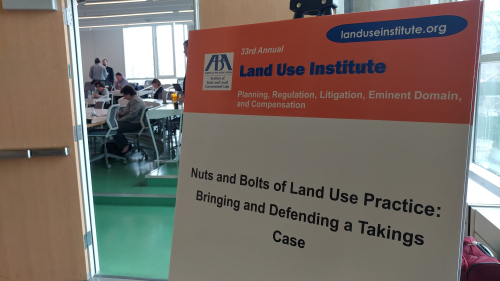
0412191003c_HDR

Here are the links from today’s two sessions (the first, federal water issues impacting local land use; the second, Bringing and Defending a Takings Case):

The morning started off with a talk by former Detroit Mayor (and Michigan Supreme Court justice) Dennis Archer, about Poletown, eminent domain, and economic

Continue Reading Links And Materials From Today’s Land Use Institute Sessions, Baltimore

We’ve been meaning to post the U.S. Court of Appeals for the Eleventh Circuit’s opinion in Hillcrest Property, LLP v. Pasco County, No. 16-14789 (Feb. 13, 2019), mostly because of the provocative way it starts off: 

The question before us is whether a litigant in this Circuit has a substantive-due-process claim under the Due Process Clause of the Fourteenth Amendment when the alleged conduct is the unlawful application of a land-use ordinance. The answer to that question is a resounding “no”—an answer that this Court delivered in McKinney v. Pate, 20 F.3d 1550 (11th Cir. 1994) (en banc), 24 years ago and has reaffirmed ever since. We held in McKinney that executive action never gives rise to a substantive-due-process claim unless it infringes on a fundamental right. A land-use decision is classic executive, rather than legislative, action—action that, at least here, does not implicate a fundamental right under

Continue Reading 11th Cir: The Use Of Land Isn’t A Fundamental Right, Even If “What happened to [the owner] here was pretty doggone s[tink]y.”

Header image LUI 2019

Come join us at the 33rd Annual Land Use Institute, in Baltimore, Maryland, April 11-12, 2019.

As the brochure notes:

This Annual Land Use Institute program is designed for attorneys, professional planners, and government officials involved in land use planning, zoning, permitting, property development, conservation and environmental protection, and related litigation. It not only addresses and analyzes the state-of-the-art efforts by government to manage land use and development, but also presents the key issues faced by property owners and developers in obtaining necessary governmental approvals. In addition, the entire approach of the program is to provide practice pointers that give immediate “take home value” by focusing on topics relevant to the average practice of the attendee.

The keynote will be delivered by Dennis Archer, former mayor of Detroit (and former Justice of the Michigan Supreme Court, and former President of the ABA), speaking about “Detroit’s New GM Plant from

Continue Reading 33rd Annual Land Use Institute: Baltimore April 11-12, 2019

It’s easy when legal cannabis or medical marijuana is involved to make a joke.

But (for now) we’ll resist that temptation and simply tell you about a webinar our colleagues at the American Planning Association are putting on about our favorite thing … Land use law. (What did you think we might say?)

Thursday, March 21, 2019 from 2:00 – 3:30pm, ET is where you want to be:

This webinar will explore how various land use and natural resource regulations shape the development of the legal cannabis industry. The scope of the conversation will range from regulatory options municipalities may consider as the legal cannabis industry develops to how individual businesses are fostered or stifled as a result of certain regulations. One goal of this webinar is to help practitioners identify key cannabis industry issues they should consider in working with either government officials or business owners.

More information including

Continue Reading Upcoming Webinar: How Land Use and Natural Resource Regulations are Shaping the Legal Cannabis Industry

The bulk of the Indiana Court of Appeals’ opinion in Grdinich v. Plan Comm’n for the Town of Hebron, No. 18A-PL-1050 (Feb. 28, 2019) is devoted to details of land use law, specifically exhaustion of administrative remedies. If that floats your boat, we’ll let you read it. 

What caught our eye was at the very last part of the opinion (page 16), where the court concluded that the property owner did not adequately plead an inverse condemnation claim, when his complaint alleged “that real estate owned by him is encumbered by a 150-foot underground storm water drainage pipeline that is owned and controlled by Hebron for public use without payment for just compensation.” In other words, an uncompensated physical invasion taking. 

The court held this did not state a claim as a matter of law because the allegedly offending pipeline was already in place at the time the plaintiff purchased

Continue Reading Indiana App: No Inverse Claim Where Government’s Permanent Physical Invasion Of Property Happened Before Purchase