This just in: the Hawaii Supreme Court has rendered a unanimous opinion in Leone v. County of Maui, No. SCAP-15-599 (Oct. 16, 2017), a case we’ve naturally been following because it involves regulatory takings (and we were involved in a similar case on a neighboring property). 

We haven’t had a chance to review the 48-page opinion in detail (once we do so, we will post a more detailed review), but the issue the court was presented with was, as we noted here, whether leaving land in its vacant state court be considered an economically beneficial use. Short story is that the court held yes, it could, thus seeming to create a lower court split (hello, cert petition) with at least one other court, the Federal Circuit in Lost Tree, concluding that economically beneficial use means more than someone might buy it down the road. 

There’s

Continue Reading Conflict Check: Hawaii Adds To Lower Court Regulatory Takings Split: Is Leaving Land Vacant On The Hope It Is Worth More In The Future “Economically Beneficial Use”?

IMG_2931

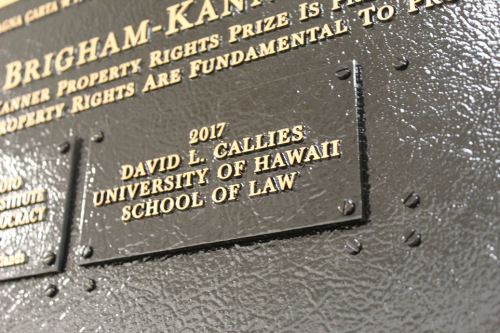
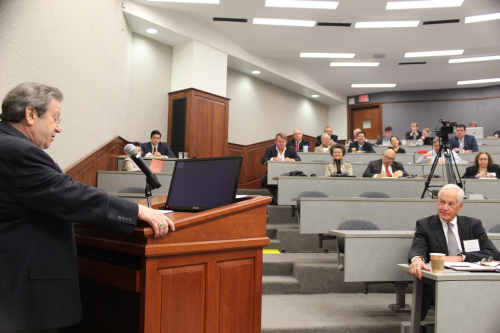
University of Hawaii Law School Professor David Callies last night was presented with William and Mary Law School’s Brigham-Kanner Property Rights Prize which is “presented annually to a scholar, practitioner or jurist whose work affirms the fundamental importance of property rights.” 

As W&M notes about Professor Callies, a “prolific scholar whose work explores land use, property, and state and local government law, Callies has lectured around the world and authored or collaborated on about 90 articles and 20 books. He has been a member of the prestigious American Law Institute since 1990 and is the Benjamin A. Kudo Professor of Law at the University of Hawaiʻi at Mānoa. Prior to entering academia, he was an attorney in private practice and an assistant state’s attorney.”

IMG_3028

We’re spending today in a series of panels which explore and build upon Professor Callies’ lifetime of work. Michael Berger, a past Prize winner, kicked off

Continue Reading Professor David Callies Awarded William & Mary Law’s Brigham-Kanner Property Rights Prize

ALI-CLE2018

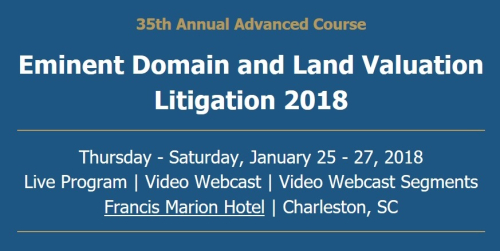
It’s not too early to reserve your spot at the 35th Annual ALI-CLE Eminent Domain and Land Valuation Litigation Conference, to be held at the Francis Marion Hotel in historic downtown Charleston, South Carolina, January 25-27, 2018. 

We’re finalizing the Conference details, but can report that the program will, as usual, feature expert presenters from across the nation, and both an in-depth update on the subjects we love, and a “101” track for those new to the field or who would appreciate a refresher. Check out some of the topics:

  • Takings and Damaging by Flood: Case Selection Advice For Savvy Practitioners
  • Quarterbacking the Case: Blocking Defenses, Controlling the Witnesses, and Converting for Verdicts
  • We’ve Been Working on the Railroad: Utility Crossing Disputes
  • Protecting Your Record,and Anticipating Appeals
  • Lucas 25 Years Later: Property Rights in the Age of Global Warming
  • Building and Growing Your Eminent Domain Practice With


Continue Reading 2018 ALI-CLE Eminent Domain Conference: Early-Bird Registration Discount Now Posted

DSCF3369

Back when the opinion was first released, we posted a list of Murr v. Wisconsin links. Now that Court is nearly back from its summer vacation, here’s an updated list:

Will there be more? No doubt. Murr is the takings case that keeps on giving. Continue Reading The Takings Case That Keeps On Giving: Murr Round-Up, Continued

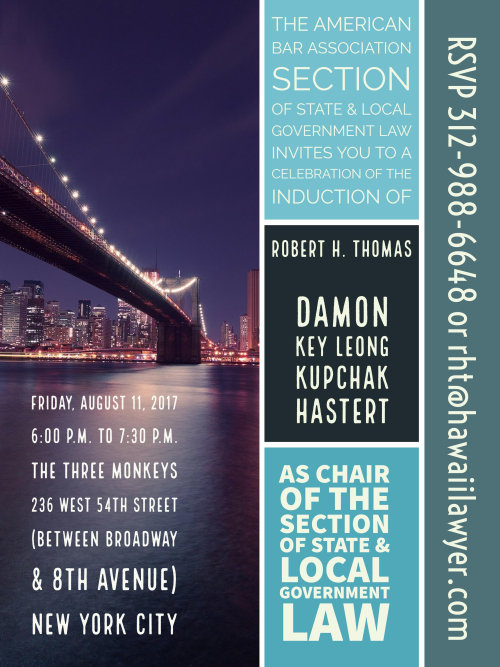
Chair Reception SLG 8-11-2017 invitation

If you are scheduled to be in or near New York City on Friday, August 11, 2017, please consider attending one or both of the following events:

  • 10-11:30am, Midtown Hilton, Concourse E, Concourse level:Murr and Beyond: Implications for Regulatory Takings.” Yes, Murr is the case that keeps on giving, and has already given CLE providers numerous opportunities to add to their coffers. The ABA is sponsoring this program, which includes the lawyers for the two main parties, and two (me included) lawyers who do this kind of thing. Come,  join your colleagues for a roundtable discussion of the case, and more importantly, what comes next. With John M. Groen, Principal Attorney, Pacific Legal Foundation, Sacramento,CA; Robert Thomas, Damon Key Leong Kupchak Hastert, Honolulu, HI; Hon. Misha Tseytlin, Solictor General , WI Dept. of Justice, Madison,WI; and Nancy Stroud, Land Use Attorney, Lewis Stroud & Deutsch, Boca Raton, FL. Our


Continue Reading ABA CLE, NYC: “Murr and Beyond: Implications for Regulatory Takings” – Aug 11, 2017

The Connecticut Appeals Court’s opinion in Stones Trail, LLC v. Town of Weston, No. AC 38078 (July 18, 2017), does not offer a lot in terms of substance — it holds that a property owner’s regulatory takings claim based on the Town’s approval of what the owner thought was a subdivision was not ripe because the owner had not actually filed a subdivision request — but the facts are interesting nonetheless:

The plaintiff had purchased the property with the purpose of dividing it into six buildable lots. Before the closing of the purchase, the plaintiff submitted three maps of the property to the town. The town’s attorney determined that the property depicted on one of the maps was not a subdivision, and that map was stamped accordingly and filed in the town land records. Thereafter, the other two maps, which altered the lot lines of the property to depict

Continue Reading After A Plaintiff Jury Verdict (And Rejection Of Town’s Four Previous Motions Over Nine Years), Takings Claim Held Not Ripe

Load this one up for your morning drive, or workout: the Federalist Society’s podcast on “Lucas v. South Carolina Coastal Council at 25.” Featuring Professor Eric Claeys, Professor Michael Wolf, and Pacific Legal Foundation’s James Burling. Well worth your time.

Here’s the description:

This spring marks the 25th anniversary of the U.S. Supreme Court’s decision in Lucas v. South Carolina Coastal Council. In Lucas, a 5-4 Court majority held that a state law can effect a “regulatory taking” and trigger inverse condemnation requirements if it deprives an owner of all viable uses of his land. Join our panel to hear a discussion of questions such as: Did Lucas mark a major change in Supreme Court regulatory takings doctrine? Was the decision about right, or did it go too far or not far enough? Is Lucas still relevant to regulatory takings law today, and what are the

Continue Reading A Quarter-Century Of Lucas: What’s Next?

SSRN

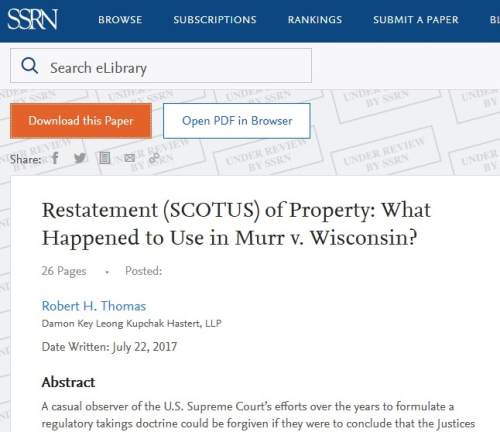
 A couple of weeks ago, we noted that the Supreme Court’s recent decision in Murr v. Wisconsin would no doubt be a boon for law review editors. To avoid shirking our duty, we’ve spent the interim doing some writing, adding a drop to the flood. First draft done, posted on SSRN here

Emphasis on “draft,” so send your comments. Continue Reading Restatement (SCOTUS) of Property: What Happened to Use in Murr v. Wisconsin?