In what might be the most cliched “New York City” land use situation, check out the Appellate Division’s opinion in Coalition For Fairness v. City of New York, No. 2023-05338 (Dec. 5, 2024).

Want to convert your SoHo-NoHo artist live/work space to unlimited residential use? Be prepared to pony up and pay to the City’s Arts Fund a non-refundable fee of $100 per square foot as a precondition of even filing a building permit. 

When owners challenged this fee as unconstitutional under Nollan/Dolan/Koontz/Sheetz, the trial division said no. But the Appellate Division held otherwise, concluding that the imposition of the fee lacked an essential nexus and was not roughly proportional to whatever impacts “certified artists” (who knew the government was in the business of “certifying” artists?) suffer when an owner converts.

The opinion, in true Appellate Division style is short (3 pages)
Continue Reading NY App Div: Requiring Art Fee “Donation” To Get Building Permit Lacks Nexus, Proportionality

‘Tis the season for TV holiday movies. Here’s one to add to your list, as it is on-brand for us dirt lawyers. “Christmas at the Drive In” is described thusly:

“A property lawyer works to prove that her town’s Drive In Theater, a local institution, is not closed down at the holidays, finding romance with the very person who is trying to sell the property.”

When property, redevelopment, historic preservation, and l’amour is involved, who could resist?Continue Reading Holiday Dirt Law Movie: “Christmas at the Drive In” (aka Rudolph The Red-Nosed Redeveloper)

Euclid_front98 years old, and still going (for better or worse)

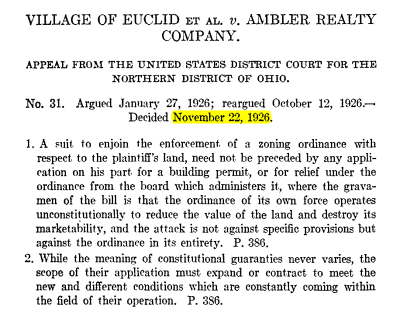
On this day in 1926, the United States Supreme Court issued its landmark opinion in Village of Euclid v. Ambler Realty Co., 272 U.S. 365 (Nov. 22, 1926).

You know this one (and can you call yourself a dirt lawyer if you don’t?). It’s the one in which the Supreme Court first upheld — against a facial due process challenge — the validity of this thing we call “zoning.” While in the intervening century, zoning has become a catch-all term for all sorts of regulatory restrictions on the uses of real property, land users know that “zoning” — ackshually — refers only to the regulation and separation of uses, and restrictions on density, and height regulation. At least that’s how it began.

While “Euclid” and “Euclidean zoning” have become part of the land use

Continue Reading (Un?)Happy Euclid Day!

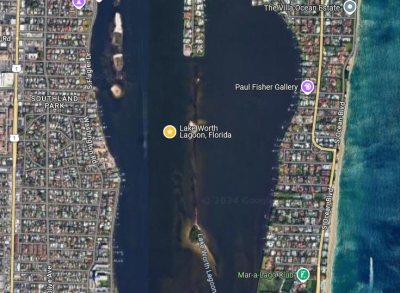
Screenshot 2024-11-20 at 09-16-50 Lake Worth Lagoon - Google Maps
Lake Worth: the “lago” in Mar-a-Lago

You know his name. He’s taken on the City of Riviera Beach twice at the U.S. Supreme Court. And won both times. The houseboat that isn’t a boat. The government can’t shut you out from speaking your mind simply because you irritate them.

That’s right, it’s Fane Lozman. A “Florida Man” that you can like and admire. And he’s back for Round 3.

He owns property that’s mostly in (in, not near) Lake Worth. Two-tenths of an acre is uplands, and the rest (7.75 acres) is submerged. As the Eleventh Circuit noted, “[o]nly a sliver of Lozman’s property is above water.” 

The city, in accordance with the usual approach to land use regulation has a comprehensive plan. That plan designates submerged lands as “Special Preservation Future Land Use,” a label which should set off your Lucas

Continue Reading CA11: Takings Claim Not Ready Despite Govt’s Enforcement Actions

Here are the cases and other materials we discussed in today’s Section of State & Local Government Law Land Use group meeting on takings:


Continue Reading Links From Today’s ABA Land Use Session

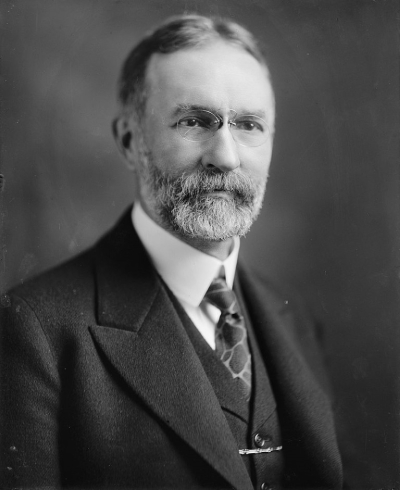
Sutherland_5
Justice Sutherland asks:
whadda mean, you don’t like apartments?

Check out this uncharacteristically-lengthy opinion from New York’s Appellate Division (and entire 6 pages!).

In Bennett v. Troy City Council, No. CV023-0709 (Oct. 24, 2024), the court invalidated a municipal upzoning (from single-family residential to Planned Development — which would permit apartments) because the city’s conclusion that the zone change would have no significant environmental impact under New York’s study-and-disclose statute.

Not content with apartments coming to the neighborhood, an adjoining owner, the “coufounder of The Friends of the Mahicantuck,” sued to challenge the negative environmental declaration. Under New York’s environmental study-and-disclose statute, the “environment” may include such things like historic or archaeological resources, and similar. 

Zoning and rezoning is generally subject to deferential judicial review under Euclid, with the courts applying rational basis review and generally taking a hands-off approach. But this was not a Euclid-like challenge

Continue Reading The Old “Neighborhood Character” Trope Dressed In Environmental Clothing

Here’s the latest takings cert petition, in a case involving a California county’s refusal to rezone property back to its former zoning to allow residential development. The only uses permitted on the property presently are “scientific research facilities uses” and hiking trails. Or, at the petition puts it, “only public, park-like uses.” Pet. at 5. 

The District Court and the Ninth Circuit both held no taking.

Here are the Questions Presented:

Does a taking analyzed under Lucas v. S.C. Coastal Council require that the affected property be left with no value even if the regulation in question deprives the property of all economically beneficial uses?

Does Palazzolo v. Rhode Island leave any room for consideration of the landowners’ expectations in a Penn Central takings analysis?

Do the decisions in Loper Bright Enters. v. Raimondo, Cedar Point Nursery v. Hassid, Sheetz v. Cnty. of El Dorado and Lingle

Continue Reading New Cert Petition: Use vs Value, And Applying Penn Central

Screenshot 2024-10-25 at 13-19-32 Housing and Exactions The Next Frontiers After Sheetz Pacific Legal Foundation

Our outfit (Pacific Legal Foundation) has put out a call for papers. on the topic of land use exactions and housing law. Honorarium included for accepted papers, and there will be a workshop to follow.

Here’s the description:

This workshop seeks to build on the result of Sheetz v. County of El Dorado and chart the course of the next steps in exactions/unconstitutional-conditions law. From Nollan v. California Coastal Commission, through Dolan v. City of Tigard and Koontz v. St. John’s River Water Management District, and now including Sheetz, the Supreme Court has looked to the doctrine of exactions and unconstitutional conditions to ensure property rights are protected. In doing so, it has created a constitutional bulwark protecting the right to build housing on private property, an important stick in the property rights bundle.

The Supreme Court’s unanimous decision in Sheetz held that legislatively-imposed development-fee schedules are

Continue Reading Call For Papers: “Housing and Exactions: The Next Frontiers After Sheetz“

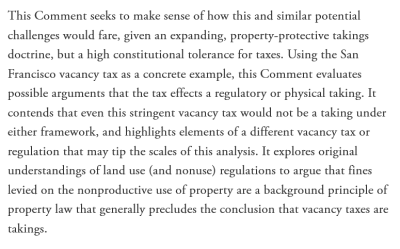
Screenshot 2024-10-24 at 12-28-24 Vacancy Taxes A Possible Taking The University of Chicago Law Review

A new student-authored journal article worth reading, Christine Dong, “Vacancy Taxes: A Possible Taking?,” 91 U. Chi. L. Rev. 1725 (2024).

Here’s the Abstract:

Vacancy taxes are an increasingly popular solution to the paradoxical problem of high housing demand coupled with high vacancy. Cities across the country facing housing shortages have either implemented or are considering adopting vacancy taxes to encourage property owners to rent or sell their property. Soon after San Francisco adopted a vacancy tax with one of the broadest definitions of vacancy, property owners lobbed a constitutional challenge under the Takings Clause, taking advantage of a moment of doctrinal instability.

This Comment seeks to make sense of how this and similar potential challenges would fare, given an expanding, property-protective takings doctrine, but a high constitutional tolerance for taxes. Using the San Francisco vacancy tax as a concrete example, this Comment evaluates possible arguments that the

Continue Reading New Article (Comment): “Vacancy Taxes: A Possible Taking?” (U. Chi. L. Rev.)

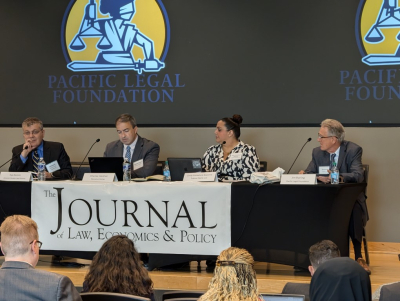
PXL_20241004_152452877.MP
Lawprof Ilya Somin (GMU Law), Mercatus Center’s Charles Gardner,
and lawyer Emily Cruikshank Bayonne (Tubman Realty, LLC)
speaking on “
How Policy Changes Can Address Incursions on
Property Rights Where Courts Have Failed to do So.”
Jim Burling (PLF) moderating.

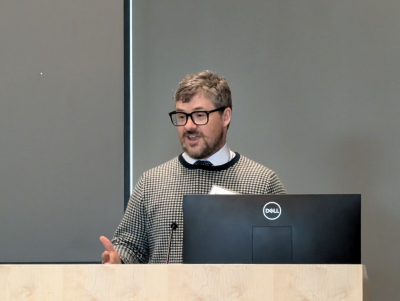
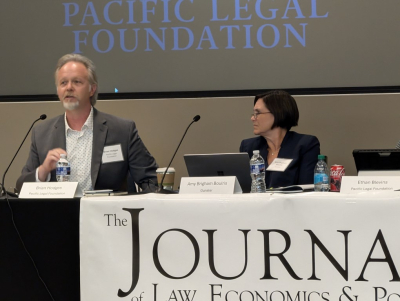
Recently, we attended a wonderful symposium co-sponsored by George Mason Law School’s Journal of Law, Economics & Policy (congratulations to the student editors who ran the show that day), and our outfit Pacific Legal Foundation. Of course, with the subject being “Imagining the Future of Regulatory Takings,” how could we resist attending?

If you missed it, it was not recorded unfortunately. But stay tuned for the full published symposium issue which shall include all of the articles and other pieces the speakers presented that day.

PXL_20241004_130701595.MP
PLF’s Ethan Blevins kicked off the day by
urging the speakers and the audience to
“make property rights cool again.”

PXL_20241004_182439511.MP
Brian Hodges

Continue Reading Imagining The Future Of Regulatory Takings: “Making Property Rights Cool Again”