Screenshot 2024-10-11 at 08-06-50 RPFSS

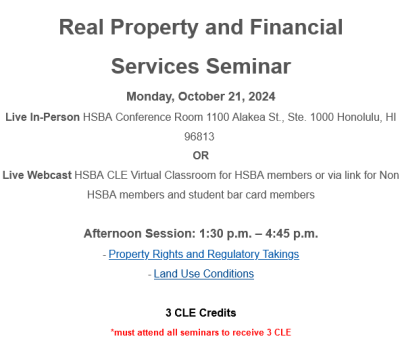
Hawaii lawyers (and those barred in the 808), take note: On October 21, 2024, the Hawaii State Bar Association will hold its annual Convention, and as always there’s a full lineup of CLE programs so you can meet your MCLE requirements.

Thanks to the Real Property & Financial Services Section, there’s a significant dirt law component. First, there’s “Property Rights and Regulatory Takings” the program on which we are presenting along with Dwight Merriam and lawprof Shelley Saxer. Here’s the official description:

This course will provide a survey of property rights and regulatory takings with an emphasis on recent decisions from the United States Supreme Court. Panelists include distinguished faculty and practitioners that will address impact fees, development rights, taking claims, rent controls, and other current issues.

Following us will be a program on “Land Use Conditions” with Cal Chipchase, Brad Saito, and a lawyer

Continue Reading Hawaii Dirt Lawyers: Don’t Miss “Property Rights & Regulatory Takings” CLE At The HSBA Convention (In-Person & Webcast)

CRE prize

Congratulations to our Pacific Legal Foundation colleague Brian Hodges for his article “Build-to-Rent Homes: A Promising Solution to Chronic Housing Shortages” being awarded the 2024 Jared Shales Prize by the Counselors of Real Estate (CRE).

From the Introduction:

When homeownership is increasingly out of reach for many, build-to-rent (BTR) housing offers a desirable alternative to traditional homeownership. First, BTRs provide flexibility that traditional homeownership cannot match. By renting rather than owning, tenants are free to move around the city or the country as their jobs, family situations or lifestyle decisions dictate. They can enjoy the benefits of urban or suburban living without being tied down to a particular location or property. Second, BTRs are often built to higher standards than traditional rental properties, with modern amenities and communal spaces that foster a community and belonging. These properties are often professionally managed, meaning that tenants can enjoy the

Continue Reading “Build-to-Rent Homes: A Promising Solution to Chronic Housing Shortages” – CRE 2024 Jared Shales Prize

A frequent vibe in cases where a member of the public asks a court to compel a local government to do something about an undesired land use (i.e., “the city should stop my neighbor from illegally renting their property,” or “the police should remove the pop-up unlicensed food stand on the sidewalk in front of my restaurant”) is that zoning enforcement is often viewed by courts as a discretionary municipal function or a question about allocation of enforcement resources — and therefore the judiciary takes a hands-off approach.

That vibe, however, did not carry the day when the Arizona Court of Appeals tackled Brown v. City of Phoenix, No. CV23-0273 (Aug. 27, 2024). In that case, the court upheld a trial court’s preliminary injunction ordering Phoenix to do something about the notorious “zone” that the trial court determined was a public nuisance “created or maintained” by the

Continue Reading Court To Phoenix: Clean Up Your Act!

81XRFQ5ONQL._SL1500_

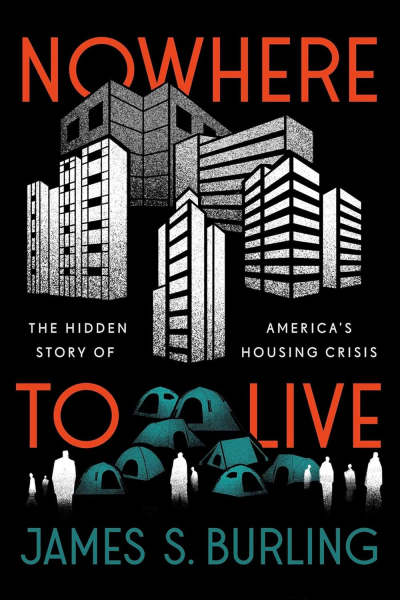
If you are in the California Southland (or plan to be in the next week), please be sure to reserve on your calendar Tuesday, August 13, 2024, to join us in-person for the launch of our colleague Jim Burling‘s forthcoming book, “Nowhere to Live: The Hidden Story of America’s Housing Crisis.”

Here’s a blurb about the book, which is available for preorder on Amazon:

A century of policy mistakes ruined America’s cities and created an unprecedented housing crisis.   
 
For many families, homelessness is no longer someone else’s problem. It is right around the corner, a real threat in their own immediate future. Our housing crisis is the result of a long history of government policies, court cases, and political manipulation. While these disparate causes make up a tangled web, they have one surprising root: the attack on private property rights. For more than

Continue Reading Book Launch Event, Aug 13, 2024: Jim Burling, “Nowhere to Live: The Hidden Story of America’s Housing Crisis”

Check out City of Kemah v. Crow, No. 01-23-00417-CV (July 25, 2024), from the Texas Court of Appeal (First District).

This is yet another takings ripeness case — here, the so-called “final decision” requirement — the second recent opinion on this issue from the Texas court. SeeFinal Decision Takings Ripeness Is Based On All Circumstances, Not Hard-And-Fast Requirements (Read That Again: A Factual Question)” for our write-up of the other case.

In this one, the owner asserted that the city issued her a building permit for her “barndominium” and and two other structures to be used as short-term rentals, but later issued a stop work order. This resulted in a Penn Central taking, she asserted.   

The city sought ripeness dismissal, asserting the owner didn’t actually have a permit issued by the city council as its ordinances require. The owner didn’t have the actual

Continue Reading Relying On Complaint’s Allegation That City Issued A Permit As Confirmed By Chief Building Officer Email, Texas App Holds Takings Claim Ripe Even Though City Said Council Must Issue Permits

Screenshot 2024-07-14 at 09-00-18 Sheetz v. County of El Dorado Legislatures Must Comply with the Takings Clause by Brian T. Hodges Deborah La Fetra SSRN

Check this out: our Pacific Legal Foundation colleagues (Brian Hodges and Deborah La Fetra we on our Sheetz SCOTUS team), have posted a new scholarly piece on SSRN, “Sheetz v. County of El Dorado: Legislatures Must Comply with the Takings Clause.”

Here’s the Abstract:

For more than 30 years, the Supreme Court has recognized that building permit conditions requiring a dedication of property to the public implicate the Fifth Amendment’s Takings Clause and are therefore subject to the unconstitutional conditions doctrine as set out by Nollan v. California Coastal Commission, 483 U.S. 825 (1987), and Dolan v. City of Tigard, 512 U.S. 374 (1994). But for nearly as long as the Nollan/Dolan doctrine has been in place, state and lower federal courts have divided on the foundational question of whether the doctrine applies equally to all branches of government, or if it applies only to administrative

Continue Reading New Article – “Sheetz v. County of El Dorado: Legislatures Must Comply with the Takings Clause” (Brian Hodges & Deb La Fetra)

Check this out, a local government has filed a cert petition seeking reversal of one of those relatively rare circumstances where the property owner won below on a temporary regulatory takings claim for the County’s denial of a development permit.

We won’t go into details on this, but urge you to read the petition, especially the Questions Presented:

In First English Evangelical Lutheran Church of Glendale v. Los Angeles County, Cal., the Court held that the Fifth Amendment requires “just compensation” for temporary regulatory takings, i.e., “those regulatory takings which are ultimately invalidated by the courts.” 482 U.S. 304, 310 (1987). The appropriate compensation for a temporary regulatory taking is described as “fair value for the use of the property during this period of time.” Id. at 322. All claims for temporary regulatory takings must be analyzed using the ad-hoc, fact-based analysis set out in Penn Central Transp.

Continue Reading New Cert Petition: Gov’t Asks Whether A Penn Central Taking Is Really A Lucas Taking

BetterCoastalCommnReportCover

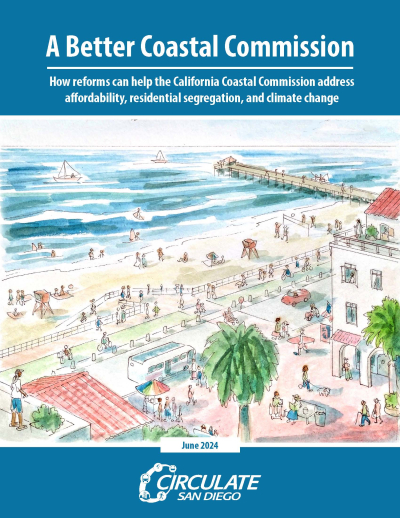
The California Coastal Commission is infamous for being the most out-of-control governmental agency in the nation. This regulatory leviathan fancies itself the undisputed czar of land use and other activities in its fiefdom, the California coastal zone.

Created in 1976 as an agency with regulatory authority across California’s 1,000+ miles of coast (and land in a defined shoreward zone), it has since expanded to its current role as a government-outside-the-government, whose main role it often seems is more about wielding an iron fist over anything that happens in the coastal area, than protecting coastal access and resources while also respecting property rights as its governing statutes require.

The Commission has been blessed with procedures that appear insanely unfair to anyone not familiar with how things work in California. For example, any two Commissioners may file an administrative appeal of a municipalilty granting a development permit to get it

Continue Reading Can The California Coastal Commission Be Reined In?

Here’s the latest in a case we’ve been following.

Check out this cert petition which asks about what actions trigger the statute of limitations on a takings claim. This is an issue that seems to be cropping up more and more these days. For example, see here, here, here, here, and here.

Here are the Questions Presented:

Whether the statute of limitations for a Section 1983 takings claim for the unconstitutional deprivation of private property (specifically real estate) can begin to run before the municipal action that caused the property owner to sacrifice all economically beneficial uses has transpired?

And further, whether the Tenth Circuit Court of Appeals used the proper unit of property to measure if Mr. Bruce was forced to sacrifice all economically beneficial uses of his property?

And finally, whether the 14th Amendment’s due process provisions permit the mayor of a

Continue Reading New Cert Petition: When Does The Statute Of Limitations Start To Run On A Reg Takings Claim?

Here are three federal circuit opinions, all unpublished. None of them worthy of a stand-alone post, but also not to be overlooked entirely.

  • GHP Management Corp. v. City of Los Angeles, No. 23-55013 (9th Cir. May 31, 2024): Lessors “failed to state a claim for a Fifth Amendment per se physical taking[,]” in their challenge to LA’s eviction moratorium. You know why: you waived your right to exclude by renting your properties, so the government prohibiting you from getting breaching tenants out is merely a regulation of the landlord/tenant relationship. Yee.
  • Innova Investment Group, LLC v. Village of Key Biscayne, No. 21-11877 (11th Cir. May 29, 2024): After the Village tagged Innova with a NOV and $4k fine for not obtaining an interior demolition permit and Innova failed to correct the violations within the 60-day deadline, the Village imposed $4k per day fines and “aggregate penalties of


Continue Reading Unpublished Wednesday: Eviction Moratorium Taking, Excessive Fines Taking, And 1983 Zoning Statutes Of Limitations