Update: San Francisco is going to appeal.

It cost a lot to live in San Francisco, these days. A whole lot, whether you own, or rent

If you’re a renter, however, you should hope and pray that your landlord wants out of the rental business. Because under a San Francisco ordinance, property owners who rent their properties but then decide they don’t want to continue to do so must get a permit from the City in order to quit. Another requirement of the ordinance is that the owner pay cash to a displaced tenant — a lump sum “relocation payment” of 24 times “the difference between the units’ current monthly rent and an amount that purports to be the fair market value of a comparable unit in San Francisco, as calculated by a schedule developed by the Controller’s Office.” 

The Levins wanted out of the rental business, and

Continue Reading Federal Court: San Francisco’s Housing Exaction Violates Nollan-Dolan-Koontz
If that title doesn’t grab you, nothing will. Here’s the description of an upcoming program from the American Planning Association that looks awfully interesting:  

The Planning and Law Division of the American Planning Association is pleased to host the upcoming webcast Sex, Guns & Drugs:  Planning for Controversial Land Useson Wednesday, October 22nd from 1:00 to 2:30 PM CST. Registration is $20 for PLD members, $40 for nonmembers, and $45 for webinar registration plus a Planning and Law Division membership. Presented by Daniel J. Bolin and Gregory W. Jones of Ancel Glink, this webcast will explore if and where controversial businesses belong in communities.

The U.S. Constitution guarantees freedom of expression, freedom of religion, and the right to bear arms. But it’s not that simple. Businesses that rely on these constitutional guarantees continue to generate controversy in communities across the country. To compound matters, state legislatures from Arizona to Massachusetts have been busy granting new — and in many cases, previously unheard of — rights to marijuana and firearm retailers.This has rapidly drawn planners and zoning practitioners into the debate over how these businesses best fit into their communities, and whether their communities are legally obligated to accommodate these uses in the first place. Spend an hour learning about the issues and regulatory strategies from around the country. 

Webcast—Sex, Guns & Drugs:  Planning for Controversial Land Uses

October 22, 2014

1:00 – 2:30 PM CST

More information here

, including registration. 
Continue Reading Upcoming Webcast: “Sex, Guns, And Drugs: Planning For Controversial Land Uses”

Ah, Williamson County. We’ve ranted about it before, so we won’t do so here (again). But takings mavens know that a property owner must meet two tests before she can raise a takings claim against a state or local government in federal court: the state or local government must have reached a final decision on the uses to which her property may be put, and she must seek (and be denied) just compensation via state procedures.

We’ve always viewed both parts of the test as very “takings-specific” and not really applicable to other areas. The rationale supporting the final decision requirement is that a court really can’t tell whether property has been “taken” until it understands what uses may be allowed by the state or local government. Absent such a decision, the government may allow some economically beneficial use. Similarly, the state procedures test rationale is that a

Continue Reading 2d Cir Extends Williamson County Ripeness “Final Decision” Requirement To ADA Claims

You mght read the headline of this post and naturally say to yourself, “well, that’s obvious.” But to the Eleventh Circuit in Kentner v. City of Sanibel, 750 F.3d 1274 (11th Cir. 2014), it wasn’t.

In that case, the court concluded that riparian rights are not “fundamental rights” protected by the Due Process Clause from arbitrary and capricious government action, in this case, a ban on the construction of docks and piers (except, apparently, city-owned docks and piers). The court concluded that riparian rights are not “fundamental” rights because they are merely “state-created” rights.

After we read it, the court’s rationale was so inexplicable we asked aloud, “[i]f you can figure out the court’s logic about why riparian rights are not fundamental, and what is a ‘state-created’ right (in contrast to a state-created right created by legislative act, or why the legislature’s hand triggers greater scrutiny than mere

Continue Reading New Cert Petition: Isn’t Property A Fundamental Right?

EM Hauulaeminent_domain_abuse

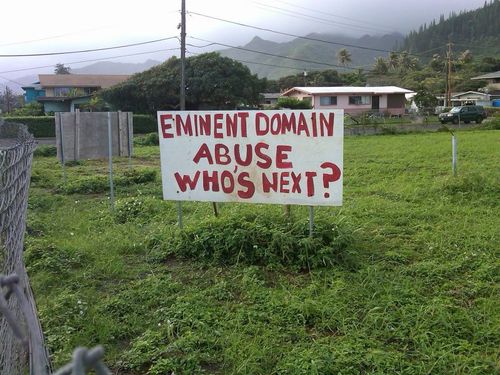
Remember that case which we posted about earlier, in which the City and County of Honolulu condemned an undeveloped lot in rural Oahu for a fire station, but has been met with staunch resistance by the property owners? Not only did we post on the case, but it made national waves, also.

The City filed an eminent domain action in state court, and obtained a writ of immediate possession. After that, the City removed the eminent domain protest signs the owners had maintained on the property. The owners objected, filing a complaint in U.S. District Court alleging that the City went on the property and posted a “removal notice” under the City’s newly-adopted “Bill 54,” an ordinance allowing the City to seize property “stored” on public property provided it “tags” it 24 hours in advance, and that the removal was retaliation for the signs’ content.

The complaint alleges that the

Continue Reading Hawaii Federal Court: “Quick-Take” In Eminent Domain May Not Give Condemnor Exclusive Possession

2010-03-24 15.24.40
Tennessee Supreme Court, Nashville

In Phillips v. Montgomery County, No. M2012-00737-SC-R11-CV (Aug. 18, 2014), the Tennessee Supreme Court held that a property owner could recover under the state’s inverse condemnation statute, Tenn. Code Ann. § 29-16-123, for a regulatory taking:

We hold that, like the Takings Clause of the United States Constitution, article I, section 21 of the Tennessee Constitution encompasses regulatory takings and that the Property Owners’ complaint is sufficient to allege a state constitutional regulatory taking claim, for which they may seek compensation under Tennessee’s inverse condemnation statute, Tennessee Code Annotated section 29-16-123.

Slip op. at 12.

That’s all well and good, and we applaud the court for doing so. But wait a minute, you say, that statute and this issue sure sound familiar.

Indeed they do. This is the same statute which the U.S. Supreme Court, in Williamson County Regional Planning Comm’n v. Hamilton Bank

Continue Reading Tennessee Finally Recognizes Regulatory Takings Cause Of Action – A Quarter Century After The US Supreme Court Wrongly Assumed It Did

Check this out, an opinion from the Appellate Division of the New York Supreme Court in a tax assessment case, Jacobowitz v. Bd of Assessors, Town of Cornwall, No. D39807 (July 30, 2014. The court held that the Fourth Amendment’s prohibition on warrantless searches and seizures means that a property owner did not have to let the Town’s appraiser into her home to “conduct an interior appraisal inspection” related to her property tax assessment. Slip op. at 1.

It’s a quick read, so we won’t spell it all out in detail, just focus on a couple of the best points. The court held that it is the government’s burden to show entitlement to entry of a home, and not the property owner’s burden to show why it should not. And the property owner’s challenge to the tax assessment did not waive her rights:

Contrary to the Town respondents’ contention

Continue Reading NY App Div: Town Needs A Warrant For Inspection Related To Property Valuation

A couple of years ago, we posted the complaint (actually, a petition for mandate) alleging a big regulatory takings claim against the County of San Luis Obispo based on the County’s denial of a permit to drill for oil. A very big claim. $6.24 billion big. SeeWow, That’s A Lot of Just Compensation.”

We always wondered what happened to that lawsuit. Now, thanks to our colleagues at the California Eminent Domain Report, we know

In “How Untimely Service Can Be Deadly To Your Takings Claim,” Ben Rubin reports that in an unpublished decision, the California Court of Appeal affirmed the dismissal of the complaint for failure to timely serve it on the County. The plaintiffs filed the complaint on time, they just didn’t serve it. Read Mr. Rubin’s write up for the details, but here are the highlights:

  • The County’s denial of the


Continue Reading Cal App: OK For County To Mislead By Omission In Due Process Notice

We usually don’t pay a whole lot of attention to unpublished opinions. Not that they are not interesting mind you, but if the court itself, for whatever reason doesn’t believe the case is worthy of publication, then who are we to say otherwise? But occasionally, we read one that has something worth sharing. Like this case, for example.

In Dagres v. County of Hawaii Planning Dep’t, No. CAAP-11- 0000071 (June 30, 2014), the Hawaii Intermediate Court of Appeals gave us one of those blogworthy tidbits, a short (one page) discussion of the appellant’s judicial takings claim. We don’t see many of those, so we had to follow up. 

The case involved three buildings near the shoreline on the Big Island. The owner wanted to fix them up, and the Planning Department concluded that two of the buildings were exempt from the requirement to obtain a Special Management Area use

Continue Reading A Hint Of Judicial Takings From The HAWICA

To those of you who joined us at the ABA’s Land Use, Planning, and Development Forum, thank you. Here are links to some of the topics I mentioned: 

Those of you who couldn’t make it can get the recording on CD or mp3 here in a couple of weeks, once it is produced.  


Continue Reading Links From Today’s Land Use, Planning, And Development Forum