Remember that case we posted about here, when it was set for oral arguments in the Hawaii Supreme Court a few months ago, where the plaintiff was asserting that the County of Hawaii Planning Department was liable for negligence for not maintaining its subdivision files accurately?

Last month, the Hawaii Supreme Court issued a unanimous opinion which declined to impose a duty of reasonable care on the Planning Department.

The opinion noted that “policy considerations counsel against the judicial creation of such a legal duty under the common law, and also hold that there is no basis under [Hawaii’s open records statute or the Planning Department’s rules of procedure], to impose negligence liability upon the Planning Department based on the temporary absence of a government record from its files. Slip op. at 2. Rebecca Copeland has more background on the case (including the briefs) here at her Record on

Continue Reading HAWSCT: Agencies Have No Duty To Keep Their Records Accurately

We bring you the latest guest post by colleague Paul Schwind, who has been tracking the issues and arguments that recently led the Hawaii Supreme Court to conclude, in DW Aina Lea Development, LLC v. Bridge Aina Lea, LLC, No. SCAP-13-0000091 (Nov. 25, 2014), that the Hawaii Land Use Commission wrongfully rescinded an earlier reclassification of land (read: “rezoning” to all you non-Hawaii land users).

The oral argument recording is posted above.

We’ll post up our thoughts on the decision in a separate post. 

—————————————————————-

Hawaii Supreme Court In Aina Lea: The Rationales Behind The Opinion

by Paul J. Schwind*

Robert has asked me to summarize the rationales behind the holdings in the Hawaii Supreme Court’s recent opinion in DW Aina Lea Development, LLC v. Bridge Aina Lea, LLC, No. SCAP-13-0000091 (Nov. 25, 2014), which he summarized the following day, outlining the litigation history of the

Continue Reading Guest Post – Hawaii SCT In Aina Lea Case: The Rationales Behind The Opinion

2015 Hawaii Land Use Law Conference Banner - Credits

Registration is now open for the 2015 Hawaii Land Use Law Conference, to be held in downtown Honolulu on Thursday-Friday, January 15-16, 2015.

This is the bi-annual conference, co-chaired by U. Hawaii lawprof David Callies and land use lawyer Ben Kudo, that brings together the big names in our area of law. In other words, the one conference you don’t want to miss if you are a Hawaii land use or property lawyer, in-house counsel, a planner, an appraiser, a property owner or manager, or a law student interested in these topics. 

Download the full brochure here, or view it below. 

The keynote speaker this year is lawprof Richard Epstein, addressing “Stealth Takings: Exactions, Impact Fees and More.” Immediately following his talk, I will be moderating a panel on “Impact Fees and Exactions After Koontz,” with colleagues Bruce Voss and David Brittin. The rest

Continue Reading Registration Open: 2015 Hawaii Land Use Law Conference, Jan. 15-16, 2015

This opinion from the Maryland Court of Appeals may be too land-usey for you takings mavens, but it starts off with an attention-getter:

Few cases inflame such deep passions as a dispute involving individual property rights. The belief that fundamental concepts of liberty entailed strong property rights informed and influenced the Founders as they undertook the epochal task of drafting our Constitution. See Sharon A. Rose, Kelo v. City of New London: A Perspective on Economic Freedoms, 40 U.C. Davis L. Rev, 1997, 2002 (2007). Infringers of these cherished rights should beware for “nothing is better calculated to arouse the evil passions of men than a wanton and unredressed invasion of their . . . property rights.” Cameron v. Chi., Milwaukee & St. Paul Ry. Co., 65 N.W. 652, 655 (Minn. 1896).

Appellant, Marquis McClure, seeks our review of the decision of the Circuit Court for Montgomery

Continue Reading Md App Waxes Poetic In A Land Use Opinion

The Hawaii Supreme Court has issued a lengthy opinion in a case we’ve been following, DW Aina Lea Development, LLC v. Bridge Aina Lea, LLC, No. SCAP-13-0000091 (Nov. 25, 2014). 

The litigation is a series of two lawsuits that originated in state court in the Third Circuit (Big Island), one an original jurisdiction civil rights lawsuit, the other an administrative appeal, the latter being the case in which the Supreme Court just ruled.

The essence of the plaintiff’s allegations is that the State Land Use Commission wrongfully amended the land use boundaries from “urban” back to to “agriculture.” Many years earlier, the LUC had amended the boundary to urban on the condition that the owner provide a certain number of affordable units by 2006. In 2008, the developer had not fully done so and the LUC ordered it to show cause why the land classification should not revert to

Continue Reading HAWSCT: Land Use Comm’n Can’t Rescind A Re-zoning Via Truncated Procedures

Check out this story from today’s Greensboro/Winston-Salem (NC) News-Record, “DOT’s long road to nowhere angers property ownersabout the practice in North Carolina of using “protected corridors” to designate property under the state’s Transportation Corridor Official Map Act for future highway use, but then not condemning and paying for the land (while preventing the owners from making any use of it). 

We posted about the NC Supreme Court’s decision in one of those cases, where the court concluded that the property owners could not litigate it as a class action, but must do so in individual cases (800 of them!). Another post on the Map Act cases here (“Lines On A Map” Or Inverse Condemnation: How Long Can A Taking Be Only ‘Planned’ But Not Executed?“). 

The News-Record story is a good read, and a quick summary; recommended reading. It doesn’t hurt that the

Continue Reading N.C.’s Map Act: Clouding Use By Condemnation On The “Long Road to Nowhere”

There’s still time to register for tomorrow’s American Planning Association (Planning and Law Division)’s webinar, Fair Housing, Affordable Housing, and Local Planning and Zoning: Understanding the Obligations and Reducing Your Community’s Legal Risk. Here’s the description:

The Planning and Law Division of the American Planning Association is pleased to host the upcoming webcast Fair Housing, Affordable Housing, and Local Planning and Zoning: Understanding the Obligations and Reducing Your Community’s Legal Risk on Tuesday, November 25th from 2:00 to 3:30 PM EST. Registration is $20 for PLD members, $40 for nonmembers, and $45 for webinar registration plus a Planning and Law Division membership. Presented by Don Elliot of Clarion Associates and Brian Connolly of Otten, Johnson, Robinson, Neff & Ragonetti, this webcast explores the connection between local land use regulation and the federal Fair Housing Act.  

Register hereContinue Reading Upcoming APA Webinar On Affordable Housing

The Hawaii Supreme Court has issued a unanimous opinion in Friends of Makakilo v. D.R. Horton-Schuler Homes, LLC, No. SCAP-13-0002408 (Oct. 30, 2014), holding that there’s not really such thing as a “cross appeal” in administratve appeals (at least in the sense that “cross appeal” is usually used in appellate procedure).  

Quick facts: D.R. Horton petitioned the state Land Use Commission for a boundary amendment (aka a rezoning). Three parties intervened and sought and were granted a “contested case.” The LUC concluded that D.R. Horton was entitled to the boundary amendment. Thirty days later, two of the three intervenors filed a notice of appeal under the Hawaii Administrative Procedures Act, Haw. Rev. Stat. § 91-14, which gives circuit (trial) courts jurisdiction over appeals by any person aggrieved by an agency’s decision in a contested case. The HAPA gives those parties 30 days to file.

Thirteen days after the appeal

Continue Reading HAWSCT: No “Cross-Appeal” In Administrative Appeals

20141104_135324

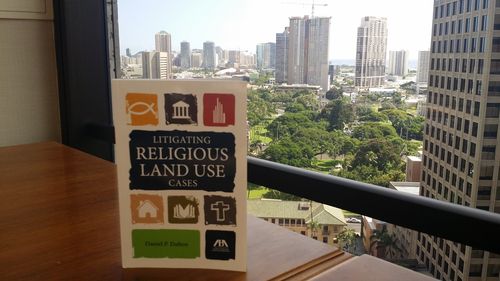
A big thank you to our friend and colleague from Detroit, Dan Dalton, who sent us a recently-published book which he authored, “Litigating Religious Land Use Cases.” 

This book discusses how to litigate such a religious land use case on behalf of a religious entity pursuant to the Religious Land Use and Institutionalized Persons Act (“RLUIPA”)  and the First Amendment. While the First Amendment dates to the founding days of the United States, RLUIPA is a much more recent federal law that can serve as an effective tool in protecting the property interests of religious organizations.

A must-have for any land use lawyer (even if you don’t focus on religious land use cases, or don’t represent religious organizations in such cases), Dan’s book is a great overview of the applicable law, and a primer on the various causes-of-action that can pop up in these type of controversies.

Continue Reading New Book: Litigating Religious Land Use Cases (Dan Dalton)

  DSCF2208

You can’t have rights without advocates.”

                              – Michael Berger

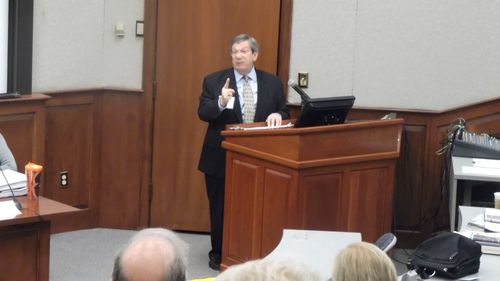
We’re at the William and Mary Law School in Williamsburg, Virginia today for the 11th Brigham-Kanner Property Rights Conference. As we’ve noted earlier, Michael Berger is this year’s B-K Prize honoree, for his career contributions to property law and his “scholarly work and accomplishments [which] affirm that property rights are fundamental to protecting individual and civil rights.”

The list of past recipients is an All-Star roster of property scholars and jurists, including lawprofs Frank Michelman, Richard Epstein, James Ely, Carol Rose, Thomas Merrill, and Supreme Court Justice Sandra Day O’Connor (the latter perhaps more for where she ended up in her Supreme Court career than where she started). See the plaque on the Law School’s wall for the complete list of

Continue Reading 2014 Brigham-Kanner Property Rights Conference Report: Honoring Michael Berger