2015

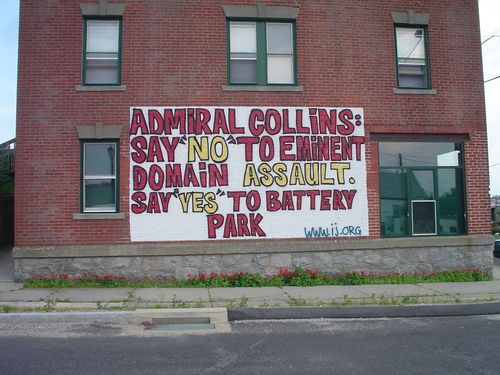
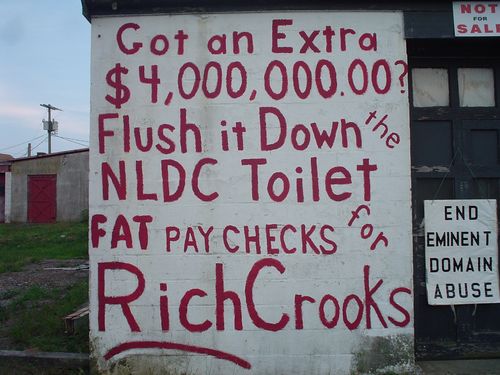
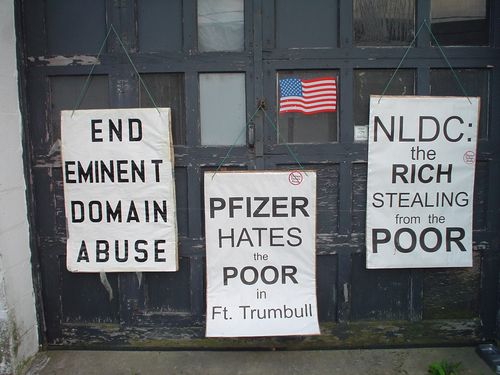
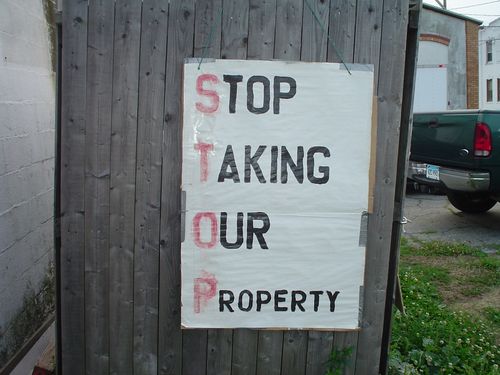
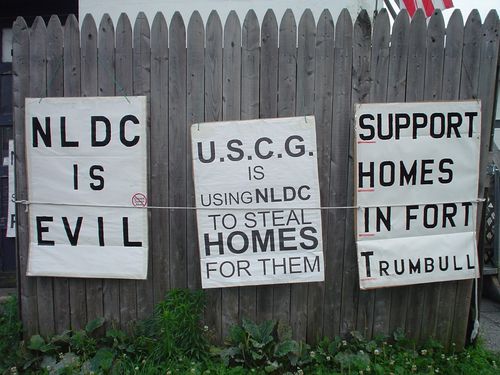
Following up on our earlier post about anti-eminent domain signs are the below, courtesy Dwight Merriam, of the Kelo neighborhood in New London, Connecticut, during the time of the strife. See also the book Dwight edited for the ABA about the case. 

The signs have long since been removed. Along with the properties themselves

Picture1

Picture2

Picture3

Picture4

Picture5

Continue Reading Speaking Of Eminent Domain Protest Signs…

131996

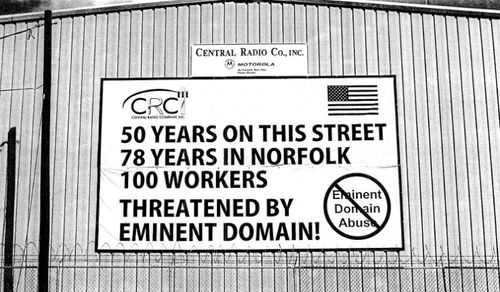
In a 2-1 decision, the U.S. Court of Appeals for the Fourth Circuit concluded that Norfolk, Virginia’s sign ordinance did not violate the First Amendment, when it was applied to bar the anti-eminent domain banner shown above.  

Central Radio Co. Inc. v. City of Norfolk, No. 13-1996 (4th Cir. Jan. 13, 2015), arose from a situation that also resulted in a property-owner favorable ruling from the Virginia Supreme Court in 2013. See PKO Ventures, LLC v. Norfolk Redevelopment and Housing Authority, 747 S.E.2d 826 (Va. Sep. 12, 2013) (a case won by our Owners’ Counsel colleagues at Waldo & Lyle). The city’s redevelopment authority planned on taking property to transfer it to Old Dominion University, but the Supreme Court shut it down, holding that the agency did not have the authority to take non-blighted property. See our write up of that decision here

While it was

Continue Reading 4th Cir OK’s City’s Sign Ordinance: You Can “Whisper” Your Anti-Eminent Domain Message, But You Can’t “Shout” It

Here’s the final program and faculty list for the 2015 Hawaii Land Use Conference, coming up Thursday and Friday, January 15-16, 2015, in downtown Honolulu.

This is the bi-annual gathering of Hawaii’s land use mavens, and this year’s program has two very special presenters. Storied lawprof Richard Epstein (perhaps more than a “mere mortal”) will be presenting the keynote talk on “Stealth Takings: Exactions, Impact Fees and More,” and our ABA colleague Patty Salkin, Dean of the Touro Law School, will get us our Ethics CLE credits with her usual exciting program on ethics topics. (As someone who has attended more than few of her presentations, we can report that it is worth the price of admission alone, and even though “ethics CLE” and “exciting” are words we usually do not associate with each other, Dean Salkin’s presentation is the exception.)

Our panel on “

Continue Reading Still Time To Join Us For The 2015 Hawaii Land Use Conference (Jan. 15-16)

On Maui today to argue an eminent domain case, so haven’t had a chance to post up a new opinion. But in our down time between hearings and flights, we were able to do some reading of our colleagues’ stimulating blog posts. Check ’em out:


Continue Reading Blog Posts We’re Reading Today: TransCanada, Admissibility Of Value Statements, HRAP Amendments Proposed

Ralph v. State of Washington Dep’t of Natural Resources, No. 88115-4 (Dec. 31, 2014), is a Washington-specific case because it involves the Washington Supreme Court’s view of a state statute governing where lawsuits “for any injuries to real property” “shall be commenced.” But since one of the claims brought by the plaintiff for flooding he alleged was caused by the State’s poor forestry practices was for inverse condemnation — and many states have similar statutes — we thought we’d give you a heads-up on the decision.

Ralph’s land in Lewis County was flooded when “heavy rains caused the Chehalis River to overflow its banks.” He asserted the DNR’s had “made its land unstable, which allowed landslides to form and debris to flow into the Chehalis River, which in turn displaced river water, flooded the river basin, and caused damage to [his] property.” Slip op. at 3. He filed suit in

Continue Reading You Really Should File Your Inverse Condemnation Complaint In The County In Which The Land Is, But If You Don’t, That’s OK With The Washington Supreme Court

PICT2385

January 10, 2015: A correction, with edits as noted below.

An astute reader has pointed out that there were actually three cases regarding the Haleakala telescope (two of them remain unresolved), and that we got them mixed up in our post. 

The first, resolved by the Hawaii Supreme Court in this opinion, was whether the BLNR should have held a contested case. The court ruled it should have, and voided the permit with BLNR had issued.

The second was the EIS challenge. The ICA concluded that no EIS was required, and the Supreme Court is considering its ruling in that case, after holding oral arguments in December 2014.

The case about which we wrote below is a challenge to the CDUA that was issued by the BLNR after it held the contested case required by Case #1. The ICA upheld the issuance of the permit in an

Continue Reading Star Trek (Or Not), Part III? – HAWSCT To Review Haleakala Telescope Case

We recently posted a summary of the TransCanada pipeline issue (currently splashed across the front pages nationally) by our Owners’ Counsel of America colleague William Blake, a partner in the Lincoln office of Nebraska law firm Baylor Evnen

Today, in a highly anticipated decision (Thompson v. Heineman, No. S14-158 (Jan. 9, 2015), a majority of the justices of the Nebraska Supreme Court (four) concluded that the legislature’s efforts to get around the Public Service Commission’s authority is unconstitutional.

But in a quirk of Nebraska law, four-out-of-seven isn’t enough. Under the Nebraska Constitution (art. V, § 2), “[n]o legislative act shall be held unconstitutional except by the concurrence of five judges.” Here’s the court’s summary:

The State appeals from the district court’s judgment that determined L.B. 1161, which the Legislature passed in 2012 [which allows “major oil pipeline” carriers to bypass the regulatory procedures of the

Continue Reading Nebraska Supreme Court Justices Conclude TransCanada Pipeline Bypass Of PUC Is Unconstitutional – Just Not Enough Of Them

Commonwealth v. Allen, No. J-68-2014 (Dec. 29, 2014), the latest from the Pennsylvania Supreme Court, is not an eminent domain or an inverse condemnation case, but we’re posting it here because the dissenting opinions contain some neat language about the importance of property rights. 

The case involved a guy who beat a criminal charge many years earlier, and then sought return of the money that was in his car when it was seized during his arrest. Eight years earlier, to be precise. The time gap between the seizure and his petition for the money’s return was the key to the majority’s ruling that he couldn’t get the property back under Pennsylvania’s rules of criminal procedure, but not because the statute of limitations had expired, as you might expect. The lower appellate court concluded that the rule did not expressly set out a limitations or repose period, but the general

Continue Reading You Snooze, You Lose: Pennsylvania Rejects Claim For Return Of Property Because Claimant Needs To Move Quickly

Here’s the property owners’ Reply Brief in Ramsey v. Commissioner of Highways, a case currently pending before the Virginia Supreme Court. 

This is the case about Virginia’s statutory requirements in eminent domain cases. As 

a prerequisite to a court exercising jurisdiction over a condemnation complaint, a state condemning agency must as an initial step present a statement of “the amount which [the condemnor] believes to be just compensation,” to the property owner, and must include an appraisal if an appraisal is required. 

The trial court viewed the required “statement” as a settlement offer, and prohibited the property owner from both telling the jury about the statement, and cross-examining the state’s appraiser about it. Even though the state’s initial statement of just compensation was $246,292, and later, its new appraiser at trial testified that just compensation was only $92,127. 

Disclosure: we filed an amicus brief in support of the property

Continue Reading Final Brief In Virginia Supreme Court Eminent Domain Case: DOT’s Precondemnation Statement Of Value Is Admissible

Congratulations to friend and colleague Thor Hearne for his being named as one the Top 50 Litigation Trailblazers by the National Law Journal. Or should we say Rails-to-Trails-Blazer?

Readers of the blog are familiar with his guest posts (see also this one), our coverage of his work, and his own Federal Takings blog, which covers his focus, recovering compensation for property owners for rails-to-trails takings in the Court of Federal Claims, the Federal Circuit, and the Supreme Court. 

More on the kudos for Thor here.  Here’s the complete write up from NLJ:

Pioneer Spirit: Thor Hearne’s first case on behalf of a landholder was when his client, a little village, had some of its property taken by the federal government under the Trails System Act. “We litigated and got into the U.S. Court of Federal Claims, where few people practice.” From there, his practice

Continue Reading Property Rights Lawyer Among National Law Journal’s “Litigation Trailblazers”