2019

Check out this story by JD Morris (“PG&E renews push to avoid strict liability for 2017, 2018 fires“) in the San Francisco Chronicle, about the recent (and ongoing) California wildfires, and the issue of what has been called the “unusual,” “unique,” and “so-called” doctrine of inverse condemnation in that state’s courts.

Recall that the theory is that when private property is damaged by a wildfire and a utility’s equipment is a substantial cause (or in the words of a recent California Supreme Court opinion, there’s a “robust nexus” between the damage and some public purpose improvement), that is a taking or damaging under the California Constitution. Like all takings and damagings resulting in the obligation to provide just compensation, traditional tort notions of fault and negligence don’t play a role. As the U.S. Supreme Court noted in Armstrong v. United States, 364 U.S. 40 (1960)

Continue Reading California Utility: To Hold Us Liable For A Taking Would Be A Taking
Here’s the cert petition in a case we’ve been following since it was decided in the property owner’s favor by the Colorado Court of Appeals.

In Carousel Farms Metro. Dist. v. Woodcrest Homes, Inc., 444 P.3d 802 (Colo. App. 2017), the court invalidated an attempt to exercise eminent domain to take property which the owner had refused to sell to developer Carousel Farms. Carousel Farms needed the parcel because without it, Carousel Farms’ agreement with the local municipality to allow the development (known as — you guessed it — Carousel Farms), could not go forward. In response to the owners’ refusal to sell, Carousel Farms formed an entity which under Colorado law has the power of eminent domain, named — get this — the Carousel Farms Metropolitan District. (Protip: if you are forming an entity with the power of eminent domain in order to take property for private

Continue Reading Hawaii Pretext Case At Center In New IJ Cert Petition: Actual Reason For Taking Trumps Stated Reason

IMG_20191106_112246

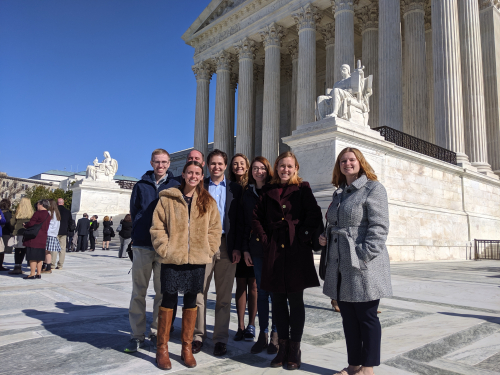
Protip for the public line for SCOTUS arguments: you have to get there really early. As in really early. Before 5 am early. Because that’s the time that we, along with some of our William and Mary Law students (pictured above, after the arguments), arrived at 1 First Street NE to take up our place in line yesterday for the arguments in the Maui Clean Water Act case. And we were — literally — the very last allowed in for the full arguments. We roadtripped it from Williamsburg (more on that in a future post), meaning that we awoke long before 5am, leaving the law school at an ungodly hour. It would have been a shame to have taken all that effort, only to not get in. So heads-up line standers: get there early.

Why all this effort, you may ask? After all, you can read the transcript the same

Continue Reading Hot Take On The Maui Clean Water Act Arguments (Protip: ARRIVE EARLY)

We’re on the road early tomorrow for another visit to SCOTUS with our William and Mary Law School class. We hope to get in for the arguments in the Maui Clean Water Act case. Last year, we attended the first Knick arguments in October, and we wanted to repeat the experience for this year’s students.

Yeah, we know that technically, the CWA case does not involve property or takings. But come on, it’s all we’ve got on the docket right now, and the case is very important to property owners who — if Earthjustice’s arguments are accepted by the Court — will only know if they are liable under the Clean Water Act for not getting a permit after they don’t get a permit. As we see it, the linkage test the respondent has advanced means that if a connection between a no-permit point source of pollution and waters

Continue Reading Road Trip SCOTUS: Maui Clean Water Act Oral Arguments (11/6/2019)

We think the Connecticut Supreme Court’s opinion in Mayer-Whitman v. Zoning Board of Appeals, No. SC 19972 (Nov. 5, 2019) is worth a read, even if it does not break new ground, because it does a good job of explaining some basic principles. 

Quick story: Breunich had a house. It didn’t conform to height, setback, and flood area requirements. That’s because it was build prior to the regulations were adopted. Dirt lawyers call this a “nonconforming use.” Civilians call it being “grandfathered.” Hurricane Sandy damaged the house, but the cost of repairs was more than 50% of the home’s value. And you know what that meant: Breunich could not rebuild without a variance.

He applied for a variance to rebuild the home in pretty much the same configuration it was before, asserting hardship because it would be impossible for the building to conform to both the height above-flood requirements

Continue Reading Connecticut: “Hardship” For Variances Means Inverse Condemnation

Registration underway, so come join us! Agenda full of hot topics in takings and appraisal law! The best national faculty! Renew friendships, and make new colleagues! And Nashville! 

Download the brochure and make your plans for January. (Don’t wait, we’ve sold out the past three years.)Continue Reading Register Now! ALI-CLE Eminent Domain And Land Valuation Litigation Conference (Nashville, Jan 23-25, 2020)

Dad was from upstate New York. More correctly, a town literally in both New York and Vermont (the state line runs right through the middle of the burg). His mother’s family were old time rural Vermonters, and he shared many of the stereotypical traits of his people – solid, self-reliant, taciturn. Many questions answered solely with a “yup” or “nope.” 

Romaine Tenney was one of those classic Vermonters. He entered the pages of history more than fifty years ago when, in reaction to the taking of his farm for Interstate 91, he burned his house and farm buildings down, and shot himself. He had nowhere else to go. As author Howard Mansfield puts it:

Tenney was that farmer by the road tourists used to stop and talk to as they sought out a specific kind of Vermont experience.

“Romaine himself, personally, he never went to town meeting, he didn’t write

Continue Reading A Permanent Memorial To Romaine Tenney, Vermont Eminent Domain Victim

Here’s a two-fer that covers very difficult and unsettled subjects in takings law: judicial takings and rent control. 

In this cert petition, New York property owners assert that the New York Court of Appeals (the state’s highest court for those of you who do not watch Law & Order (dun-dun)), took private property when the court held that the petitioner’s apartments are governed by the Rent Stabilization Law.

That holding subjected luxury apartments that were never formerly governed by rent control to the tenant’s power to renew less-than-market rent in perpetuity. The petition asserts that before the Court of Appeals’ ruling, “It was settled as a matter of New York law and practice … that Section 421-g property was eligible for luxury decontrol[.]” Pet. at 35.

Here are the Questions Presented:

In Stop the Beach Renourishment, Inc. v. Florida Department of Environmental Protection, 560 U.S. 702

Continue Reading New (Judicial Takings!) Cert Petition: NY Court Took Property When It Disallowed Deregulation Of Luxury Rent Controlled Apartments

EXHIBIT A

We’re back again at that supposed distinction between the police power and the eminent domain power, which reminds us of that old tale about President Lyndon Johnson:

After reviewing a contingent of Viet Nam-bound Marines in California, Lyndon Johnson strode purposefully toward what he thought was his helicopter. “That’s your helicopter over there, sir,” said an officer, steering the President toward a different craft.

“Son,” replied Johnson evenly, “they are all my helicopters.”

Well, it’s all government power. 

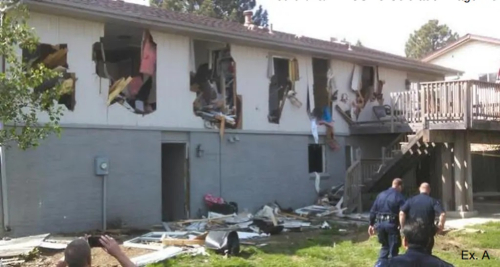
But not to the Tenth Circuit, which in this unpublished order concluded that when local SWAT teams destroyed an innocent family’s house to dislodge a fleeing suspect who had for hours holed up there and taken shots at the police, it wasn’t a taking because, guess what, the police were not exercising eminent domain power, it was the police doing what police do.

The Tenth Circuit relied on the fact that

Continue Reading CA10: SWAT Attack On Home Where Shoplifting Suspect Holed Up Isn’t A Taking

Here’s the other shoe that we’ve been waiting to drop.

Recall that in our last post on the pending Clean Water Act case (SCOTUS oral arguments scheduled for November 6, 2019 – yeah, as in one week from tomorrow), we suspected that a declaratory judgment action would be filed in a Hawaii state court to resolve the internal dispute between the various branches of the Maui County government about which branch(es)’s approval is needed to settle the case. On one side, the Mayor claims that the settlement of the CWA case needs his approval (which he isn’t giving). The Corporation Counsel’s analysis backs his argument up. On the other side, the County Council — which, by a one-member margin voted to settle the case because the CWA plaintiff’s lawyers are terrified of what the Supreme Court might do with the case — who assert that they alone have

Continue Reading Citizens Sue Maui Mayor (Finally) To Force Him To Settle SCOTUS Clean Water Act Case – But Is It Too Late To Scuttle The Arguments?