2020

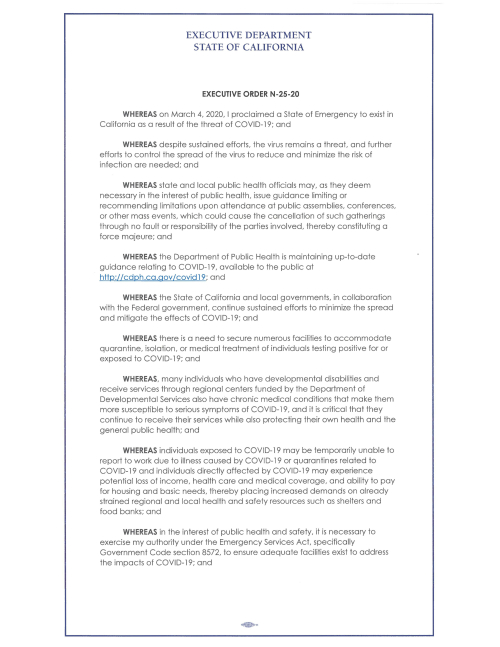
Cal Emergency EO

You remember the TV trope where Starsky, Hutch, or some other police officer is in hot pursuit of a dangerous criminal and flags down a motorist and “commandeers” their private vehicle and drives off?

We thought of that when we were reading the news reports about various governments invoking their emergency powers to respond to the coronavirus crisis. 

So while we were on the telephone on hold (bailing out of every conference, event, and travel arrangement in the foreseeable future), we thought we would take a look at the recent Executive Order, issued by California Governor Gavin Newsom, which expressly mentioned the “power to commandeer [private] property” such as hotels and medical facilities and press them into public service, as needed:

The California Health and Human Services Agency and the Office of Emergency Services shall identify, and shall otherwise be prepared to make available-including through the execution of any
Continue Reading #CoronavirusLaw: Is There A Difference Between “Commandeering” Property In An Emergency, And “Taking” It?

2587424782425260032

A minimum of twenty seconds, they say.

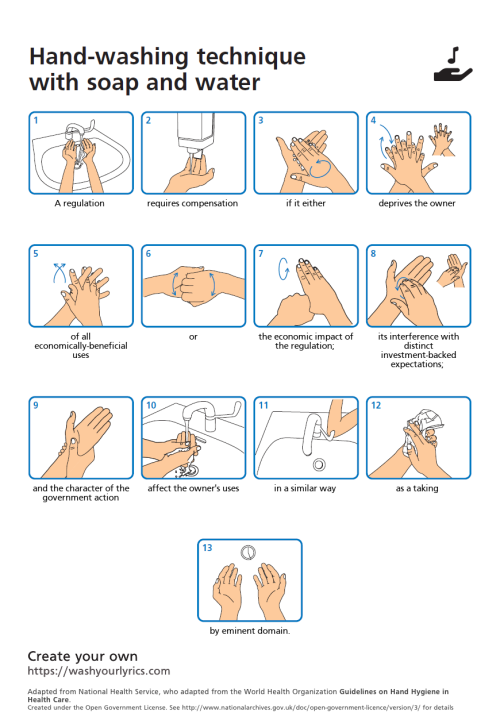
To help you do it right, here’s a mantra / mnemonic for you to say (silently, please) while you accomplish the task.

Keep healthy, everyone! Continue Reading Wash Your Hands!

Here’s the latest in a case we’ve been following that involves a local government prohibiting, via a zoning ordinance, the mining of silica (used as “frac sand”). Kind of like how Pennsylvania barred certain coal mining in our old friend, Pennsylvania Coal Co. v. Mahon, 260 U.S. 393 (1922). 

In Minnesota (where our story takes place) the right to subsurface minerals is separate from the rest of the land. Kind of like how Pennsylvania law recognized subsurface rights as a separate “stick” in Mahon. Here, the plaintiff owned several leases which allow it to mine silica. Sounds like a property interest, no? 

Well, no. At least not to a majority of the Minnesota Supreme Court, which held in Minnesota Sands, LLC v. County of Winona, No. A18-0090 (Mar. 11, 2020) (affirming the court of appeals) that the right to mine silica was a property right, but

Continue Reading Pennsylvania Coal Revisited: Outlawing Silica Mining Isn’t A Taking, Even Though Mining Rights Are “Property” Under State Law

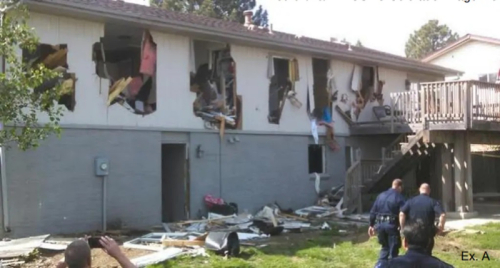
EX A

Here’s the cert petition that we’ve been eagerly waiting to drop in a case we’ve been following (and which gathered a lot of public — and academic — attention and outrage). 

Yes, this is the case where the Village police pretty much destroyed a family home in the course of their efforts to dislodge a shoplifter who had taken refuge there while fleeing. Homeowner sought compensation for a taking. The Tenth Circuit, however, concluded “no taking” because the police were exercising the police power. And you can’t have a taking where the government is exercising the police power.

We were not terribly surprised by the ruling as grossly unfair as it is, because it is pretty typical: customs agents inspect and seize your laptop at the border to check it out but destroy the data on the hard drive? no taking; DEA holds your legal prescription drugs as evidence against

Continue Reading New IJ Cert Petition: Purposely Destroying Your House Could Be A Taking, Even If Govt Was Exercising Its Police Power

As we noted recently, our spring William and Mary Law course is taking a look at the role of property rights in the debates about the ratification of the U.S. Constitution and the political atmosphere from the founding to the Civil War. Being able to studying these subject in Williamsburg is even better, because we’re right in the center of where some of the most important historical events occurred.

But wait, you say, the ratification debates took place in Philadelphia, not peninsular Virginia, so what gives? Our view is that the unsettled question of whether the U.S. Constitution is a pro- or anti- slavery document was not resolved in law until the Civil War, and that the factual debate continues to this day. And the critical events that set the ball in motion took place right down the road from the law school.

First, Point Comfort, the location

Continue Reading “And although they may be poor, not a man shall be a slave” – A Brief Visit To The Birthplace Of A More Perfect Union

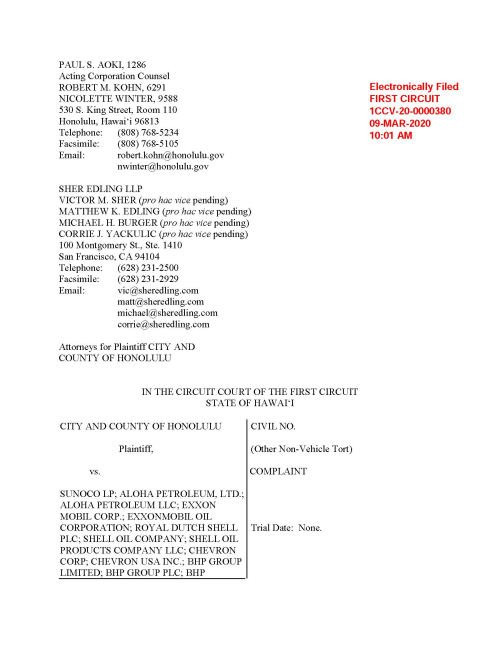
Complaint front page

Make what you will of this 205-paragraph, 114 page (including 128 footnotes) Complaint, filed yesterday by the Acting Corporation Counsel for the City and County of Honolulu and a battery of outside lawyers against gasoline producers, alleging that they are responsible to pay the costs of sea-level rise and other symptoms of what the complaint calls the “climate crisis.”  

It’s a challenging read, but the fun part is in the claims for relief (fast forward to page 99), which include (for you property mavens) nuisance, private nuisance, and trespass (by flooding), as well as affirmative and negligent failure to warn of the dangers of fossil fuel products. 

Will this lawsuit go anywhere? Is a big municipal payday in the cards? Will it get to a local jury? Your guess is as good as ours. But we’ll be following along, for sure.  

Complaint, City and County of Honolulu v. Sunoco

Continue Reading Complaint: Honolulu Sues Gas Companies (For Nuisance) To Recover The Cost Of Sea-Level Rise

Here’s the video of the OA held this morning (March 10, 2020) in a case we’ve been following, about the statute of limitations governing inverse claims. Maryland Reclamation Association filed an regulatory takings claim in 2013, and eventually the jury awarded a whopping $45 million in just compensation and interest. Hartford County asserted the claim was barred by the three-year statute of limitations, and the claim accrued in 2007 when the Board of Appeals administratively denied MRA’s variance request. 

The Maryland Court of Special Appeals concluded that “An inverse condemnation claim ‘accrues when the affected party knew or should have known of the unlawful action and its probable effect.'” Okay, the County responded, MRA discovered the County’s conduct in 2007 when the Board denied the variances. In response, MRA asserted that the taking must become “permanent or stabilized,” and that didn’t occur until the court of appeals affirmed the

Continue Reading Maryland Court Of Appeals Considers Statutes Of Limitations In Inverse Condemnation: Do Appeals Toll Time?

Here are the final cert-stage briefs in a case we’ve been following for what seems to be a long time.

We say that because we represented the property owner the last time it was up before SCOTUS, when we came tantalizingly close to making the cut

After the Court denied review, the property owner sued the Commission in federal court, asserting that being undercompensated in state court was itself a violation of the U.S. Constitution.

The district court dismissed the case, followed by the Fifth Circuit affirming in Bay Point Properties, Inc. v. Mississippi Trans. Comm’n, 937 F.3d 454 (5th Cir. 2019). The Fifth Circuit held that a property owner who asserted that it was not fully compensated in state court inverse condemnation case, could not then sue the state DOT in federal court for the difference. The reason wasn’t based on the substance of the allegations

Continue Reading Final Cert-Stage Briefs In Case Asking: Does The Self-Executing Just Compensation Clause Abrogate A State’s 11th Amendment Immunity?

ALICLE-tagline-250x90

At the recent ALI-CLE Eminent Domain and Land Valuation Litigation Conference in Nashville, our colleagues, New York’s Jon Houghton and Hawaii’s Dave Day presented a very informative program on litigating regulatory takings cases. Jon is a property owner-side lawyer, while Dave is a Deputy Attorney General who represents the State of Hawaii in such cases. So it was a practical and balanced presentation.

Well, Jon and Dave are taking (pun intended) it to the next level. On Friday, April 24, 2020 at 2-3pm Eastern Time, they will be presenting “Strategies for Litigating Regulatory Taking Cases” in a webinar produced by ALI-CLE. This isn’t simply a repeat of their Nashville program, but they will be exploring in more detail the practicalities of building and defending these difficult cases. 

Here’s the description of the program:

The U.S. Constitution provides that private property may not be taken for public use


Continue Reading Mark Your Calendars (Friday, Apr 24, 2020): ALI-CLE Webinar – Strategies for Litigating Regulatory Taking Cases

Here’s the latest in a case we’ve been following.

No. 52 Maryland Reclamation Associates, Inc. v. Harford County, Maryland

Issues – Constitutional Law – 1) Does a takings claim under the Maryland Constitution accrue at the time of a stayed administrative decision or at the time of a final judicial decision affirming that result? 2) May a regulatory taking become permanent and stabilized before a court of proper jurisdiction determines the validity of the regulation effecting the taking? 3) Should Petitioner’s takings claim be dismissed based on Petitioner’s failure to raise this constitutional issue in any administrative proceeding? 4) Did the decision of the Harford County Board of Appeals prohibiting a proposed use of Petitioner’s land to protect the public constitute a taking for which compensation is due? 5) Does the jury’s damages award as compensation for an unconstitutional taking contravene Maryland law when the damages are not the fair

Continue Reading Upcoming Arguments In Maryland Takings Case – 10am ET, Tuesday, March 10, 2020