2020

You recall that a short while ago, in Oil States Energy Servs., LLC v. Greene’s Energy Group, LLC, 138 S. Ct. 1365 (2018), the Supreme Court held that patents are a form of “public property” (more like a government-created entitlement), and thus Congress can withhold the usual Article III tribunal and a jury when the validity of that property is challenged. The majority held that “inter partes review,” under which the Patent and Trademark Office administratively reconsiders (and may cancel) previously-issued patents, does not run afoul of the Constitution because a patent is a “public right,” and therefore more like a grant of a franchise than classic common law property.

Although the Court validated inter partes review, it left open the question of whether a patent owner who has her patent (in thousands of cases, these patents were issued before inter partes review was adopted) invalidated via
Continue Reading New Cert Petition: Are Patents “Property” Protected By The Takings Clause (Is Inter Partes Review A Taking)?

IMG_20200303_191820

We just completed a fun hour-long talk with the students in the William and Mary Law School’s American Constitution Society, the Native American Law Society, and the Society on Environmental and Animal Law about the various pipeline cases that are ongoing nationwide. (If our tech worked, we shall post the audio recording in a future post.)

The theme of our talk was that these cases are an excellent illustration of the need for lawyers to think outside their usual lanes when it comes to addressing and solving their clients’ problems, because they present a smorgasbord of legal issues that range from property and eminent domain law, to administrative law, constitutional law, state and local government law, environmental law, federal courts, and civil procedure. 

The lawyers who are litigating these cases have done a good job of not being bound by convention and thinking creatively. They are thankfully analyzing the cases

Continue Reading Cases And Materials From Today’s WM Law ACS Talk: “Pipelines at the Intersection of Environmental, Administrative, and Property Law: How Divergent Interests Joined Forces To Challenge Big Energy”

IMG_20200220_054717

Update: here’s a report (video included!) about our spring “field trip” to what arguably is the birthplace of a “more perfect union” (which just happens to be right down the road from William and Mary Law School).

********

This semester, we’re teaching a short course at William and Mary Law School (and yes, thanks to a willing administration and student body, we will be back in the fall for the “big” Eminent Domain and Property Rights course). 

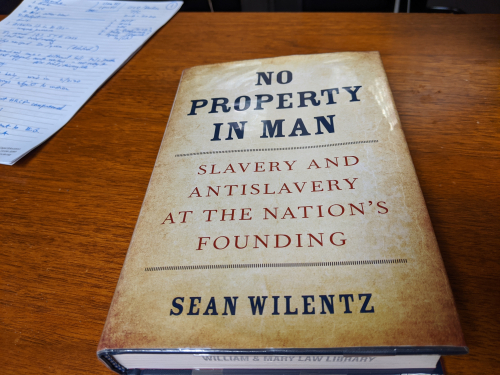
The title of the spring class is “No Property in Man: Slavery and Antislavery at the Nation’s Founding,” and the focus of the course is the book by Princeton historian Sean Wilentz from which we filched our title. Professor Wilentz’s book is a recounting of the debates surrounding the ratification of the U.S. Constitution and the political atmosphere from the founding until the Civil War.

When we read it last year

Continue Reading William & Mary Spring Course: “No Property in Man” – Slavery And Property Rights

Here’s the latest episode of Clint Schumacher’s Eminent Domain Podcast. Featuring an interview with the Institute for Justice’s Robert McNamara about an eminent domain case we’ve been following, Woodcrest Homes, Inc. v. Carousel Farms Metro. Dist., No. 19-607 (cert. petition filed  Nov. 7, 2019). Also included, a short talk with Delia Root, a William and Mary Law student who attended the Nashville ALI-CLE Eminent Domain conference

Check it out. Continue Reading Latest Ep. Eminent Domain Podcast: Carousel Farms Cert Petition, William & Mary Law

RF

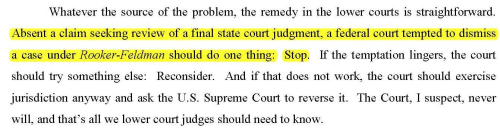
After the recent demise of Williamson County‘s state procedures requirement, we’ve been looking at other ways in which takings claims raised in federal courts may be challenged. You know, things like the Eleventh Amendment, the still-valid final decision rule, full faith and credit and res judicata, and our old favorite obscure legal doctrine, Rooker-Feldman. Especially in the context of judicial takings

You remember the Rooker-Felman doctrine (named after the two Supreme Court decisions which defined its contours), right? All it says is that U.S. District Courts do not have appellate jurisdiction to review final judgments of state supreme court. That’s it. But thanks in part to an article by a law school mentor of ours (Williamson B.C. Chang, Rediscovering the Rooker Doctrine: Section 1983, Res Judicata and the Federal Courts, 31 Hastings L.J. 1337 (1980)), the doctrine was read much more

Continue Reading Sixth Circuit Reminds Us That Rooker-Feldman Does Not Limit Judicial Takings Cases

The local government does stuff that local governments do. Things like improve nearby roads. In doing so, they often interfere with the ingress and egress that nearby landowners enjoy. 

In Clark v. City of Pembroke Pines, No. 4D18-3549 (Feb. 26, 2020), the city had many reasons for erecting concrete barriers (among them the closure of nearby roads). But the end result was that access to Clark’s parcel (which happened to be over the city line, in an adjacent town) was partially (but not totally) cut off:

Before the City’s road construction, Clark had unrestricted access to SW 54th Place in front of his home. Afterwards, he said the barriers significantly impeded his travel because with them in place, Old SW 54th Place effectively became a “one-way, ten-foot-wide road” with no room for vehicles to turn around. Additionally, Clark’s only direct means of east and southbound travel—via SW 199th Ave—was

Continue Reading Substantial Loss Of Access — Even If Not Total — Is A Taking

A super short one (a hair over 4 pages) from the Massachusetts Supreme Judicial Court.

In Gentili v. Town of Sturbridge, No. SJC-12810 (Feb. 24, 2020), the court made short work of a property owner’s claim that an earlier Land Court verdict concluding that the town had obtained a prescriptive easement to discharge storm water on the property was a taking requiring compensation. The Land Court concluded that the fact that the town had been discharging the water since 1987 meant that it had gained an easement to do so (think public adverse possession). Instead of appealing the Land Court’s conclusion about the prescriptive easement, the owners sued in state court for compensation. 

No deal, held the SJC. The Land Court’s order recognizing the easement wasn’t a statutory “order of taking.” Nor did the easement itself amount to a taking — even though a discharge of water on someone’s land

Continue Reading Mass: No Takings Claim For Flooding Because Owner Let It Happen For A Long Time

Peasants carousing

The last two cert-stage briefs have been filed in a case we’ve been following for a while (since it was decided by the Colorado Court of Appeals). 

In Carousel Farms Metro. Dist. v. Woodcrest Homes, Inc., 444 P.3d 802 (Colo. App. 2017), the appeals court invalidated an attempt to exercise eminent domain to take property which the owner had refused to sell to developer Carousel Farms. Although the Carousel Farms Metropolitan District couldn’t point to a present public use or benefit from the taking, it asserted that in the future the public would benefit from the condemnation because if Carousel Farms were allowed to develop its property in accordance with its agreement with the town, the public would receive new infrastructure such as roads and sewers. The trial court upheld the taking, but the court of appeals reversed. The real purpose of the taking was to facilitate the developer’s

Continue Reading Carousing at Carousel Farms: Final SCOTUS Cert-Stage Briefs In Colorado Eminent Domain Abuse Case

20180805_155740_HDR
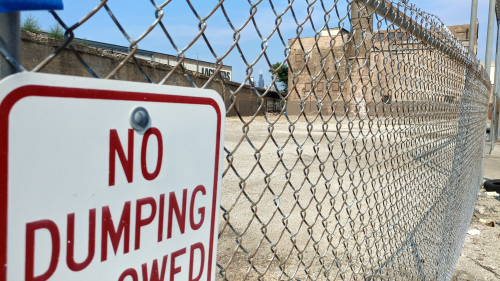
Where is this? The clues are all in the picture. 

You’ve seen the citation so many times, your eyes probably gloss over it. After all, Westlaw lists it with 4,507 “Citing References.” That’s a heckuva lot of citations to a single case. 

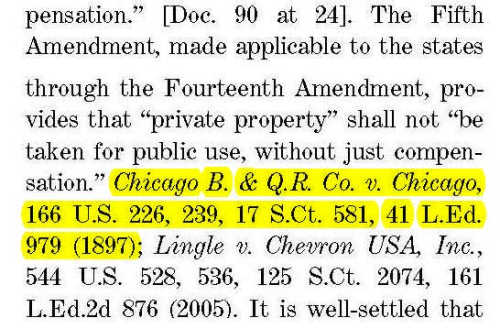
Like this one, pulled from a recent random federal district court opinion: 

Chcago cite

And we admit that we’ve done it: cited (but didn’t read) Chicago B. & Q.R. Co. v. Chicago, 166 U.S. 226 (1897) for the proposition that the rights in the Bill of Rights (in that case, the Fifth Amendment right to Just Compensation) have been selectively incorporated against states and local governments under the Due Process Clause of the Fourteenth Amendment. You’ve done it. We’ve all done it. 

To cure that shortcoming, we read and analyzed the case in our William and Mary class. And before we included it in the syllabus, we had

Continue Reading Just Compensation Site Visit: The First Right “Incorporated” Against States, And Local Govts

We were all set to take a deeper dive into the Court of Federal Claims’s recent opinion in the “downstream” Harvey flooding cases (we could not do so at the time the opinion was issued last week because we were tied up doing real lawyer stuff), when our Reno, Nevada colleague Steve Silva (who most recently was on the faculty at the ALI-CLE Conference in Nashville) beat us to the punch.

On his Taking Nevada blog, Steve has posted “Major flood decision in Texas turns on Divine Intervention” —

Analyzing and comparing tort to taking is difficult. A tort is generally seen as something wrongful. A private injury committed by one person against another. A classic “taking” by exercising the power of eminent domain in direct condemnation to acquire land and pay compensation is not a wrongful act. It merely is.

Further complicating things, the clearest

Continue Reading Steve Silva (Taking Nevada) On Flood Takings, Torts, And Tortes