In case you missed it live, here’s the recording of the recent one-hour program on “The Future of Regulatory Takings at the Supreme Court,” featuring our colleagues Joshua Thompson (Pacific Legal Foundation) and Paul Utrecht (Utrecht & Lenvin, LLP), with Jim Burling (PLF) moderating.

The program discussed Cedar Point Nursery v. Hassid, Knick v. Township of Scott, and Pakdel v. City and County of San Francisco and what might be on the horizon.

If you are a takings nerd, a must-listen.Continue Reading Watch: “The Future of Regulatory Takings at the Supreme Court”
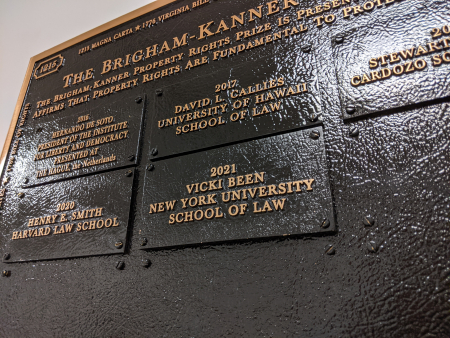
PXL_20210920_195630876

There’s still plenty of time to register and join us for the 18th Annual Brigham-Kanner Property Rights Conference at the William and Mary Law School, Thursday and Friday, September 30 and October 1, 2021.

Yes, you may attend in-person, or remotely. The registration fees are very reasonable, ranging from $0 (yes, free!) to $200 (go here, and click “Tickets” for the details).

This year’s Brigham-Kanner Property Rights Prize winner is Professor Vicki Been (NYU Law). The Conference includes presentations on:

  • Remembering Toby Brigham
  • The Role of Empirical Research in Defining the Scope of Constitutionally Protected Property Rights: A Tribute to Been
  • The Relationship between Eminent Domain and Social and Racial Injustice (this is the panel on which we’ll be presenting)
  • Just Compensation Issues, Changing Public Uses, and Other Recent Developments
  • The Interdependence of Property and First Amendment Rights
  • The Distributional Implications of Land Use Regulation

Details on

Continue Reading 2021 Brigham-Kanner Property Rights Conference (Sep. 30 – Oct. 1, 2021) – Still Time To Join Us

Check this out. A short online comment at the Yale Journal on Regulation by Judge Thomas Griffith, “A New Test Or Merely A New Name For Some Regulatory Takings?

The comment addresses the notion that the Supreme Court in Cedar Point shuffled up takings doctrine:

Much of the commentary about the Supreme Court’s recent decision in Cedar Point Nursery v. Hassid, 141 S. Ct. 2063 (2021), has focused on its implications for labor law. Yet some of the Chief Justice’s language in the majority opinion suggests a substantial reworking of the Court’s approach to “regulatory takings”—an area that the Court has acknowledged to be “a problem of considerable difficulty.” A close read of the opinion, however, suggests that even though Court may have reshuffled the categories it has used in the past to analyze takings claims, the law remains largely unchanged, if not slightly more obscure.

Continue Reading New Comment: Cedar Point – “A New Test Or Merely A New Name For Some Regulatory Takings?”

On one hand, the U.S. Court of Appeals’ opinion in Buending v. Town of Redington Beach, No. 20-11354 (Aug. 20, 2021) is not a big deal, at least in terms of the issue in the case: did the Town take the plaintiffs’ private beach property when it adopted an ordinance allowing the public to use it? Maybe it did, maybe it didn’t. The opinion simply vacates the district court’s grant of summary judgment to the property owners because there are disputed issues of fact on the Town’s affirmative defense of customary use. The district court concluded the Town could not raise the customary use defense.

The Eleventh Circuit, however, held that the Town was not precluded from raising the defense that the property the plaintiffs claimed was exclusively private was also subject to the public’s use under longstanding custom, and that the Town’s opposition to the plaintiff’s motion for

Continue Reading CA11: No Summary Judgment For You On Takings Claim When Town Provided Some Evidence Of Public Customary Use Of Beach

All the topics you want to know about, presented by top-notch faculty from across the nation. Sessions include:

  • Keynote: Do Animals Have Property Rights?
  • Did the Supreme Court Signal a New Direction in Property Rights in Cedar Point Nursery?
  • Maximizing Relocation Benefits: Understanding the Law and Regulations to Ensure Fairness
  • Challenging Public Use: Lessons From a 67-Day Trial
  • COVID Takings
  • Property Rights as Civil Rights
  • Eminent Domain National Update
  • Federal Court and the Daubert Challenge: How to Prepare
  • How to Position Your Client for the Fallout When Projects Don’t Get Built
  • Rural Broadband and the Emerging Constitutional Challenges
  • Are Precondemnation Entry Statutes Still Valid After Cedar Point Nursery?
  • How Condemnor and Property Owners’ Counsel Prepare the Battlefield
  • How Will the Trillion Dollar Infrastructure Bill Impact Your Practice?
  • Ethics
  • …and more, including a full slate of networking and social events!

We’ve sold out the last few years, so don’t Continue Reading Registration Open Now: ALI-CLE Eminent Domain & Land Valuation Litigation Conference, Jan 26-29, 2022, Scottsdale

Screenshot 2021-08-08 at 23-55-14 The Dawn of a Judicial Takings Doctrine em Stop the Beach Renourishment  Inc v Florida De[...]

Here’s what we’re reading today, a recently-published law review article by Brendan Mackesey, The Dawn of a Judicial Takings Doctrine: Stop the Beach Renourishment, Inc. v. Florida Department of Environmental Protection, 75 U. Miami L. Rev. 798 (2021). 

Here’s the Abstract:

In Stop the Beach Renourishment v. Florida Department of Environmental Protection, 130 S. Ct. 2592 (2010), the U.S. Supreme Court granted certiorari to determine whether the Florida Supreme Court had violated a group of littoral property owners’ Fifth Amendment rights—or committed a “judicial taking”—by upholding the state of Florida’s Beach and Shore Preservation Act. Under the Act, the State is entitled to ownership of previously submerged land it restores as beach; this is true even though the normal private/state property line, the mean-high water line, is moved seaward, and the affected littoral owner(s) lose their right to have their property about the water. Although a four-justice plurality

Continue Reading New L Rev Article: “The Dawn of a Judicial Takings Doctrine: Stop the Beach Renourishment v. Florida Department of Environmental Protection,” 75 U. Miami L. Rev. 798 (2021)

Screenshot 2021-08-11 at 14-56-53 Constitutional Litigator Property Rights (two openings) Pacific Legal Foundation

You’ve got big dreams, you want fame…

If so, here’s your chance: two (2!) Takings Maven Dream Jobs® are now available.

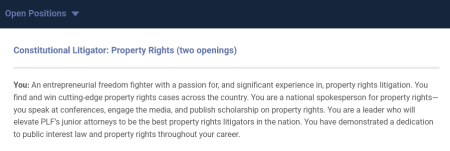
Pacific Legal Foundation requesting applications for positions as a Property Rights Constitutional Litigator. Job description includes “You will find and win the next important Supreme Court property rights case.”

Oh, have we got your attention now?

You: An entrepreneurial freedom fighter with a passion for, and significant experience in, property rights litigation. You find and win cutting-edge property rights cases across the country. You are a national spokesperson for property rights—you speak at conferences, engage the media, and publish scholarship on property rights. You are a leader who will elevate PLF’s junior attorneys to be the best property rights litigators in the nation. You have demonstrated a dedication to public interest law and property rights throughout your career.

You will be a leader in PLF’s

Continue Reading Takings Maven Dream Job® (x2): Property Rights Constitutional Litigator at Pacific Legal Foundation

The hits keep coming. There have already been complaints alleging takings against the feds for the CDC eviction moratorium, and against the State of California for its moratorium. 

Now this, a complaint against the City of Angels alleging that its version of the moratorium works a taking, either a per se physical invasion taking, a regulatory taking, and a taking under California law.  

Not much more to say about it, unless you want to check out the LA Times’ report on the filing, “Landlord sues L.A. for $100 million, saying anti-eviction law caused ‘astronomical’ losses.”

Barista’s note: sorry about the potty-mouth movie clip at the top, but we’ve always thought this character’s sardonic comment about an ongoing situation (the 1968 Tet Offensive) really encapsulated the burden-spreading vibe of Armstrong v. United States, 364 U.S. 40, 49 (1960) (“The purpose of the Takings Clause is to “bar

Continue Reading New Complaint: LA’s Eviction Moratorium Is A Taking

Untitled Extract Pages

Here’s what we’re reading today. And this is one of those articles that you should not miss.

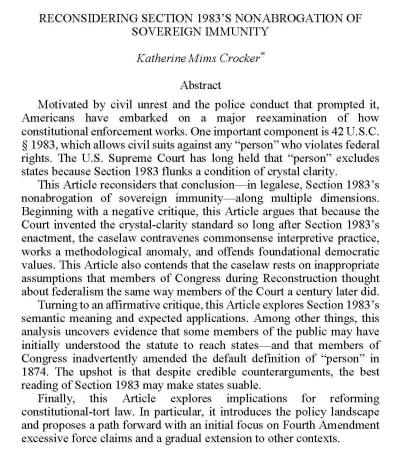
Our W&M colleague Katherine Mims Crocker has published “Reconsidering Section 1983’s Nonabrogation of Sovereign Immunity,” 73 Fla. L. Rev. 523 (2021).

Why is this a “must read” you ask? Because Professor Crocker concludes, “[t]he preceding Parts have revealed substantial arguments for reading Section 1983 to abrogate sovereign immunity, which would make state governments susceptible to damages actions for violating constitutional rights.”

There’s not a mention of our friend the Takings Clause in the article (it focuses mostly on excessive force cases), but it doesn’t take much to see how the analysis Prof Crocker sets out can include section 1983 takings claims.

Here’s the Abstract:

Motivated by civil unrest and the police conduct that prompted it, Americans have embarked on a major reexamination of how constitutional enforcement works. One important component is

Continue Reading New Must-Read Article: Katherine M. Crocker, “Reconsidering Section 1983’s Nonabrogation of Sovereign Immunity,” 73 Fla. L. Rev. 523 (2021)

The U.S. Court of Appeals for the Fourth Circuit’s opinion in Zito v. N.C. Coastal Resources Comm’n, No. 20-1408 (Aug. 9, 2021) is just the latest in a growing list of decisions about an issue we’ve been following (see here, here, here, here, and here for example), including the District Court’s decision in this very case.

That issue is whether a property owner can sue a state for just compensation for a taking in federal court.

You know how that works. Knick held that local governments and officials can be sued in federal court for violating the federal constitution and for civil rights violations. Check. But it didn’t expressly say anything about whether there’s something different about a state or a state official (in their official capacity) that prohibits the same thing. After all, the Eleventh Amendment has been interpreted, it prohibits federal court

Continue Reading CA4 Tells Landowner To Beat It (From Federal Court): 11th Amendment “Sovereign Immunity” Bars Suing State For Fifth Amendment Compensation In Federal Court