Here’s one, just issued by the U.S. Court of Appeals for the Eleventh Circuit.

We’ll let you read the opinion in Chmielewski v. City of St. Pete Beach, No. 16-16402 (May 16, 2018), for the full story, but to get you started, here’s the summary: the court affirmed a jury verdict in favor of a property owner who asserted that the City’s invitation to the public to permanently and continually access the adjacent beach via a private parcel, was a physical taking.

The short story is that the Chmielewskis owned a beach parcel in a subdivision, and earlier had sought to quiet title against the City which owned several other parcels within the subdivision. As part of the settlement of that action, the City agreed “that its [the City’s] ownership of five lots in the Subdivision did not give the general public the right to use Block M, including
Continue Reading 11th Cir: City Inviting Public To Access Beach Across Private Land Is Inverse Condemnation

You might not think that the conclusion which the U.S. Court of Appeals for the Tenth Circuit reached in M.A.K. Investment Group, LLC v. City of Glendale, No. 16-1492 (May 14, 2018) would be all that controversial: when private property is declared by a municipality to be “blighted” and subject to redevelopment (and eminent domain), the municipality needs to tell the owner about it, even if the taking may occur somewhere down the road. But apparently it was not obvious, for it took years of litigation to figure it out.

Colorado’s urban renewal statute permits local governments to designate private property as blighted (by looking at eleven factors), take it any time within the next seven years, and transfer the land to a new private owner. An owner has a very short time window — 30 days — to challenge the blight determination by filing a lawsuit in a Colorado

Continue Reading 10th Cir: When City Declares Property Blighted And Subject To Condemnation, It Must Tell The Property Owner

Here’s what we’re reading today:


Continue Reading Monday Readings: South Africa Takings, Redevelopment, Metes and Bounds, And More

20180419_150416_HDR

We’re in Detroit the rest of the week at the Mercy Law School for the venerable Land Use Institute, now in its 32nd iteration.

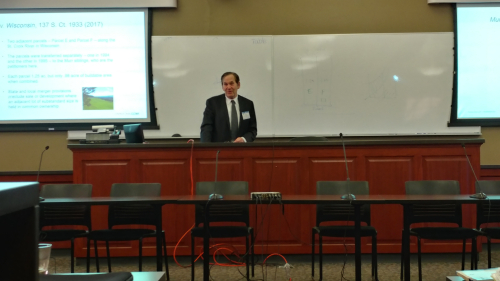
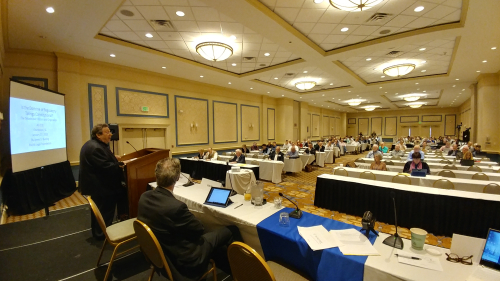
Planning Chair Frank Schnidman has assembled a great faculty including out Detroit colleague Alan Ackerman (above, talking about takings liability for flooding), and we’ll be spending the time talking inverse condemnation, public trust, planning law, homelessness, autonomous vehicles, affordable housing, RULIPA, and similar topics. We’ll be presenting on “Eminent Domain, Vested Rights, and Regulatory Takings,” “Client Representation: Developer, Government, and Citizens Groups,” and “Federal Laws Affecting Local Land Use Decision Making.” 

If you are here with us in Detroit, stop by and say hello. If you aren’t here, shame on you! This is one of the best and most affordable tuition deals in CLE.

But all kidding aside, if you are not in Detroit now, be sure to calendar these

Continue Reading Land Use Institute – Detroit

Here is the video of last Friday’s oral arguments in a case we’ve been following, in which the owners of a mobile home park successfully challenged a California municipality’s rent control ordinance as a taking.

In Colony Cover Properties v. City of Carson, a U.S. District Court for the Central District of California jury awarded the park owner just compensation, concluding that under Penn Central, the rent control ordinance was a compensable taking. The total award to the park owner, including damages for lost rental income, attorneys’ fees, and interest, was over $9 million. As far as we can tell, this is the first case in which a mobile home park owner has succeeded in obtaining compensation for a taking for rent control.

Predictably, the city went ballistic, and its brief in the Ninth Circuit argues the City is the aggrieved party:

In April 2006, Plaintiff Colony Cove

Continue Reading Video: Ninth Circuit Penn Central Oral Arguments

20180127_091506_HDR

We’re on our third day at the 2018 ALI-CLE Eminent Domain and Land Valuation Conference in Charleston, SC, and as usual, we’re having our headline presentations by takings guru Michael Berger (pictured above), who is updating us on the most interesting and important cases of the past year, and Jim Burling, who will be answering the question, “Should We Rethink Regulatory Takings Law? The Takings Clause, Privileges and Immunities, and Due Process.”

DUjbnOtV4AEgwXW.jpg large

Here are links to the

Continue Reading ALI-CLE Eminent Domain Conference, Third Day: Berger And Burling On Takings

In Cappel v. Nebraska Dep’t of Natural Resources, No. S-16-1037 (Dec. 22, 2017), the Nebraska Supreme Court concluded the Department’s notices to Cappel pursuant to an interstate water compact which closed off his land’s ability to draw surface water from the Republican River for irrigating his crops was neither a physical nor regulatory taking. 

As you might expect, the central takings question which the court addressed was whether Cappel’s water allocations were “property.” The court held that because the closing notice was made pursuant to the Department’s obligations under the compact, “the water rights at issue were not a compensable property interest and the Cappels’ physical taking argument must fail.” Slip op. at 454. The court also dispensed with the regulatory takings claim by applying the Penn Central test. And you know what that means. 

Here’s the money quote, which reveals the court’s essential problem with the takings claims:

Continue Reading Nebraska: No “Property” In Water Rights Subject To Interstate Compact

IMG_20171211_090714This photo of the view from the lectern at the start of the day
proves we really
were in the room and not distracted by all the distractions
possible in Las Vegas

Here are the materials and cases which I spoke about earlier today at the CLE International Eminent Domain Conference in Las Vegas. I had the lead off session on updates, and my talk focused on cases that I didn’t cover in the written materials:


Continue Reading Links And Materials From Today’s Las Vegas Eminent Domain Conference

The title of West Virginia Lottery v. A-1 Amusement, Inc., No. 16-1047 (Nov. 13, 2017) alone may not give you an indication that this is a takings case, but yes, it’s a takings case. 

As the title might indicate, it’s a case involving the state-run lottery and video lottery machines. If we’re reading the details right, the lottery issued permits to the plaintiffs, after which they were instructed to use a different software program, and informed that using any other software would render their machines illegal. The amusement companies were not prepared to retool (they’d have to buy new machines, they alleged), and brought regulatory takings, due process, and civil conspiracy claims. 

The trial court refused to dismiss the complaint, concluding that damages for the takings and due process claims could not be limited to the lottery’s insurance policy limits, and that the lottery had waived its sovereign

Continue Reading West Virginia: Takings Clause Protects More Than Just Land – Owners Of Personal Property Can Bring Inverse Condemnation Claims

The Georgia Supreme Court’s analysis in Diversified Holdings, LLP v. City of Suwanee, No. S17A1140 (Nov. 2, 2017) reminded us of that old trope from logic, “no true Scotsman.” 

According to a completely reliable source (Wikipedia):

No true Scotsman is a kind of informal fallacy in which one attempts to protect a universal generalization from counterexamples by changing the definition in an ad hoc fashion to exclude the counterexample. Rather than denying the counterexample or rejecting the original claim, this fallacy modifies the subject of the assertion to exclude the specific case or others like it by rhetoric, without reference to any specific objective rule (“no true Scotsman would do such a thing”; i.e., those who perform that action are not part of our group and thus criticism of that action is not criticism of the group).

(And, in case you were wondering, “For the practice of

Continue Reading Georgia: No True Taking – Challenge To City’s Refusal To Rezone Isn’t Really Inverse Condemnation