What do takings mavens think about when they hear “New York City” and “takings?” Probably the granddaddy case of them all, Penn Central. Or maybe Courtesy Sandwich Shop, or Loretto. All good ones, landmarks. 

But this post isn’t about a visit to the sites of those cases (not to worry, we’ll get to Grand Central soon), or even about a matter that ended up in the official reports, but about a New York eminent domain story that has been more lost to time, and which is now being rediscovered and recognized. It’s a visit to Seneca Village.

20170813_151125

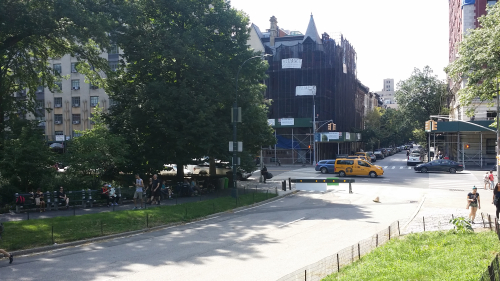
You wouldn’t know it today, but just inside the boundary of what is now Central Park, right near the West 85th Street entrance, once was “the largest community of free African-American property owners in antebellum New York.”  Beginning in 1825, this locale was home to up to 250 residents in 70

Continue Reading New York City Takings Pilgrimage, Central Park Edition

The Connecticut Appeals Court’s opinion in Stones Trail, LLC v. Town of Weston, No. AC 38078 (July 18, 2017), does not offer a lot in terms of substance — it holds that a property owner’s regulatory takings claim based on the Town’s approval of what the owner thought was a subdivision was not ripe because the owner had not actually filed a subdivision request — but the facts are interesting nonetheless:

The plaintiff had purchased the property with the purpose of dividing it into six buildable lots. Before the closing of the purchase, the plaintiff submitted three maps of the property to the town. The town’s attorney determined that the property depicted on one of the maps was not a subdivision, and that map was stamped accordingly and filed in the town land records. Thereafter, the other two maps, which altered the lot lines of the property to depict

Continue Reading After A Plaintiff Jury Verdict (And Rejection Of Town’s Four Previous Motions Over Nine Years), Takings Claim Held Not Ripe

The Township of Scott, Pennsylvania, apparently has a problem of unregulated cemeteries. Who knew?

So it did what local government do when they think they have a problem, it passed a law. That law, Ordinance 12-12-20-001, required owners of all cemeteries, public or private, to maintain them. The ordinance also contained two troublesome provisions. First, it requires the owners of the cemeteries to keep them open to the public during the day. Second, it allows the Township’s code inspectors to enter “any property” to inspect and see if it is in compliance with the ordinance.  

Under the authority of the ordinance, a code inspector came on Knick’s property without a warrant, and told her “guess what, these stones are actually grave markers, and you better clean up this cemetery.” Knick’s response was “what cemetery? My land doesn’t have a cemetery on it.” Not buying it, the inspector wrote

Continue Reading Night of the Living Zombie Zoning Inspectors – Ordinance Allowing Searches For Unauthorized Cemeteries “Constitutionally Suspect,” But Not Yet Justiciable

You heard that right. After the Michigan Court of Appeals’ recent ruling in Lanzi v. Township of St. Clair, No. 329795 (May 23, 2017), you should consider skipping the usual Williamson County step of filing your federal takings claims in state court.

In that case, property owners sued the township after the township’s sewage system broke down and backed up grey water into the plaintiffs’ basement. They brought a complaint in Michigan state court alleging both negligence and a physical invasion taking. The township alleged it was immune by statute from such suits. The trial court rejected the argument and the township appealed. 

The court of appeals reversed on the negligence claim, agreeing with the township that it was immune because it had taken reasonable steps to repair any defects in the sewer system. We’ll let you read that part of the opinion if you’re interested.

What got us

Continue Reading Michiganders: Go Ahead, File Your Federal Regulatory Taking And Inverse Condemnation Claims In Federal Court

Facepalm

We all have had those moments, haven’t we?

Today’s linked story is more land-usey than eminent domain-ey, but still interesting for you condemnation lawyers on the line (besides, condemnation lawyers really do have to know land use law, don’t they?).

Honolulu can is a tough place to be, with our status as one of the most expensive places in the world to live, and the high cost of housing is one of the prime reasons for that. In Honolulu Civil Beat, Stewart Yerton has a story on the legal risks triggered when a City Council member suggested that the council might deny development permits if the permitted condos were sold to Chinese nationals instead of local residents. 

In “Opposition To Foreign Condo Sales Raises Legal Questions,” In addition to national experts on such things like Professor Eugene Volokh, the article quotes us about those times we have

Continue Reading Land Use Facepalm

We don’t usually post unpublished opinions, but the Fourth Circuit’s recent decision in Clayland Farm Enterprises, LLC v. Talbot County, No. 15-1755 (Dec. 2, 2016), raised some issues worth your time. 

The property owner brought its claim in Maryland state court claiming, among other things, that the County’s two indefinite moratoria on development and sewer availability — which prohibited owners from seeking or obtaining County subdivision — was a facial taking. The lawsuit asserted “the moratorium is facially unconstitutional,” although it’s not clear from the majority opinion what remedy the complaint sought. 

The County removed the case to federal court and moved to dismiss. The district court granted the motion, because “[i]t is beyond the province and competence of this court to make zoning decisions[.]” 

The Fourth Circuit reversed. “Count I is a facial challenge to the moratoriums and is thus clearly ripe.” Slip op. at 7. Because a

Continue Reading 4th Circuit (Unpublished): Federal Court Facial Takings Claim Ripe After Removal By Govt To Fed Court

ALI2017 - Copy
ALI2017

We’ve teased some of the details on the 2017 ALI-CLE Eminent Domain and Land Valuation Litigation and Condemnation 101 Conference, to be held at the Westin San Diego, January 26-28, 2017, but here are the details you’ve been waiting for.

This is the “big one,” our annual 3-day festival of all things eminent domain, property, takings, inverse condemnation, and just compensation. Truly national in scope, this is the 34th annual edition, and the one conference you must attend. Our 2016 conference in Austin was one of the best in years, and we’re on the way to replicating it in 2017, with a great venue in an exciting city. 

Look for the web and printed brochures to show up in your mailboxes, but in the meantime, here are some of the highlights (we’ll post more in the next few days):

  • Relocation, relocation, relocation: we are featuring two sessions on this


Continue Reading Details: ALI-CLE Eminent Domain And Land Valuation Conference – San Diego, January 26-28, 2017

 IMG_20160929_102807
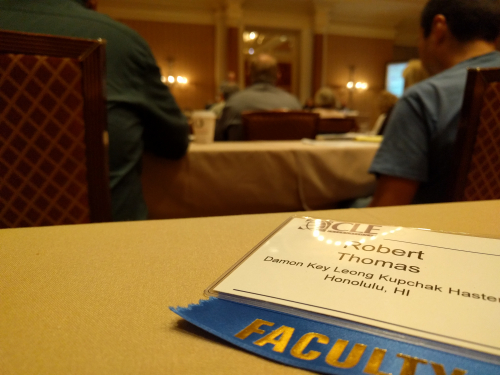
During. Good crowd.

20160929_074511
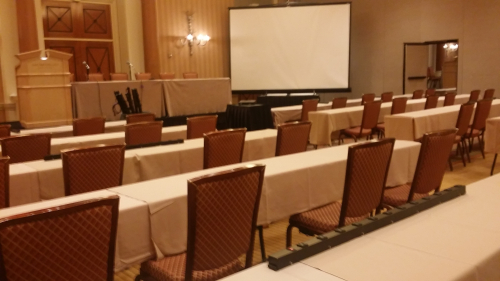
Before. Note the power strips on the tables.
Well played, Caesar’s, well played
.

To supplement your written materials, here are the decisions and other materials which we spoke about this morning at the CLE International Eminent Domain seminar:


Continue Reading Links And Notes From Today’s Las Vegas Eminent Domain Seminar

The issue resolved by the Minnesota Supreme Court in Zweber v. Credit River Township, No. A14-0893 (July 27, 2016) was one that land use lawyers deal with constantly: when an administrative agency is alleged to have violated someone’s constitutional rights, what procedural route must the legal challenge take — is the plaintiff required to go to court via administrative channels, or can she initiate an original jurisdiction (“de novo”) case?

In Zweber, the court came down on the side of original jurisdiction. There, Zweber owned undeveloped land which he wanted to develop, and he submitted a preliminary subdivision plat to divide it up. After a neighbor objected for the usual reasons (traffic), the County approved the plat application. But Zweber didn’t begin development and instead, a couple of years later applied for a new subdivision. “This time, based on the recommendation of the Planning Commission, the County Board denied

Continue Reading Constitutional Property Claims Are For Courts, Not Agencies

A new(er) law review article, worth reading, from Dean Shelly Saxer, “When Local Government Misbehaves,” 2016 Utah L. Rev. 105 (2016). Here’s the abstract:

In this article, Dean Saxer examines the Supreme Court’s decision in Koontz v. St. Johns River Water Management District. In that land use case, the Court held that proposed local government monetary exactions from property owners to permit land development were subject to the same heightened scrutiny test as imposed physical exactions. The Court left unanswered the question of how broadly this heightened scrutiny should be applied to other monetary obligations imposed by the government. Saxer argues that “in lieu” exactions that are individually assessed as part of the permitting process should be treated differently than the impact fees that are developed through the legislative process and are applied equally to all developers without regarding to a specific project. Accordingly, Koontz’s application should be

Continue Reading New Article On Nollan/Dolan/Koontz: “When Local Government Misbehaves”