Programming note: On the day we remember our nation’s war dead, we thought we’d repost this one, about how Arlington National Cemetery came to be, and how yes, there’s a takings story there.

———————————————————
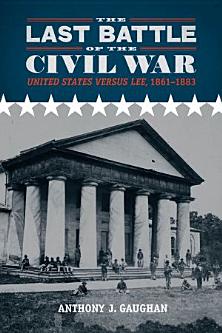
LastbattlebookYou know how we’re always saying that the provisions in the Takings Clause are “self-executing,” that even in the absence of a waiver of sovereign immunity, the Tucker Act, and section 1983, property owners would still be able to maintain a claim for compensation? Well here’s an article that explains that how that rule was first articulated, and not in a dry academic way, but with a fascinating historical story.

It’s the tale of United States v. Lee, 106 U.S. 196 (1882). We knew the land that is now Arlington National Cemetery was once owned by Robert E. Lee, but we can’t say that we gave much thought to how it became public property. We

Continue Reading Memorial Day, Arlington National Cemetery, And Takings

Check out this post (“Did the Sixth Circuit Unintentionally Adopt an RLUIPA Equal Terms Test?“) from RLUIPA gurus Evan Seeman, Karla Chaffee, and Dwight Merriam on their RLUIPA Defense blog, analyzing the Sixth Circuit’s recent opinion in Tree of Life Christian Schools v. City of Upper Arlington, No. 14-3469 (May 18, 2016).

We won’t go into the details because our colleagues cover them pretty well, but wanted to point this one thing out. The issue in the case was whether the city could be held liable under RLUIPA’s “equal terms” provision (which requires local governments to impose land use regulations on religious and nonreligious users on an equal basis), after it refused to allow a religious school to rezone property in an economic development zone to allow the school.

The school didn’t conform to the area master plan, which allowed only uses which would increase the government’s

Continue Reading 6th Cir: Avoid Your RLUIPA Problems By Condemning Church-Owned Property, Then Selling It “to a buyer that the government thinks offers superior economic benefits”

Here’s a new cert petition, seeking SCOTUS review of an unpublished opinion from the Eleventh Circuit. That court concluded that Dibbs’ equal protection challenge to the Hillsborough County’s Community Plan failed because he could not identify others who were similarly situated but treated differently.

Dibbs asserted. among other claims, that the County treated him differently from others when it rejected his development proposals as inconsistent with the Community Plan for three parcels he owned. Motivated by malice, he asserted, the County singled him out for ill treatment because of “vindictiveness, maliciousness, animosity, spite or other reasons unrelated to a legitimate government interest.”

Dibbs isn’t part of a protected class, so this is an Olech class-of-one claim in which he must show that he was treated differently from others similarly situated, and that the County “applied a facially neutral ordinance for the purpose of discriminating.” The district court and the

Continue Reading New Cert Petition: Circuit Split On “Class Of One” Equal Protection Claims – “Similar” Or “Identical?”

20160114_125445

As we noted here (“Latest On The Latest Hawaii Takings Case: Unconstitutional Conditions, Statutes Of Limitations, And Vested Rights“) the U.S. District Court for the District of Hawaii is considering a regulatory takings case (removed by the defendant State of Hawaii from Hawaii courts) involving a stalled development on the Big Island.

At the hearing last month, District Judge Mollway stated she was inclined to grant a part of the State’s motion for summary judgment and deny the rest, and that she would issue a formal ruling by the end of the month. In this order, filed on the last day of an extended February, the court as promised issued its decision. 

Bottom line: the plaintiff’s takings claims (Lucas and Penn Central) are going to trial, the balance of the remaining claims (vested rights, etc.) are gone.

This case came about after a property owner

Continue Reading Hawaii Federal Court: Get Ready For Trial On Lucas And Penn Central Takings Claims

20160114_125445

Here’s the latest on a takings case that is winding its way through the U.S. District Court in Honolulu. Yes, you read that right: a takings case being litigated in federal court.

Intrigued? Read on. 

We’ve covered this case and the related state court litigation several times here before, so this isn’t entirely unfamiliar ground. This is a case in which a property owner (the developer of the Aina Lea project on the Big Island, just north of the Waikoloa beach area) filed a case in Hawaii state court seeking, among other things, just compensation for the temporary taking of its right to develop its property. The case ended up in federal court because the State of Hawaii Land Use Commission waived the State’s 11th Amendment immunity and removed the case from state court under federal question jurisdiction. 

The litigation began as two lawsuits originating in state court in the

Continue Reading Latest On The Latest Hawaii Takings Case: Unconstitutional Conditions, Statutes Of Limitations, And Vested Rights

We’ve posted a lot lately reporting on the 2016 ALI-CLE Eminent Domain and Land Valuation Litigation Conference, recently held in Austin. We have a couple of more posts for you before we turn to other things. Here is the first, a run-down of the blogs of faculty members, and others we were in the audience. If your blog is missing from this list, email me the link and I will update the post to include it.


Continue Reading The Blog Lineup From The 2016 ALI-CLE Eminent Domain Conference

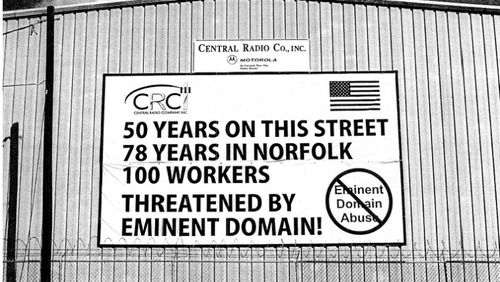
Norfolk_sign

Talk about timing: Dana Berliner, Andy Gowder, and I were talking about the Central Radio case during a session on free speech and other First Amendment issues at the recent ALI-CLE Eminent Domain Conference, when we learned that at the same time we were speaking about the case, the U.S. Court of Appeals for the Fourth Circuit was issuing its opinion on remand from the Supreme Court. 

Bottom line: Norfolk, Virginia’s sign ordinance is an unconstitutional restriction on free speech. See slip op. at 1 (“Applying the principles of content neutrality articulated in Reed, we hold that the sign ordinance challenged in the plaintiffs’ complaint is a content-based regulation that does not survive strict scrutiny. Accordingly, we reverse the district court’s judgment with respect to the plaintiffs’ First Amendment challenge and remand that claim to the district court to award nominal damages to the plaintiffs and for consideration of other

Continue Reading Fourth Circuit: City Violated First Amendment By Banning Anti-Eminent Domain Sign

Here’s the recently-published brochure with more details about the ALI-CLE Eminent Domain and Land Valuation LItigation conference, set for Austin in January 2016. 

In the coming days and weeks, we’ll be posting more details about the conference. Our co-planning chairs Joe Waldo, Jack Sperber, and Andrew Brigham have assembled a great agenda, taught by the usual stellar faculty. If eminent domain, appraisal, or land use is your thing, you really should attend. 

33d Annual ALI-CLE Eminent Domain and Land Valuation Litigation Conference, Jan. 28-30, 2016, Austin, TX

Continue Reading ALI-CLE Eminent Domain And Land Valuation Conference: Full Brochure

Here’s the latest in a case that we’ve been following, which was in both state and federal court, Bridge Aina Lea v. Land Use Comm’n

The litigation is a series of two lawsuits that originated in state court in the Third Circuit (Big Island), one an original jurisdiction civil rights lawsuit, the other an administrative appeal (that’s a writ of administrative mandate for you Californians). The State removed the civil rights lawsuit to U.S. District Court in Honolulu and promptly moved to dismiss, and this portion of the case nearly caused us to flash back to our Federal Courts class in law school, since it raised a host of procedural questions such as the effect of removal, whether certain defendants are “persons” under 42 U.S.C. § 1983, whether the federal court must abstain from addressing the federal takings claim, whether there is a state damage remedy for

Continue Reading Hawaii Federal Court Gets Rid Of Most Claims Against Land Use Commission, But Allows Takings And Vested Rights Claims To Go Forward

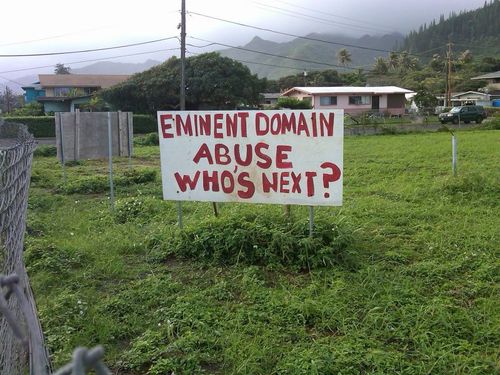
EM Hauulaeminent_domain_abuse

You remember that case about property on the rural north shore of Oahu, in which the City and County of Honolulu is condemning a vacant parcel in order to build a new fire station. The City hasn’t moved on building the station and hasn’t included money in the budget to do so. There’s even some question about whether this is a good place for a fire station.

All this caused the property owner to erect several protest signs on the parcel, one of which is depicted above. An additional brouhaha arose when the City removed and stored the signs, which caused the owner to sue the City in federal court, alleging among other things, due process and First and Fourth Amendment violations, and violations of the City’s “stored property” ordinance.  

We reported on proceedings in the first case, where the court denied the City’s motion for summary judgment. The City argued

Continue Reading Federal Court: City Stopped Blowing Hot And Cold And Had Exclusive Possession Of Property Under Quick-Take Statute, So It Was OK To Seize Anti-Eminent Domain Sign