Here’s our latest article, from the upcoming edition of The Practical Real Estate Lawyer, via ALI-CLE.

Despite its grand title, “A Full and Perfect Equivalent for Just Compensation: The Historical Context and Practice,” its just a short piece that asks whether just compensation is the next big thing, identifies three issues in just compensation in eminent domain that may be on the horizon, and urges the Supreme Court to provide some guidance on this issue.   
Continue Reading New Article: “A Full and Perfect Equivalent for Just Compensation: The Historical Context and Practice”

9780199322541_450After a couple of days detouring to election law, today we’re back to our usual programming.

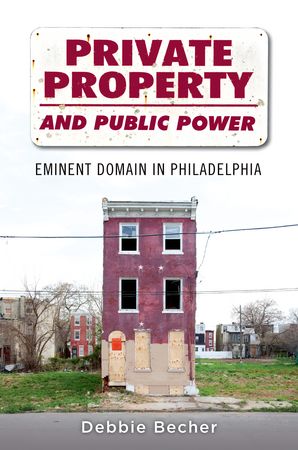
We caught wind of an upcoming book (September 2014), “Private Property and Public Power: Eminent Domain in Philadelphia,” by Barnard College Professor Deborah Becher. “Her book—the first comprehensive study of a city’s eminent domain acquisitions—explores how and why Philadelphia took properties for private redevelopment between 1992 and 2007.” Sounds intriguing. More information about the book here.

Here’s an interview with Professor Becher about the book and her study, which lists some of her more controversial — and debatable — conclusions. Highlights:

  • “The problem is that pundits and activists present the transfer of ownership to a new private owner as the fundamental problem. They say that if government were to take property for a school, a highway, or a public park, abuse wouldn’t be an issue, and that all takings for new


Continue Reading Upcoming Book: Private Property and Public Power – Eminent Domain in Philadelphia

Here’s a law review article that you might find worthy. In Property as the Law of Democracy (pdf here), Harvard lawprof Joseph Singer writes that “[p]roperty is not merely the law of things. Property is the law of democracy.” Heady stuff, for sure. 

As the abstract notes:

In both his article Property as the Law of Things and his prior work, Professor Henry Smith has revitalized property law theory by emphasizing the architectural role that property plays in private law and the ways in which modular property rights reduce information costs and promote both property use and transfer. I applaud Smith’s insistence that we focus on the systemic nature of property rights and the benefits of bundled entitlements. At the same time, it is important to understand the limitations of Smith’s analysis.

Property law goes beyond managing the complexity of human interaction. Property not only presents a coordination

Continue Reading New Article: Joseph W. Singer, Property as the Law of Democracy

Lgo

ALI-CLE, the good folks who put on the annual programs on Eminent Domain and Land Valuation, and Condemnation 101: How to Prepare and Present an Eminent Domain Case, have announced the dates and venue for the 2015 conferences:

Thursday – Saturday, February 5-7, 2015 

Hotel Nikko, in San Francisco.

Those of you who have attended or taught at these conferences in the past know they are the premier programs on this topic, and feature exciting presentations and excellent faculty.

I’ve been honored to be asked to serve as the Planning Co-chair of the 32d annual Eminent Domain and Land Valuation Litigation program, stepping into the able shoes of Leslie Fields, who retired last year. Joe Waldo is continuing as Planning Co-Chair. Joe and I are currently putting together the agenda and faculty for the program, and we will have more on that soon. Andrew

Continue Reading Mark Your Calendars: 2015 ALI-CLE Eminent Domain and Land Valuation, and Condemnation 101 – February 5-7, 2015, San Francisco

Worth reading: Gideon Kanner, Detroit and the Decline of Urban America, 2013 Mich. St. L. Rev. 1547 (2014), in the forthcoming issue of that august publication. Its not yet available on the law review’s web site, but Professor Kanner has written up a summary on his blog (he might even send you a copy of the complete article if you ask him):

It deals with the causes of decline of older American cities; what caused their populations to leave en masse and move to the suburbs, leaving behind empty swaths of urban desolation (If you want to see how desolate, go to Google, type in “ruins of Detroit” and hit “enter.’ Here are some samples).

His summary includes the key points of the article, and identifies six factors as contributing to urban flight and depopulation, including abuse of the eminent domain power. 

The article is a fascinating and

Continue Reading New Article Of Note: The Role Of Eminent Domain Abuse In Detroit’s Downfall

Back in October, we had the honor of moderating a discussion about the ripeness issue in takings law at the 40th Anniversary Symposium on The Takings Issue at Touro Law School (see here and here for more). Professor Vicki Been and Pacific Legal Foundation’s J. David Breemer were the panelists, each weighing in on how Williamson County came to be, and what future the rule may have, if any. 

The Touro Law Review has now published Dave’s article, “The Rebirth of Federal Takings Review? The Courts’ ‘Prudential’ Answer to Williamson County’s Flawed State Litigation Ripeness Requirement.” Here’s the summary:

This article addresses recent developments in the law of takings arising from the courts’ application of the rule, articulated in Williamson County Regional Planning Commission v. Hamilton Bank, 473 U.S. 185 (1985), that a property owner must sue for damages in state court to ripen a Fifth Amendment takings

Continue Reading New Article Of Note: The Rebirth of Federal Takings Review? The Courts’ ‘Prudential’ Answer to Williamson County’s Flawed State Litigation Ripeness Requirement

Cover_42_3_ The Urban Lawyer, the law review produced by the ABA Section of State & Local Goverment Law has published an article which we wrote with our Damon Key colleagues Mark Murakami and Bethany AceRecent Developments in Eminent Domain: Public Use, 45 Urban Lawyer 809 (2013).

Here’s the Introduction to the article:

IN KELO V. CITY OF NEW LONDON, the United States Supreme Court held that a municipality’s exercise of eminent domain power supported only by claims that doing so would help the local economy was not a per se violation of the Public Use Clause of the Fifth Amendment. The Court’s majority—and especially Justice Anthony Kennedy’s concurring opinion, which provided the fifth vote to affirm—left open the possibility that some takings would not qualify. In the intervening time, however, the Court has not provided any guidance whatsoever about what takings it would consider unconstitutional private-to-private

Continue Reading New Article: Recent Developments in Eminent Domain: Public Use

Cover_42_3_ The Urban Lawyer, the law review produced by the ABA Section of State & Local Goverment Law has published my article Recent Developments in Regulatory Takings, 45 Urban Lawyer 769 (2013).

Here’s the Introduction to the article:

THE SUPREME COURT’S 2012 TERM promised to be a banner year in regulatory takings law, with no less than three cases on the Court’s docket. In Arkansas Game and Fish Commission v. United States, a case involving a takings claim against the federal government for compensation resulting from a flood, the Court held that flooding need not be “permanent” in order to result in liability, and reinforced the principle that categorical takings are not favored, and stated that the default analysis is the multi-factored Penn Central test. In Koontz v. St. Johns River Water Management District, the Court held that monetary development exactions fall within the reach of the

Continue Reading New Article: Recent Developments in Regulatory Takings

Be sure to check out this interview with a person we’re proud to call a friend and a colleague, Gideon Kanner, in the most recent edition of Right of Way magazine, a publication of the International Right of Way Association.

A Fierce Advocate for Just Compensation” is a sitdown with Professor Kanner, and covers a lot of ground, so to speak. The entire piece is worth reading, but here’s what a colleague pointed out as perhaps the best part:

If you represent a property owner in an eminent domain case, particularly an inverse condemnation one, you must understand that your client is persona non grata or the law’s “poor relation,” as U.S. Supreme Court Chief Justice William Rehnquist once said. The California Supreme Court once stated in an opinion that it was its duty to keep condemnation awards down, which is a hell of a hurdle to overcome when your task is to persuade the Justices that your client was undercompensated by the court below. So in those not-so-good ol’ days of the 1960s, when I walked into court, I had my job cut out for me. Sometimes, the hostility emanating from the bench was palpable. As Alex Kozinski, Chief Judge of the U.S. Court of Appeals for the 9th Circuit once noted, what property owners in this field often get from the bench is “thinly-disguised contempt.” This is not a line of work for the faint of heart.

We agree.
Continue Reading Why We Fight: An Interview With Gideon Kanner, “A Fierce Advocate for Just Compensation”

A must read from our colleague Professor Steven Eagle (author of the Regulatory Takings treatise) about the Koontz case, Koontz in the Mansion and the Gatehouse, forthcoming in the Urban Lawyer.

Here’s the abstract:

This Article focuses on problems in implementing the U.S. Supreme Court’s expansion of its doctrine of unconstitutional conditions pertaining to land development approvals in Koontz v. St. Johns River Water Management District. As earlier developed in Nollan v. California Coastal Commission and Dolan v. City of Tigard, the doctrine applied only to unrelated or disproportional exactions of interests in real property. The doctrine was expanded in Koontz to include denials of development approval after landowner refusal to accede to unreasonable exaction demands, and also to exactions of money as well as real property interests.

Drawing an analogy to Yale Kamisar’s disparate treatment of criminal defendants in the “mansion” of the judicial system and the “gatehouse”

Continue Reading New Article: “Koontz in the Mansion and the Gatehouse” (Professor Steven Eagle)