As we noted here, the International Academic Association for Planning Law and Property Rights, 8th Annual Conference 2014 will take place in Haifa, Israel, February 11-14, 2014. Earlier this year, we attended PLPR when it visited Portland, and it was well worth going, so the 2014 conference should be similar.

Professor Rachelle Alterman, Chair of the 2014 conference forwards this reminder:

This is a reminder that the deadline for abstract submissions for PLPR 2014 is15 October 2013. Click here for the website, here for the call for papers and here to submit your abstract now.

We are happy to announce that our opening reception will take place on 12 February and will be hosted by the Mayor of Haifa, in the historic City Hall in the Hadar mid-town area.  In addition, we will have a special pre-dinner reception on 13 February, hosted by the Bahai World Center (click here for more on the Bahai Gardens in Haifa).

Please note that we have added a new workshop to our list of optional pre-conference workshops: Workshop 5 on National Land Ownership and housing policy. Click here to see the new workshop in the list and and to submit your workshop registration form (you are welcome to resubmit if your preferences have changed).

We look forward to seeing you at PLPR 2014 Conference

Rachelle Alterman for the Local Organizing Committee

So fire up those keyboards and get to writing!
Continue Reading Reminder: Upcoming Deadline For Abstracts For Property Rights Conference

A lot of interesting law review articles published lately, and here’s the latest: William Baude, Rethinking the Federal Eminent Domain Power, 122 Yale L.J. 1738 (2013). As the title suggests, the author argues that for 75 years, the original view was that the federal government lacked eminent domain power, because it was not expressly granted and it “was too great of a power to be granted only by implication.” While this view has not prevailed, he argues this history should be reexamined. Here’s the summary:

It is black-letter law that the federal government has the power to take land through eminent domain. This modern understanding, however, is a complete departure from the Constitution’s historical meaning.

From the Founding until the Civil War, the federal government was thought to have an eminent domain power only within the District of Columbia and the territories—but not within states.  Politicians and judges

Continue Reading One More Law Review Article: “Rethinking the Federal Eminent Domain Power”

Here’s one that might make you feel better, particularly if you end up drawing the short straw in litigation: in The Upside of Losing, 113 Colum. L. Rev. 817 (2013), Professor Ben Depoorter writes about how winning may not be the “only thing” in public interest litigation.

Of particular interest to the readers of this blog is the section that begins on page 831, which focuses on the Kelo case and its aftermath. There’s one where the litigant didn’t win in the Supreme Court, but the issue jumped to the forefront of the public consciousness:

What first resembled a resounding loss eventually became a victory of a different sort for the opposition to economic development takings. The history of Kelo illustrates that, as much as a plaintiff might hope to win a favorable verdict, substantial benefits also obtain in defeat. Fundamentally, Kelo and its aftermath suggest that certain disputes

Continue Reading New Law Review Article, “The Upside of Losing,” Focuses On Kelo

Much of the interest in eminent domain law since Kelo v. New London understandably has been on the Public Use Clause, but as condemnation lawyers know, a supermajority of the issues in these cases involve the other part of the Takings Clause, the question of just compensation.

The shorthand usually employed is that an owner whose property is taken is entitled to “fair market value,” but that is only part of the equation, since, as the Supreme Court has held, the Just Compensation Clause requires the “full and perfect equivalent” be provided when an owner of forced to give up property for the public good. See Monongahela Navigation Co. v. United States, 148 U.S. 312, 325 (1893).

A newly-published law review article addresses some of those issues, and is worth reading.  Brian Angelo Lee, Just Undercompensation: The Idiosyncratic Premium in Eminent Domain, 113 Colum. L. Rev. 593 (2013).

Continue Reading New Law Review Article On Just Compensation: Property Owners Getting Too Much

Cle-logoFor those of you attending the Virginia Eminent Domain Conference, here’s the expanded papers on “Tough Takings Questions: Regulatory Takings, Zoning Issues and Judicial Takings” and Public Use issues.

Use the password provided at the conference to open the pdf’s. It’s the same p/w for both. If you forgot the password, email me.

For those who did not attend, sorry folks, there are some benefits to coming to a conference! Y’all are going to have to wait for a bit — after a decent interval to allow the attendees to get their money’s worth, we’ll remove the password.

For more about the cases and books we discussed yesterday during my presentation on “Virginia’s Place in National Eminent Domain Trends, check these out:

  • Lingle v. Chevron, U.S.A., Inc., 544 U.S. 528 (2005) (gas station rent control, and the demise of the “substantially advance” test as a takings test).

     
    Continue Reading Materials From Today’s Virginia Eminent Domain Conference

    Here’s what we’re reading on this Tuesday-after-a-long-weekend:

    • Economic Impact in Regulatory Takings Law,” a forthcoming article by lawprof Steven J. Eagle about one of the prongs of the Penn Central takings test. Professor Eagle “concludes that unresolved issues and complexities in adjudicating the ‘economic impact of the regulation on the claimant’ test provide an additional reason why the conceptually incoherent Penn Central doctrine must be replaced.”
    • NY Fed report sees cracks in eminent domain proposals” – “… a new blog from researchers at the Federal Reserve Bank of New York suggests such a plan would have proved to be ineffective anyway. Their reasoning for this conclusion is that many of the targeted borrowers have already benefited from either falling interest


    Continue Reading Tuesday Tidbits

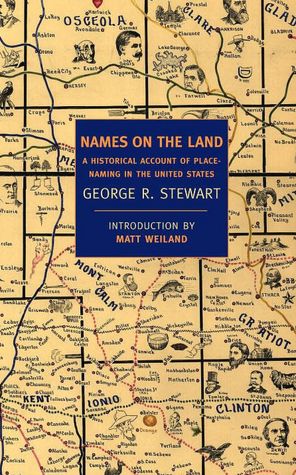
    NamesonthelandIt’s easy to forget that place names are not “real” in the sense that they exist other than in our collective minds, but are impermanent markers bestowed on places by man. There’s nothing that commands New York is “New York,” the Mississippi River to be so named, or the island of Molokai to be called that.

    I’m reminded of this each time I fly. From 35,000 feet you can see many natural barriers and landmarks, but there are no labels on the land as on a map. This gives a fleeting sense of perspective which reduces political distictions — which are bolstered by names and labels — to a somewhat random convention, and makes the age-old fights over land and territory seem a bit trivial.

    If you didn’t already possess that sense, then Names on the Land by George R. Stewart (originally published in 1945, republished in 2008), should give

    Continue Reading Book Review – Names on the Land

    In a recently-published law review article, U. Hawaii lawprof David Callies found that “the Moon Court [1993-2010] decided some of thestate’s most important property and related environmental and Native Hawaiianrights cases in favor of the various non-governmental organizations bringingthem (Sierra Club, Earthjustice, Hawaii’s Thousand Friends, and the NativeHawaiian Legal Corporation) approximately eighty-two percent of the time,sixty-five percent of which reversed the Intermediate Court of Appeals,” a result he concluded was “appalling.”

    Well here’s the counterpoint, a paean to the Moon Court from another U.H. lawprof, who asserts that the court’s environmental jurisprudence wasn’t so much focused on outcome, but rather on process. Yes, plaintiffs won a whole lot, but don’t be fooled the results, she writes, because the court was only insuring that the doors to the courthouse remain open to all comers under the environmental standing doctrine:

    At first blush, the Hawai‘i Supreme Court’s environmental review jurisprudence under

    Continue Reading A Partial Rebuttal To Professor Callies: 1993-2010 HAWSCT Environmental Record Most Concerned With Public Participation

    43_ELR_10189_Page_01Thanks to the folks at the Environmental Law Institute, who have allowed us to reprint an article from a recent Environmental Law Reporter which brings some clarity to the subject of the “denominator” issue in regulatory takings.

    In Temporary Takings, Tahoe Sierra, and the Denominator Problem, William W. Wade, Ph.D., a resource economist with the firm Energy and Water Economics (Columbia, Tennessee), writes:

    Hundreds of briefs, decisions, and journal articles debating “how much loss is enough” should be sufficient proof that the Keystone Bituminous “taking fraction” provides poor guidance to decisionmaking in partial regulatory takings. The Penn Central court intended to measure the severity of economic impact by interference with distinct investment-backed expectations. Where lost income from use of the property is at stake, standard economics requires the denominator in the “taking fraction” to be the owner’s investment in the property. Instead, too many judicial decisions have

    Continue Reading Temporary Takings, Tahoe Sierra, and the Denominator Problem

    Here’s a follow-up to our recent post about the U. Hawaii Law Review article authored by lawprof David Callies which summarizes the land use and property decisions of the Hawaii Supreme Court during the tenure of now-retired Chief Justice Ronald Moon. You know, the article setting out the stunning success rates of certain parties in the court, which chides the Justices for their often-lengthy opinions, and labels the Moon Court’s record on property rights “appalling.” Download the article here.

    Today’s Honolulu Star-Advertiser has a follow-up interview with Professor Callies, most of which is behind a paywall. But if you don’t have an e-subscription (a real deal for those with mainland zip codes, by the way), here are the choice parts:

    • “Callies says he isn’t against planning in general, but thinks there must be legitimate police powers involved for the right of development to be abrogated.”
    • QUESTION: A recent


    Continue Reading More From U.H. Lawprof On 1993-2010 HAWSCT’s “Appalling” Record On Property Rights