Screenshot 2024-02-28 at 13-12-21 Call for Papers Too Far Imagining the Future of Regulatory Takings PDF Justice Crime & Violence

Have thoughts about where regulatory takings are (or should be) headed? Here’s your chance to get in on the conversation, and to shape the future of the law. Our outfit, the Pacific Legal Foundation, in cooperation with the Antonin Scalia Law School’s Journal of Law, Economics, and Policy, are calling for papers on “Imagining the Future of Regulatory Takings.” There will be an in-person discussion of these papers at the Law School in October 2024.

Here’s the full description:

A century ago, Oliver Wendell Holmes, speaking for the Supreme Court, assured us that “[t]he general rule at least is that while property may be regulated to a certain extent, if regulation goes too far it will be recognized as a taking.” In the ensuing one hundred years, courts have struggled to draw the line defining “too far.” Some still wonder whether such a line should even exist. As Justice Clarence

Continue Reading Call For Academic Papers: “Too Far: Imagining The Future of Regulatory Takings”
Screenshot 2024-02-05 at 12-23-56 Missed Opportunities in State Takings Challenges to Pandemic-Era Restrictions

Thank you to the Brennan Center for Justice at NYU Law School’s State Court Report (#statecourtreport) for publishing our piece “Missed Opportunities in State Takings Challenges to Pandemic-Era Restrictions.” The title gives a hint about what this is about: how state and local government’s reaction to Co-19 spurred challenges not only under the U.S. Constitution, but under state constitutions. We give examples of — and comment on — missed opportunities and out-and-out errors in several approaches.

Here are the opening paragraphs:

Responding to the Covid-19 pandemic, the federal government and many state and local governments imposed a variety of restrictions on individuals and businesses. The Centers for Disease Control and Prevention, for example, purported to suspend the ability of property owners to evict nonpaying tenants — a move the U.S. Supreme Court rejected as beyond the agency’s power. State and local governments adopted similar eviction moratoria, and many directed

Continue Reading New Article: Missed Opportunities in State Takings Challenges to Pandemic-Era Restrictions (Brennan Center’s State Court Report)

We’ve been eagerly waiting for the new season of the Institute for Justice’s podcast series, “Bound by Oath” to drop. Not only because it’s a great series – produced by John Ross, it is more like an audio documentary than a typical podcast – but also because John was kind enough to ask us to participate again (our last appearance was in Season 1, where we guested on the episode about the origins of the “incorporation” doctrine).

This season is all about property rights, and episode 2 is all about regulatory takings. Pennsylvania Coal Co. v. Mahon, and Penn Central Transp. Co. v. New York City, to be exact.

So just over a year ago, John and I headed up to anthracite coal country in Pennsylvania. We wanted to be on site on the exact 100th anniversary of the Supreme Court issuing the Mahon
Continue Reading “Groping in a Fog” – Bound by Oath Podcast, S3 E2: Regulatory Takings – Penn Coal And Penn Central … Unplugged!

PXL_20231202_194330453.PORTRAIT

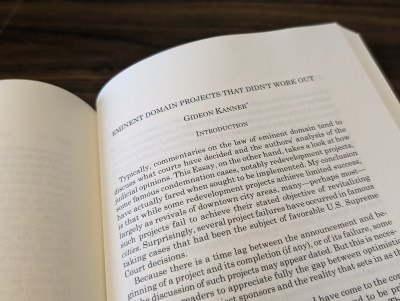
Here it is — Professor Gideon Kanner’s final law journal article, published shortly before his passing:

Gideon Kanner, Eminent Domain Projects That Didn’t Work Out, 12 Brigham-Kanner Prop. Rts. J. 171 (2023).

Appropriately, we think, published in William and Mary Law School’s Brigham-Kanner Property Rights Journal, named in part in Gideon’s honor.

This isn’t a typical law journal article, but an essay collecting Professor Kanner’s thoughts, comments, and (best of all) opinions on, well, eminent domain (and redevelopment) projects that didn’t work out.

In Gideon’s own words, from the Introduction:

But whether you favor widespread use of eminent domain or not, and whether the projects created by its use are sound or not, it is deplorable that the power of eminent domain has been often deployed to the detriment of racial and politically powerless minorities. Typically, redevelopment projects tend to displace middle class and poor people from

Continue Reading Professor Kanner’s Final Article: “Eminent Domain Projects That Didn’t Work Out,” 12 Brigham-Kanner Prop. Rts. J. 171 (2023)

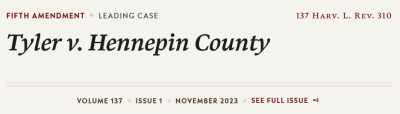
Screenshot 2023-11-24 at 11-46-32 Tyler v. Hennepin County - Harvard Law Review

Check this one out, the Harvard Law Review‘s summary of Tyler v. Hennepin County, the “home equity theft” takings case decided unanimously by the Supreme Court.

Some highlights:

Beginning with traditional principles, Chief Justice Roberts suggested that a property interest in surplus equity had English origins — King John proclaimed in the Magna Carta that when collecting debts owed to him by a deceased person, any surplus “shall be left to the executors.” Parliament endorsed this principle, giving the Crown the power to seize and sell a taxpayer’s property to satisfy a tax debt but requiring the surplus to be returned to the original owner.And according to Blackstone, the English common law required the same.

So too did historic and contemporary American laws.

While the Tyler Court continued the trend of a robust Takings Clause, it introduced novel evidence of a taking: a lack of internal consistency

Continue Reading Harvard Law Review On Tyler v. Hennepin County: Reflecting The “Diminishing” Role Of State Property Law In Takings

Here’s the latest in a case and an issue we’ve been following.

Recall that the U.S. District Court for the Eastern District of Texas concluded that the City of McKinney, Texas was liable for the taking of Vicki Baker’s home, after city police officers destroyed a large part of it while apprehending a suspect who had taken refuge therein. The court awarded just compensation and the city appealed.

Now, the other shoe drops: in Baker v. City of McKinney, No. 22-40644 (Oct. 11, 2023), the U.S. Court of Appeals for the Fifth Circuit reversed, concluding that because the invasion was necessary and a justified use of the city’s police powers, it does not owe compensation.

We’ve been down this path before, so we won’t go over it in detail (recall that the Tenth Circuit reached the same conclusion and the subsequent cert petition was denied by the Supreme

Continue Reading Fifth Circuit Kicks Down The SWAT Takings Door (And Boots The Issue Upstairs)

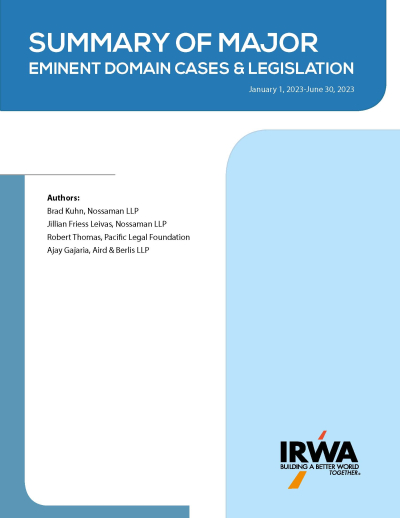
IRWA 6-2023 summary jpg

Thanks to our co-authors for the latest issue of this recurring update.

The International Right of Way Association’s Real Estate Law Committee produces twice-a-year reports “which contain summaries of eminent domain decisions and legislation within the United States.” (This is the “international” right of way association, so that last qualifier is important.)

And what is really nice is that they make the report available.

The laboring oars on this are really Brad Kuhn and Jullian Friess Leivas (both from the Nossaman firm), but they were kind enough to include us. Brad and Jillian wrote up more at the California Eminent Domain Report:

We recently had the pleasure of collaborating with Robert Thomas and Ajay Gajaria once again for the International Right of Way Association’s (IRWA) biannual report covering numerous eminent domain cases at local, state and federal levels from January through the end of June 2023. This


Continue Reading Just Published – IRWA’s “Summary of Major Eminent Domain Cases & Legislation: Jan 1, 2023 – June 30, 2023”

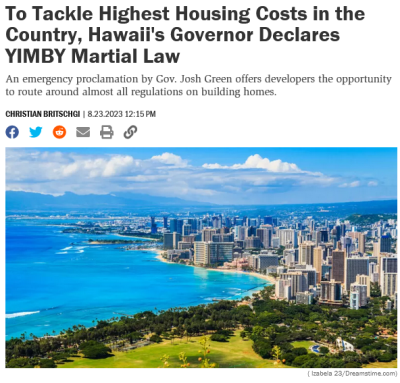
Screenshot 2023-08-23 at 16-13-54 To tackle highest housing costs in the country Hawaii's governor declares YIMBY martial law

Here’s an excellent report on a situation we’ve been following, the Hawaii governor’s proclamation of a housing emergency. In “To Tackle Highest Housing Costs in the Country, Hawaii’s Governor Declares YIMBY Martial Law,” Christian Britschgi at Reason writes:

Developers with a [Beyond Barriers] working group [what we cheekily referred to as the “Privy Council”]–certified project wouldn’t have to comply with normal zoning restrictions. They wouldn’t have to go through Hawaii’s cumbersome environmental review process (which can add months or years to a project’s approval). They could avoid historic preservation regulations, and get relief from normal impact fees and taxes. They could also skip the need to get approval from the state’s Land Use Commission—a duplicative zoning body.

The story is an excellent summary of the substance of the emergency proclamation, the support and objections it has received, and some prognostication (including ours):

Thomas says that

Continue Reading “YIMBY Martial Law” – More On Hawaii Gov’s Gordian Knot Cutting

Screenshot 2023-07-31 at 08-01-31 Necessity Exceptions to Takings

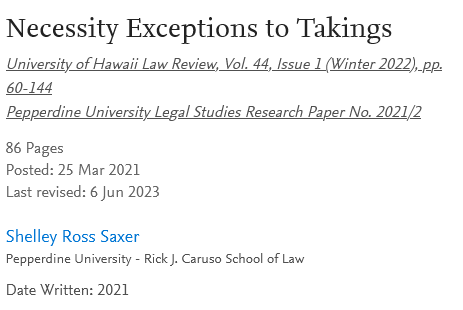
Worth checking out: a new article from Pepperdine Law School’s Shelley Ross Saxer, published in the University of Hawaii Law Review, “Necessity Exceptions to Takings,” 44 U. Haw. L. Rev. 60 (2022). [Disclosure: as noted in the author’s note, we reviewed an earlier draft of the piece and provided some thoughts.]

Here’s the Abstract:

The doctrine of necessity has strong roots in the common law of tort and property going back hundreds of years. In the United States the doctrine has been applied in various situations to negate judicial review of constitutional challenges to government action, most recently in some of the wildfire and flood claims resulting from disasters. But now, the states’ responses to the COVID-19 pandemic have brought one of these necessity doctrines—the public health necessity relying on Jacobson v. Massachusetts—to the forefront as courts across the country review constitutional challenges to state public

Continue Reading New Article – “Necessity Exceptions to Takings” (Shelley Ross Saxer)

PC PREL

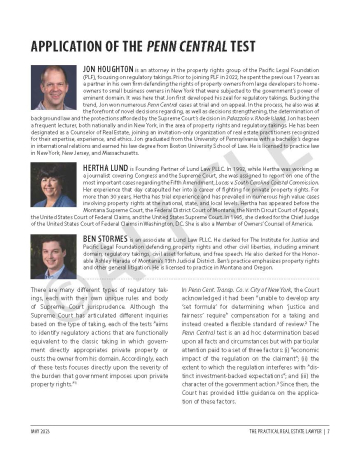
Here’s a recently-published article (ALI-CLE’s The Practical Real Estate Lawyer) on a subject that we know you will want to read about: Jon Houghton, Hertha Lund, and Ben Stormes, Application of the Penn Central Test, 7 Prac. Real Estate Lawyer 7 (May 2023).

Check it out. It’s short, practical (naturally), and worth your time.

Jon Houghton, Hertha Lund, and Ben Stormes, Application of the Penn Central Test, Prac. Real Estate Lawyer…

Continue Reading New Article: Application of the Penn Central Test