Not saying Kelo

A big thanks to friend and colleague Paul Henry for bringing to our attention this article by Andrew Stuttaford, UFOs and Eminent Domain.

No, it (unfortunately) is not the latest tenure-making scholarly law journal article (but we can dream, can’t we?), but a piece in National Review.

It details a proposal to release federal documents relating to UFOs. Nice. But buried in the measure is this (according to Reuters):

Under the measure, records must be publicly disclosed in full no later than 25 years after they were created unless the U.S. president certifies that continued postponement is necessary because of a direct harm to national security.

It also establishes that the federal government would have “eminent domain” over any recovered technologies of unknown origin and any biological evidence of “non-human intelligence” that may be controlled by private individuals or entities.

Who among us is going to be
Continue Reading New Article: “UFOs and Eminent Domain”

Screenshot 2023-07-08 at 12-41-47 Property as Service Streams

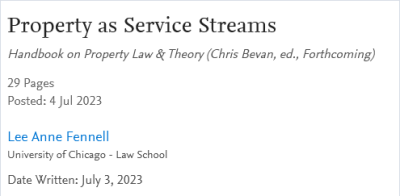
New noteworthy dirt law scholarship, from U. Chicago’s Prof. Lee Anne Fennell, “Property as Service Streams.” Here’s the Abstract:

Property’s job is to help people derive benefits from resources. But often it cannot do this work well. A core problem is an outmoded model of benefit production that treats the individually owned parcel or “thing” as the relevant unit of analysis. In this paper, I argue for a conceptual shift from a property-as-thing-ownership (PATO) paradigm to a property-as-service-streams (PASS) model. I start with the simple point that resources are only valued for the streams of beneficial services that they can provide. Further, owned items can only stream services to their users when combined with other resources and entitlements, many of which are controlled by other parties. Keeping discrete owned assets at center stage misdirects energy towards allocating and protecting things, when we should be examining how to nurture

Continue Reading New Scholarship: “Property as Service Streams” (Prof. Lee Anne Fennell)

Screenshot 2023-07-03 at 20-07-59 Texas A&M Journal of Property Law Vol 9 No. 4

The Texas A & M Journal of Property Law is always a good read, with many articles worthy of your time. But the Journal‘s latest, Volume 9, No. 4 (2023) stands out because it includes the papers for the Symposium on Natural Property Rights.

Check out these titles and authors:


Continue Reading New(er) Articles: Texas A & M Journal of Property Law – Natural Property Rights Symposium

Here’s what we’re reading this Tuesday:

Worth checking Continue Reading Tuesday Round-Up: Sackett, Tyler, Defending Zoning, Canada Property Rights … And More

DSCF3117
If you know, you know.

Pacific Legal Foundation (that’s us) has put out a call for papers about “Rethinking Penn Central.” Here’s the details (pdf).

Here’s some of the suggested topics:

  • Can Penn Central be salvaged or does it need to be fully replaced?
  • If it is to be replaced, what should the new test be?
  • Alternatively, what improvements can be made to Penn Central that would address problems raised by critics without uprooting the test entirely?
  • Is economic loss primarily relevant to compensation owed rather than the threshold question of whether a taking has occurred?
  • Can a more categorical approach, like those taken in cases including Cedar Point Nursery v. Hassid, Hodel v. Irving, or Lucas v. South Carolina Coastal Council, adequately address regulatory takings?
  • What insights does the original meaning of the Takings Clause offer regarding how to fix or replace Penn


Continue Reading Rethinking Penn Central: A Call For Symposium Papers

Cover

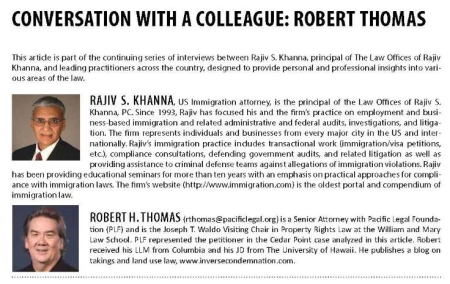
Thank you to to good folks at ALI-CLE’s The Practical Lawyer, for putting me together with Rajiv Khanna, and memorializing our recent conversation in this piece to be published in next month’s issue: “Conversation With a Colleague: Robert Thomas,” The Practical Lawyer (ALI-CLE June 2023).

Rajiv and I chatted about property law (including the Rule Against Perpetuities, even!), the difference between public interest lawyering and private practice, online vs in-person, a national practice vs a local practice, pathways to professional contentment, and considering yourself as a general practitioner in the age of legal specialization:

You still consider yourself to be a general practitioner. You have focused on property in private practice. You teach property in law school, and you also are doing public interest litigation. Out of all of these careers, what do you think you find the most satisfying?

That is truly a tough question. I

Continue Reading In Which We Have A Conversation With A Colleague About Property Law, Public Interest Lawyering, And How To Pronounce “Schedule” (May Be TMI)

Here’s an article for your Monday reading, Bethany R. Berger, Property and the Right to Enter, 80 Wash. & Lee L. Rev. 71 (2023).

Here’s the abstract:

On June 23, 2021, the Supreme Court decided Cedar Point Nursery v. Hassid, holding that laws that authorize entry to land are takings without regard to duration, impact, or the public interest. The decision runs roughshod over precedent, but it does something more. It undermines the important place of rights to enter in preserving the virtues of property itself. This Article examines rights to enter as a matter of theory, tradition, and constitutional law, arguing that the law has always recognized their essential role. Throughout history, moreover, expansions of legal exclusion have often reflected unjust domination antithetical to property norms. The legal advocacy that led to Cedar Point continues this trend, both undermining protections for vulnerable immigrant workers in this case

Continue Reading New L Rev Article: “Property and the Right to Enter” (Bethany Berger)

Check this out, a recently-published article in the Virginia Law Review, Aziz Z. Huq, “Property against Legality: Takings after Cedar Point,” 109 Va. L. Rev. 233 (Apr. 10, 2023).

Here’s the abstract:

In the American constitutional tradition, a zealous judicial defense of property is closely aligned with the idea of “the rule of law.” Conventional wisdom holds that the Takings Clause of the Fifth Amendment vindicates both property rights and the rule of law by foreclosing arbitrary, lawless state action. But the standard story linking property rights, legality, and a constraint on arbitrary governance is more commonly stipulated than analyzed. This Article uses an apparent sharp break in takings jurisprudence, the United States Supreme Court’s June 2021 decision in Cedar Point Nursery v. Hassid, to closely scrutinize the relationship between legality and property rights. To that end, it offers first a careful analysis of the sharp rupture

Continue Reading New L Rev Article: “Property against Legality: Takings after Cedar Point (Huq)

Alex Boone note

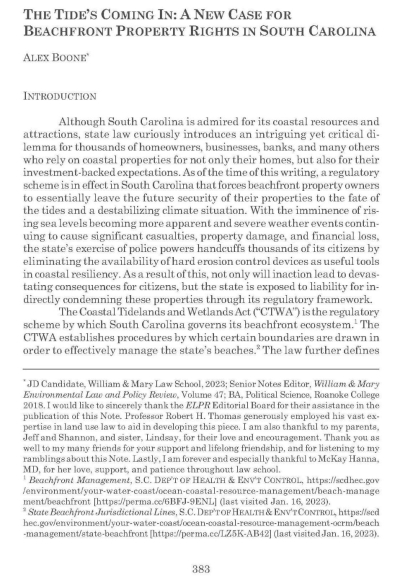
Check this out, a new student-authored note from William and Mary third-year law student Alex Boone, “The Tide’s Coming In: A New Case for Beachfront Property Rights in South Carolina,” 47 Wm. & Mary Envtl. L. & Pol’y Rev. 383 (2023).

Here’s the Abstract:

Part I of this Note explores the scientific data as it relates to the impending consequences of climate change on South Carolina’s coast and will introduce the disastrous scenarios that are predicted to arise as a result of rising sea levels and the accelerating strength and severity of extreme weather events. Part II compares the effectiveness of various coastal resiliency tools and highlights the regulatory framework that prohibits their use by beachfront property owners. Part III explores the topic of regulatory takings and their indirect prophylactic nature of protecting citizens from regulatory overreach and offers a case for a South Carolina court to find

Continue Reading New Article: Alex Boone, “The Tide’s Coming In: A New Case for Beachfront Property Rights in South Carolina” (Wm & Mary Envt’ L & Pol’y Rev)

Screenshot 2023-02-23 at 11-13-54 Toward Principled Background Principles in Takings Law

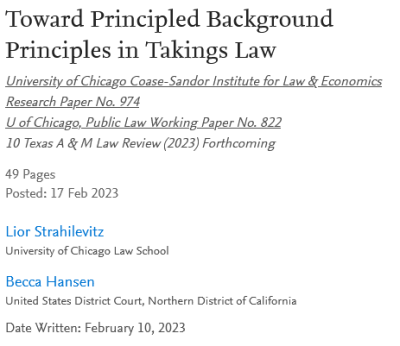
Check this out, a new article co-authored by a federal judge’s law clerk and lawprof Lior Strahilevitz (Chicago). With the title, “Toward Principled Background Principles in Takings Law” are we going to read it? You bet. (Unlike a lot of new scholarship that we post here, we read this one immediately.)

Here’s the Abstract:

Blunders made by lawyers, judges, and scholars have caused the Supreme Court’s recent opinion in Cedar Point Nursery v. Hassid to be deeply misunderstood. In Cedar Point, the Court re-wrote takings law by treating temporary and part-time entries onto private property as per se takings. Prior to Cedar Point these sorts of government-authorized physical entries would have been evaluated under a balancing framework that almost invariably enabled the government to prevail. As it happens, there were two well-established rules of black letter law that California’s lawyers and amici mistakenly failed to invoke in defending

Continue Reading New Article: “Toward Principled Background Principles in Takings Law” (Strahilevitz & Hansen)