Carrie_nation_1910-460

If we were to ask you for your best guess whether a state’s ban of “bump-fire” stocks (a topic we’ve covered before) effects a regulatory taking, requiring compensation, what might you predict as the result knowing nothing else about the case?

As we noted here, it doesn’t take a rocket scientist (or even a legal scholar) to figure out that a court is going to be hard-pressed to order compensation, especially where the ban isn’t an outright confiscation requiring the owner to turn over the item to the government for the government’s use. This is not so much a legal conclusion, but one based on the fact that few judges want to be highlighted in tomorrow’s paper as having “approved” of a device that can turn a semi-auto rifle into a dreaded sturmgewehr. Especially in a state like Florida where judges are elected.

A Florida federal
Continue Reading Florida Court: No Regulatory Takings Claim For Personal Property, Unless Govt Actually Seizes It

Goofus-gallant

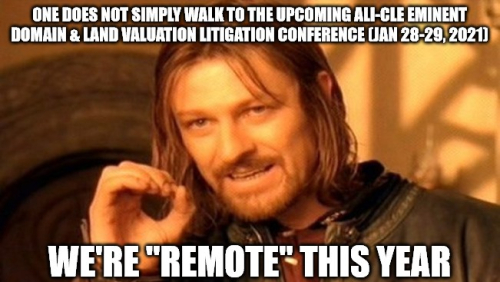
Yes, it starts tomorrow, Thursday, January 28, 2021, but we’re “remote” this year, so it is not too late to register to join us for the 38th Annual ALI-CLE Eminent Domain & Land Valuation Litigation Conference. This is the “big one” where the nation’s best practitioners, scholars, jurists, and other industry professionals gather to talk shop about the subjects we know and love.

Details here (ALI-CLE’s page with faculty, agenda, and times), or here (a recent episode of Clint Schumacher’s Eminent Domain Podcast, where we preview the Conference). Here’s your chance to be a part of what is the best conference on these topics.

We have set it up to take advantage of the remote format, and tuition has been reduced (thank you to ALI-CLE for recognizing this, and for our sponsors for being so generous). We’re seeing a lot of first-time registrations, and this is a great opportunity

Continue Reading Still Time To Join Us: ALI-CLE Eminent Domain & Land Valuation Litigation Conference (Online!) This Thursday & Friday. Tuition Deals! #EminentDomain2021

Here’s the latest complaint in a long train of complaints alleging that a COVID-related shutdown or moratorium is a taking or damaging of private property for public use.

This time, it’s from Northern California wine country (Napa County Superior Court, to be specific), and the taking claims (skip to page 19 if you want to cut to the takings chase) only seeks relief under the California Constitution (“Private property may be taken or damaged for public use and only when just compensation, ascertained by a jury unless waived, has first been paid to, or into court for, the owner.”).

The complaint alleges:

91.    Coalition members have property interests in their respective outdoor-service restaurants, wineries, and related businesses. Prohibiting them from reopening for outdoor service while allowing similarly-situated businesses to reopen for indoor customer service, and without recourse or protection from arbitrary enforcement, constitutes a taking of their property under the California

Continue Reading New Complaint: Shutdown Is A (California) Taking Or Damaging Of Wine Country Restaurants

We would not have guessed back in March when we posted the “first” coronavirus shut down takings complaint that we’d still be at it at the end of 2020, but here we are.

The latest is this complaint filed last week in the U.S. District Court for the District of Oregon against Oregon’s governor (in her official capacity), the City of Portland, and Multnomah County, asserting that “several provisions of law, including state statutes, executive orders, and municipal ordinances that, taken together, significantly impair Plaintiffs’ rental contracts and amount to per se takings and unreasonable seizures of Plaintiffs’ property for a public purpose without just compensation.” Complaint at 2.

The laws referred to are a series of state and municipal statutes and ordinances that establish and enforce a moratorium on termination of tenancies. Rather than go into details, we recommend you read the complaint (it’s not one of those massive

Continue Reading New Complaint: Oregon’s Eviction Moratorium Extension Is A Taking

Screenshot_2020-11-05 Legal challenges regarding COVID-19 emergency orders

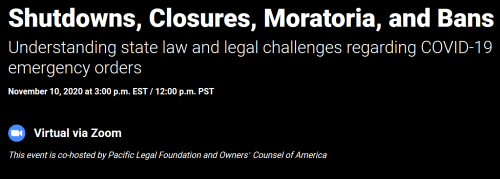
Join us next Tuesday, November 10, 2020 at 3pm ET (12 noon Pacific) for the free webinar “Shutdowns, Closures, Moratoria, and Bans,” produced by Pacific Legal Foundation and Owners’ Counsel of America.

Along with my colleagues Leslie Fields (Executive Director, OCA), and Jim Burling (PLF), I’ll be talking about the legal foundations for objections, some of the cases that have made their way to decision, and what the future might look like. To register (did I mention it was free?) go here.

Here’s the program description:

Governors and state legislatures across the country have implemented an array of policies in an attempt to contain the virus and its socioeconomic impacts. Many of these policies broadened the scope of government power while placing a heavy burden on property owners and businesses already struggling with the pandemic.

Join representatives from Pacific Legal Foundation and Owners’ Counsel of America as

Continue Reading Join Us: Tuesday, Nov. 10, 2020 (3pm ET, 12n PT) For Free (!) Webinar: “Shutdowns, Closures, Moratoria, and Bans”

We all know that despite the heightened Twombly/Iqbal federal pleadings standard, that it doesn’t mean a whole lot if a complaint survives a 12(b)(6) motion to dismiss. All this means that the court thinks it is plausible that the complaint states a claim. And that the plaintiff gets to keep going. That’s it.

But when takings claims are involved, we also know that courts can be dismissive, and a property owner surviving a motion to dismiss can be kind of a big deal.

In Hunters Capital LLC v. City of Seattle, No. C20-983 (Oct. 16, 2020), the U.S. District Court for the Western District of Washington dismissed the plaintiffs’ equal protection claims, but held that the procedural and substantive due process, and takings claims survived. This is the case on which we posted earlier, in which property owners in the part of Seattle known as CHOP (or

Continue Reading Federal Court: If It’s True That Seattle Provided Material Support To CHOP/CHAZ, That Could Be A Taking

This just in in a case we’ve been following. In In re Certified Questions, No. 161492 (Oct. 2, 2020), the Michigan Supreme Court responded to the federal court’s certified question about whether, under Michigan’s statutes, the governor has the authority to effectively extend a declared state of emergency by terminating an expiring declaration and issuing a new declaration “again declaring a ‘state of emergency’ and
‘state of disaster’ under the EMA for the identical reasons as the declarations that had just been terminated — the public-health crisis created by COVID-19.” Slip op. at 8.

The court held no, the statute does not allow the governor to do that, in the absence of the Legislature’s approval of an extension:

The Governor argues that because MCL 30.403(3) and (4) provide that ‘[t]he governor shall, by executive order or proclamation, declare a state of [disaster/emergency] if he or she finds [a

Continue Reading Michigan SCT: Without Legislature’s Assent, Governor’s Emergency Powers Terminate At 28 Days

This one doesn’t involve a takings claim, but since we’re tracking the cases involving coronavirus-related shut down orders and restrictions, we thought we would post this here too.

In Harvest Rock Church, Inc. v. Newsom, No. 20-55907 (Oct. 1, 2020), a panel of the Ninth Circuit rejected a church’s request for an injunction pending appeal of the District Court’s denial of a preliminary injunction. The church is challenging the California governor’s order that have the effect of restricting religious services even though the orders apparently do not expressly target religious services:

The evidence that was before the district court does not support Harvest Rock’s arguments that the Orders accord comparable secular activity more favorable treatment than religious activity. The Orders apply the same restrictions to worship services as they do to other indoor congregate events, such as lectures and movie theaters. Some congregate activities are completely prohibited in

Continue Reading Ninth Circuit, Over Dissent, Denies Injunction For Church COVID Restrictions

We were honored to be a guest on an episode of the Pendulum Land Podcast. Here’s the description from the show notes:

Hawaii inverse condemnation lawyer and William and Mary Law School adjunct professor Rob Thomas joins your hosts to discuss recording his classic single “Smooth” with Carlos Santana, whether the COVID moratoriums on evictions constitute a taking, and his favorite flavor of SPAM! (Don’t act like you don’t love SPAM.) This is the first of two episodes with the publisher of the popular eminent domain blog inversecondemnation.com.

We had to bring our “A game” because the hosts were full of rapid-fire questions, wit, and nerd trivia. It was hard to keep up at times. But we did our best (and yes, we did talk about our favorite flavors of SPAM). We also chatted about the coronavirus related takings claims, and an interesting takings case working its way up

Continue Reading In Which We Go Over To The Dark Side: Our Guest Appearance On The Pendulum Land Podcast (SPAM, Takings, Star Trek/Wars, and More!)