


Court of Federal Claims | Federal Circuit

After Murr, the pending cert petition in Lost Tree was D.O.A., and today, the Court made it official. Cert denied. We thought that the Federal Circuit’s denominator analysis was the better one (although pretty much anything would have been better than what Justice Kennedy and his Immortals came up with in Murr). But since Lone Tree was a property owner win in the Federal Circuit, cert denial isn’t a bad thing.

The denial also let stand the Federal Circuit’s (correct) rule that it isn’t an economically beneficial use when the only use left after a regulation is that the property may recover its value some time in the future (aka “investment value”). This blows significant holes in the government’s common argument that the regulation isn’t a wipeout or a significant loss under Penn Central, because property usually rises in value so one day, the economic impact
Continue Reading Cert Denied In Lost Tree (Relevant Parcel)

We obviously wish we had better news, but today, the U.S. Supreme Court in this order declined to review the Mississippi Supreme Court’s decision in a just compensation case in which we represented the petitioner

Justice Gorsuch, joined by Justice Thomas filed this brief statement:

When a State negotiates an easement limited to one purpose but later uses the land for an entirely different purpose, can the State limit, by operation of statute, the compensation it must pay for that new taking? The Mississippi Supreme Court held that it may do just that. But this decision seems difficult to square with the teachings of this Court’s cases holding that legislatures generally cannot limit the compensation due under the Takings Clause of the Constitution. See Monongahela Navi. Co. v. United States, 148 U. S. 312, 327 (1893). Tension appears to exist, too, between the decision here and decisions of

Continue Reading “Important” Issue And A Lower Court Split, But Cert Denied In Just Comp Case

Here’s the latest case in an issue we’ve been tracking, whether takings plaintiffs who bring major claims for just compensation against the federal government must do so in the Article I Court of Federal Claims, or can bring the claim in an Article III district court. The Sixth Circuit recently held that the feds have sovereign immunity, and have only consented to be sued in the CFC. That court also held that there’s no right to jury trial on a takings claim against the feds. [See 7/24/2017 update, below]

In Sammons v. United States, No. 17-50201 (June 19, 2017), the U.S. Court of Appeals for the Fifth Circuit effectively adopted that same reasoning. In a short opinion, it held that takings claims involve “public rights,” and therefore, Congress may validly assign adjudication of those rights to non-Article III courts. Like the Sixth Circuit, the Fifth Circuit panel rejected the

Continue Reading Fifth Circuit: “the United States’s sovereign immunity can bar cases against it based on the Takings Clause”

Here’s the audio recording of the talk we gave to the ABA Section of State and Local Government Law’s Land Use Committee earlier today. (Some of you may note that in the intro we say the talk was on “June 17,” but since that’s tomorrow, we assume you understand that is just an error.)

The links to the cases and materials we mentioned in the talk are posted hereContinue Reading Recording – “Takings: Emerging Issues” ABA State & Local Government Law Section Talk

Here’s one we’ve been waiting for (we filed a brief in support of the property owner), one in which we were hoping (although not expecting) a more favorable result.

In Brott v. United States, No. 16-1466 (May 31, 2017), the Sixth Circuit held that federal inverse condemnation plaintiffs who sue for more than $10k are not entitled to bring their claims before an Article III tribunal in the first instance, and can be forced by Congress to pursue claims in the Court of Federal Claims. The court also concluded that it wasn’t a problem constitutionally for the property owners to not be able to have their claims determined by a jury. 

The opinion noted the oft-quoted Supreme Court cases which concluded that the Just Compensation requirement in the Fifth Amendment is “self-executing,” that this means that a waiver of sovereign immunity isn’t necessary, that once a taking occurs

Continue Reading 6th Cir: Takings Clause Isn’t Really Self-Executing, So Federal Takings Plaintiffs Must Go To The CFC; And No, They Don’t Get A Jury Either

Seattle

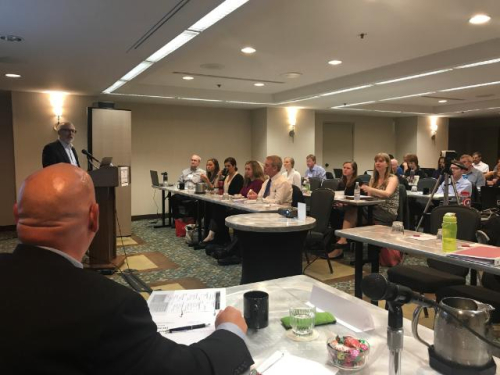
My thanks to Bart Freedman (K&L Gates) and Kinnon Williams (Inslee Best Doezie & Ryder) for asking me to speak on national takings and inverse condemnation issues at yesterday’s Eminent Domain conference in Seattle.

As you can see, the room was packed and standing room only. Here are the cases and issues I mentioned during my talk, “National Takings Trends, Hot Practice Areas, and Property Rights in the Age of Trump:”


Continue Reading Cases And Links From Washington Eminent Domain Conference

No, it’s not for that job position, recently vacated.

This is an opening at a slightly lower level, but perhaps of more interest to our readers. The U.S. Department of Justice is seeking a “Trial Attorney (Inverse Condemnation) GS-14/15.” Here’s the job description:

The attorney selected will be expected to represent the United States in Fifth Amendment takings litigation before the Court of Federal Claims and federal district courts throughout the nation. Cases will involve border security, military readiness, transportation infrastructure, and flood control. The attorney must be comfortable in a “first-chair” role in multiple complex cases, and have demonstrated and substantial experience in all aspects of civil litigation, including pre-trial discovery, presentation of oral argument, and examination of fact and expert witnesses.

The cases handled by the Section require attorneys to achieve intellectual command of complicated facts, scientific principles, and legal issues, often rapidly. Successful candidates

Continue Reading Job Opening At The DOJ (No, Not That One)

Here’s the latest in the “audacious” takings case brought by AIG against the federal government for the 2008 fed takeover. The heart of the complaint is that the acquisition of AIG was an unconstitutional exaction. The Court of Federal Claims rendered a verdict that was hailed as a groundbreaking victory, but which ultimately denied the only relief which the CFC can enter, a money judgment. An appeal to the Federal Circuit followed, naturally.

In Starr International Co., Inc. v. United States, No. 15-5103 (May 9, 2017) that court threw out the takings claim for lack of standing. The corporation had standing to assert the claim, not individual shareholders.

There’s a lot to digest in the 38 page opinion, and the 32 page concurring opinion, and we will allow you to read them for yourself. The key portion of the majority opinion, in our view, starts on

Continue Reading Fed Cir: Even Uberlawyers’ Plaintiffs Need Standing To Bring A Takings Claim

Here’s another amici brief (on behalf of the Virginia Institute for Public Policy, and Owners’ Counsel of America, authored by takings/SCOTUS superstar Michael Berger) supporting the cert petition we filed last month which asks the U.S. Supreme Court to review a decision of the Mississippi Supreme Court. Here’s the amicus brief which Pacific Legal Foundation filed earlier

This post has the background on the case and issues.

The VIPP/OCA brief argues:

1. It is important for the Court to reassert the primacy of federal law as determining the baseline protection provided to private property owners by the 5th and 14th Amendments. Although the issue should not be at large, a number of courts — as exemplified by the Mississippi Supreme Court — are seeking to secure for themselves the right and the power to redefine property in such a way as to confiscate private property for the use of

Continue Reading Another Amici Brief Supporting SCOTUS Cert Petition: “Ordering The Jury to Return A Verdict For Peanuts Instead Of Millions” Violates Just Comp Clause

Here’s the amicus brief, filed yesterday by Pacific Legal Foundation is support of the cert petition we filed last month which asks the U.S. Supreme Court to review a decision of the Mississippi Supreme Court.

First, some background. In 2005, Hurricane Katrina destroyed “Toll Project No. 1,” the U.S. Highway 90 crossing of Bay St. Louis, Mississippi. The bridge had been partially built on Petitioner Bay Point’s property pursuant to a highway-purpose easement granted to the State in 1952 by Bay Point’s predecessor-in-title. After the hurricane, the Mississippi Transportation Commission removed what was left of the bridge. The destruction of the bridge and the removal of the remnants discontinued the specific use authorized by the easement, and Bay Point should have immediately recovered unencumbered possession. Instead, MTC built an entirely new bridge in a different location, and converted the majority of the former highway easement into a public recreational park.

Continue Reading New SCOTUS Amicus Brief: Just Compensation Is Determined By Courts, Not Legislatures