Court of Federal Claims | Federal Circuit

ALI2017 - Copy
ALI2017

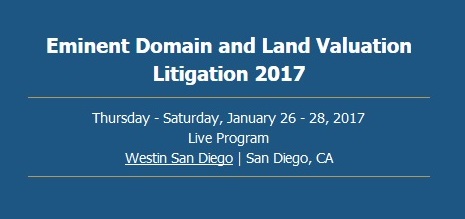
We’ve teased some of the details on the 2017 ALI-CLE Eminent Domain and Land Valuation Litigation and Condemnation 101 Conference, to be held at the Westin San Diego, January 26-28, 2017, but here are the details you’ve been waiting for.

This is the “big one,” our annual 3-day festival of all things eminent domain, property, takings, inverse condemnation, and just compensation. Truly national in scope, this is the 34th annual edition, and the one conference you must attend. Our 2016 conference in Austin was one of the best in years, and we’re on the way to replicating it in 2017, with a great venue in an exciting city. 

Look for the web and printed brochures to show up in your mailboxes, but in the meantime, here are some of the highlights (we’ll post more in the next few days):

  • Relocation, relocation, relocation: we are featuring two sessions on this

Continue Reading Details: ALI-CLE Eminent Domain And Land Valuation Conference – San Diego, January 26-28, 2017

 IMG_20160929_102807
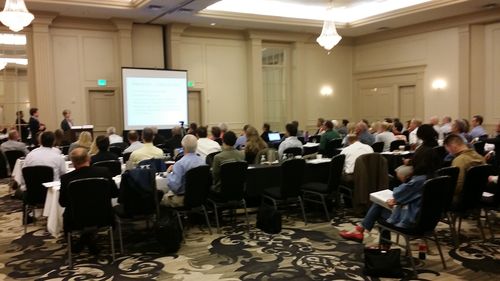
During. Good crowd.

20160929_074511
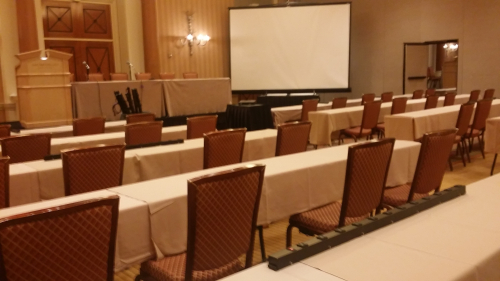
Before. Note the power strips on the tables.
Well played, Caesar’s, well played
.

To supplement your written materials, here are the decisions and other materials which we spoke about this morning at the CLE International Eminent Domain seminar:


Continue Reading Links And Notes From Today’s Las Vegas Eminent Domain Seminar

A new article worth your time by economist William Wade, “Theory and Misuse of Just Compensation for Income-Producing Property in Federal Courts: A View From Above the Forest,” 46 Tex. Envtl L. J. 139 (2016).

Bill is familiar to regular readers, as he has been a frequent guest poster, and a prolific author. This article is his latest, and focuses on how compensation should be calculated in regulatory takings cases, and contrasts how lawyers view economic losses, and how economists view the same thing (not necessarily the same way). 

We are grateful to the Texas Environmental Law Journal and the Environmental and Natural Resources Section of the Texas State Bar for their permission to post the article. Continue Reading New Article: “Theory and Misuse of Just Compensation for Income-Producing Property in Federal Courts: A View From Above the Forest”

On one hand, we don’t care for attorneys’ fee fights. They are satellite litigation, almost always after the merits have been resolved. They can get tedious (does anyone like going over years of timesheets and billing records, and haggling over whether a motion should have reasonably taken 1 hour or 5 hours?), many judges don’t really like fee requests (even where the law requires fee shifting), and some judges are not really tuned in to the real-world financial realities of funding litigation and believe their job is to cut down fee requests to whatever level the judge thinks is acceptable. It can be a remarkably capricious process. 

On the other hand, however, these things are obviously vitally important, and really worth the tedium. In many jurisdictions, (Hawaii, for example), property owners in eminent domain or inverse cases generally cannot recover attorneys’ fees and costs, either as part of just compensation

Continue Reading New Cert Petition: Does The Court Have To Say Why (And How) It Cuts Down A Property Owner’s Attorney Fee Recovery?

We’re not going to go into much detail about the Court of Federal Claims’ ruling in Katzin v. United States, No. 12-384L (July 15, 2016): (1) it’s long (44 single-spaced pages), (2) it’s a post-trial ruling and not from an appellate court, and (3) we’re busy today.

But we still recommend you read it, eventually, because it looks like a fascinating case. Here’s the CFC’s ruling, to start:

This post-trial opinion addresses claims by plaintiffs Dr. Richard Lewis Katzin (“Dr. Katzin”), Mary Beth Katzin Simon (“Ms. Katzin”), and Rose Marie Kjeldsen Winters (“Ms. Winters”) that the United States (the “government”) interfered with their ownership rights to a parcel of land (“Parcel 4”) which overlooks the Atlantic Ocean on Culebra Island, Puerto Rico, and that the interference effected a taking in contravention of the Fifth Amendment.

. . . .

This case raises factual questions of property ownership that

Continue Reading Pirate Of The Carribean: Govt Claiming Ownership And Clouding Title Is A Physical Taking

Arlington

Here’s the amici brief we filed today in a fascinating case we told you about recently

The core issue in Brott v. United States, No. 16-1466, which is currently being briefed in the Sixth Circuit, is whether plaintiffs who allege the United States took their property in a rails-to-trails case can only bring their lawsuit for just compensation in the Court of Federal Claims. They filed suit in a U.S. District Court, and the case was dismissed for lack of jurisdiction.  

Our brief, filed on behalf of the National Association of Reversionary Property Owners, the Property Rights Foundation of America, the Pioneer Institute, and Professor Shelley Ross Saxer, supports the property owners’ arguments that they are entitled to file the case in an Article III court. The owners’ brief covers the issues very well, and we didn’t repeat their arguments.

Rather, we covered a somewhat forgotten decision

Continue Reading Amici Brief: “the hallmark of our American system is that we do not have kings lording over us who must first consent before they can be sued in their own courts.”

IMG_4369

Here’s one we’ve been waiting for, but had been hoping for a better result.

In Resource Investments, Inc. v. United States, No. 15-802 (cert. petition filed Dec. 16, 2015), the U.S. Supreme Court was being asked to consider the issue it left open after United States v. Tohono O’odham Nation, 131 S. Ct. 1723 (2011), whether takings claims must be excepted from the rule in Tohono that the Court of Federal Claims is deprived of jurisdiction in any case which is based on the same operative facts “pending in any other court any suit or process.”

Tohono was not a takings case, but rather a non-takings claim for damages. The Supreme Court upheld the dismissal of the claim by the CFC on jurisdictional grounds, because the at the time the Nation filed its CFC complaint against the United States for money damages, the District Court was considering the Nation’s

Continue Reading SCOTUS Denies Cert In Last Hanging Takings Case – Tohono’s Jurisdictional Ambush Remains Lurking

Here’s the latest in a case we’ve been following, and that could be hugely important. This is a case about federal court jurisdiction and takings claims against the federal government.

We reported on the of Brott v. United States when it commenced: it’s a rails-to-trails takings case, so it would be understandable if you thought this was going to be another one of those dry posts about Court of Federal Claims and Federal Circuit jurisdiction. But it isn’t.

Because, you see, our colleague Thor Hearne and his team brought the case in the United States District Court for the Western District of Michigan, where the property is located. But wait, you say, they can’t do that, because they are seeking more than $10,000 in just compensation, and that means the CFC, an Article I court, has exclusive jurisdiction over the complaint.

Or does it? Not according to this brief,

Continue Reading “Juridical Garlic,” The Takings Clause, And Magna Carta: Sixth Circuit To Consider Jury Right And Article III Courts For Federal Reg Takings Claims

20160609_095451

A very good crowd for today’s Oregon Eminent Domain Conference in Portland. 

Here are the links to the cases and other materials that we spoke about today in our session “Inverse Condemnation and Regulatory Takings – Issues and Trends.”  

Our thanks to Planning Chairs Jill Geleneau and Paul Sundermier for putting together a great program, and for inviting us to speak. 


Continue Reading Links From Today’s Oregon Eminent Domain Conference

Untitled Extract Pages

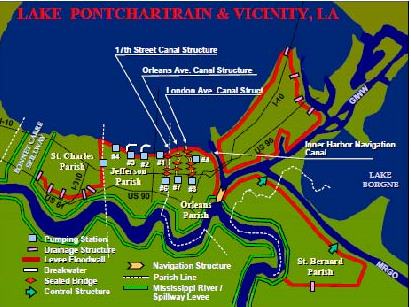
About this time last year, the Court of Federal Claims held that the federal government was liable for a temporary taking to certain property owners for the flooding caused by Hurricane Katrina and the Corps of Engineers’ failure to maintain the “MR-GO” (Mississippi River-Gulf Outlet) canal system. See also a guest post by our colleague Ed Thomas, “Katrina Flood Decision Emphasizes Science.” 

The CFC has now followed up on that ruling with an order (St. Bernard Parish Gov’t v. United States, No. 05-1119L (May 4, 2016)) determining just compensation, thus teeing the case up for the federal government’s appeal to the Federal Circuit.

The opinion is a long one (44 single-spaced pages, including footnotes) and has a lot of detail and technical stuff for you smart readers, but it also has pictures and charts for the rest of us.  

The opinion also contains

Continue Reading CFC Awards Just Comp In Katrina Flooding Case And Tees Up The Appeal