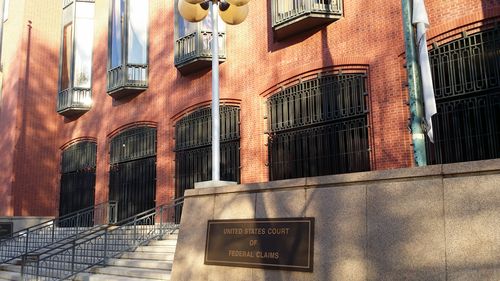
Court of Federal Claims | Federal Circuit

20151205_150101

A noteworthy opinion from the Court of Federal Claims in Petro-Hunt LLC v. United States, No. 00-512L (Apr. 26, 2016), dismissing a claim for a judicial taking for lack of subject matter jurisdiction because the claim would require the CFC, an article I court, to review the actions of the Fifth Circuit, an article III court. The CFC concluded that in this situation, the Federal Circuit holds there’s no jurisdiction.   

The takings case came about after the Fifth Circuit held that the plaintiff did not own mineral leases in Louisiana because under federal common law, it did not acquire any rights by prescription. The plaintiff asserts in the CFC that this is a taking because the Fifth Circuit’s ruling altered its previously-established rights by changing the law. The court accepted that fact as true, but concluded that the CFC has no jurisdiction to tell the Fifth Circuit it
Continue Reading CFC Tackles Judicial Takings: SCOTUS “Cracked Door Ajar,” But Federal Circuit Mostly Says No Jurisdiction

20151205_145903

Earlier today, we asked the Federal Circuit for its permission to file this amici brief urging the court to rehear its recent panel decision in Romanoff Equities, Inc. v. United States, No. 15-5034 (Fed. Cir. Mar. 10, 2016).

This is a rails-to-trails takings case in which the panel concluded that the words in the original easement grant “for railroad purposes and for such other purposes as the Railroad Company … may … desire to make” mean that the easement was a “general” easement which allowed the grantee to not only make railroad use of the easement, but literally any use it desired. Thus, when the railroad abandoned the line and the City of New York turned it into the Highline public park, the reversionary property owners were not entitled to compensation.    

Our brief argues that there’s no such animal as a “general” easement that allows the

Continue Reading Amicus Brief: NYC’s Highline Park Is A Taking: A “General” Easement Allowing All Uses Isn’t Really An Easement At All

We’re tied up today, so can’t write much, but wanted to post this recent decision from the Court of Federal Claims. Here’s the court’s own summary:

Plaintiffs Love Terminal Partners, L.P. (“Love Terminal Partners”) and Virginia Aerospace, LLC (“Virginia Aerospace”) are leaseholders of property at Dallas Love Field Airport (“Love Field”), located in Dallas, Texas. In their complaint, filed in the United States Court of Federal Claims (“Court of Federal Claims”) on July 23, 2008, plaintiffs allege that the federal government, through the enactment of the Wright Amendment Reform Act of 2006 (“WARA”), prohibited the use of their property, thereby destroying all economic value or benefit of their leasehold and effecting a taking without just compensation, in contravention of the Fifth Amendment to the United States Constitution. Plaintiffs seek compensation for the taking as well as interest from the date of the taking, attorneys’ fees, appraiser and expert witness fees

Continue Reading $133,500,000 CFC Verdict For A Categorical Lucas Taking

20160129_091552

The second day of the 2016 ALI-CLE Eminent Domain and Land Valuation conference went as well as the first. Here are some highlights:

  • Austin Mayor Steve Adler (pictured above), who is (was?) also an eminent domain lawyer, welcomed us to his city. 
  • We moderated a discussion between Andy Gowder and Dana Berliner about “First Amendment for Fifth Amendment Lawyers: Free Speech, Signs, Defamation, FOIA, and RLUIPA Claims,” how takings lawyers deal with these issues when they crop up in their cases. 
  • One update from that session: at nearly the same time that we were talking about Central Radio, the case about the Norfolk, Virginia “anti-eminent domain” sign, the Fourth Circuit issued its opinion on remand from the U.S. Supreme Court. We’ll have more in a full post soon, but here’s the bottom line for now: no, the City can’t ban the sign (“we hold that the sign


Continue Reading 2016 ALI-CLE Eminent Domain Conference, Austin: Second Day

20160128_091958

20160128_092004

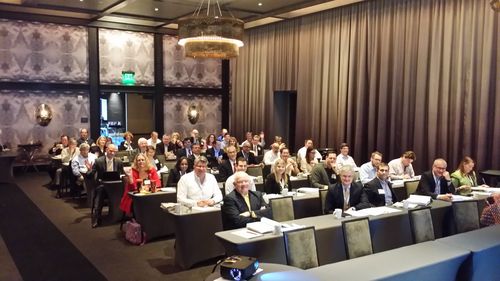
Here’s what’s going on today, the first day of the 33d annual ALI-CLE Eminent Domain and Land Valuation conference in Austin, Texas. We’re at standing room only, with a record number of attendees and our usual nationally renown faculty.

We started off the day with our usual “Eminent Domain Update” session with Amy Brigham Boulris, and as mentioned, the links to the opinions which we discussed are going to be posted in a separate post today. 

We are being followed by a panel on pipeline takings, one of the hot issues nationwide, with Joe Waldo, Matthew Ray, MAI, Thomas Peebles, and Dave Domina.

That session was followed by Professor Ilya Somin, talking about his book, “The Grasping Hand: Kelo v. City of New London and the Limits of Eminent Domain.”  

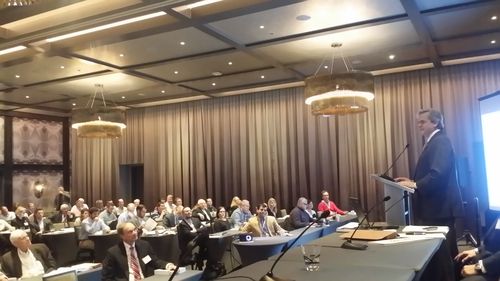
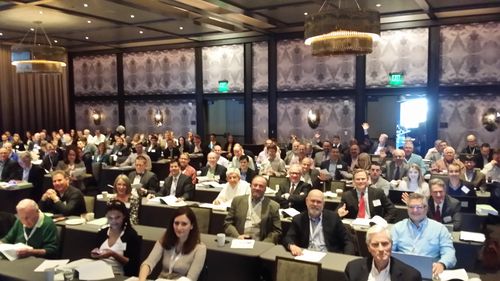
Above are our annual “proof of life” photos taken from the lectern, to show

Continue Reading ALI-CLE 2016 Eminent Domain Conference, First Day: Standing Room Only, National Expertise

20160126_164326

Austin, Texas, is where we’re at for the next few days, for the 2016 edition of the American Law Institute-CLE Eminent Domain and Land Valuation conference, now in its 33d year. First time we’re in Austin, however, and our registration numbers are looking very good, and we haven’t had this big a turnout in years.

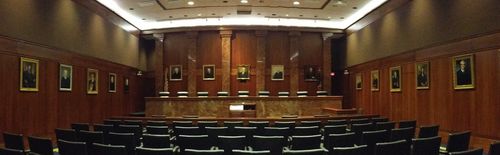
We haven’t been back to Austin in a few years ourselves, so we did what law nerds sometimes do when we go to new towns: visit the local courtroom to check out the scene. So we dropped by the Supreme Court of Texas to take a look. Turns out it was an off-day for the court and it was not in session and the courtroom was locked. But Security suggested that if we asked the Clerk nicely, she might retrieve the key and let us take a look around. And you know what? She did.

Continue Reading ALI-CLE 2016 Eminent Domain Conference: Austin Scouting Report

Here’s the amici brief filed last week by the Cato Institute and the National Association of Reversionary Property Owners in Resource Investments, Inc. v. United States, No. 16-802. That’s the case in which the property owner is claiming that the delay in issuing Clean Water Act permits was so extraordinary, it was a temporary taking. Ultimately, the Federal Circuit upheld the dismissal of a takings claim by the Court of Federal Claims for lack of jurisdiction under of 28 U.S.C. § 1500.  

We also filed an amicus brief in the case (posted here). 

Here’s a summary of the Cato/NARPO brief:

In United States v. Tohono O’odham Nation, 131 S. Ct. 1723 (2011), this Court considered 28 U.S.C. 1500, a Civil War-era statute intended to relieve the United States from responding to duplicative litigation in multiple courts. The Tohono majority found that Section 1500

Continue Reading Amicus Brief: Congress Cannot Bar Property Owners From Vindicating Right To Just Compensation

Here’s the amicus brief we filed today in support of the Petitioner/property owner in Resource Investments, Inc. v. United States, No. 16-802. That’s the case in which the property owner is claiming that the delay in issuing Clean Water Act permits was so extraordinary, it was a temporary taking. Ultimately, the Federal Circuit upheld the dismissal of a takings claim by the Court of Federal Claims for lack of jurisdiction under of 28 U.S.C. § 1500.  

That statute, as federal takings mavens know (and as the Supreme Court recently held in United States v. Tohono O’odham Nation, 131 S. Ct. 1723 (2011)), deprives the CFC of subject matter jurisdiction if there’s a claim based on the same operative facts “pending in any other court any suit or process.” In this takings case, the property owner filed its CFC complaint — which alleged that the


Continue Reading Amicus Brief: Applying Civil War-Era Statute To Toss Federal CFC Takings Claims “Gives Credence To The Belief That ‘The Law Is An Ass.’”

After the usual preliminaries — certification of a 253-member class, subclass certifications, discovery, and motions and cross-motions for summary judgment — the parties in a rails-to-trails takings case in the Court of Federal Claims mediated the dispute and ended up agreeing to $110 million plus interest as just comp for the property taken, and slightly more than $2 million in statutory attorney fees and costs under the Uniform Relocation Act. Many of the class consented to this deal.

Class counsel and the government filed a joint motion for court approval, but a day later, class counsel sought additional fees under the “common-fund” doctrine in the neighborhood of $35 million, based on its contingency fee agreement with some members of the class which entitled them to a percentage of the total award. The CFC did some calculating:

As to whether class counsel’s request for thirty percent of the common fund was

Continue Reading Fed Circuit On Rails-To-Trails Class Action Attorneys Fees, The Uniform Relocation Act, And A Possible Circuit Split

ALI-CLE-2016-masthead

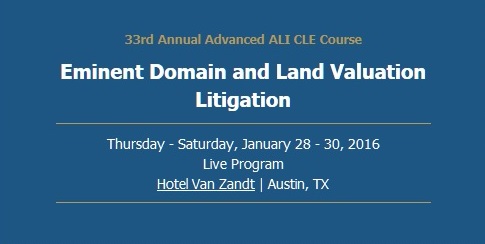
Here’s our second day of highlights from the upcoming American Law Institute-CLE Eminent Domain and Land Valuation Litigation / Condemnation 101 Conference, which will be held in Austin, Texas, from January 28-30, 2016.  

This is the first time the conference has been to Austin, and we’re hoping for a good turnout. Here’s the full agenda for the program. 

  • We especially focused on the ethics component this year, and are looking forward to the session on “Ethics: Tips and Traps for the Eminent Domain Practitioner” at the first plenary session on the second day, taught by Jamila A. Johnson (Schwabe, Williamson & Wyatt, Seattle), Robert B. Neblett, (Jackson Walker L.L.P., Austin). and Joseph V. Sherman (Waldo & Lyle, P.C., Norfolk, Virginia). 
  • Pipeline takings are a huge issue, and we’ve got the lawyers on the very tip of the spear on these cases. “Pipelines and Energy


Continue Reading More On The Upcoming ALI-CLE Eminent Domain Conference (Austin, Jan 28-30, 2016)