


Worth listening: a 17-minute podcast by Professor Richard Epstein, with his thoughts — apparently without a script and seemingly in a single breath — on the oral arguments in Koontz v. St Johns River Water Mgmt Dist., No. 11-1447 (cert. granted Oct. 5, 2012). 

Download the mp3 here. If that doesn’t work, go here.

Continue Reading Epstein’s Podcast On Koontz: “The Vexed Doctrine Of Unconstitutional Conditions”
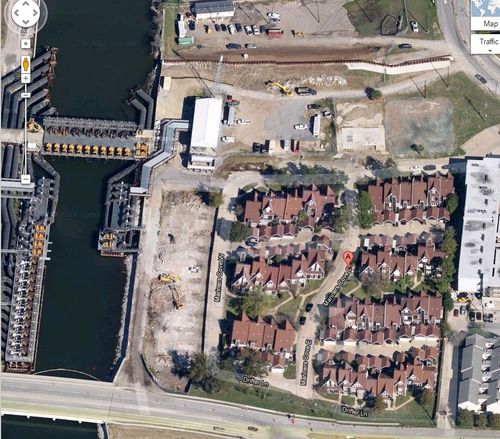
Marinerscoveneworleans

In United States v. 0.073 Acres of Land, No. 11-31167 (Jan. 28, 2013), the U.S. Court of Appeals for the Fifth Circuit held that a townhome association’s right to collect maintenance assessments from its members was property under Louisiana law, but was not compensable property in an eminent domain action.

The case involved a 58-townhome community next to Lake Pontchartain in New Orleans. The area was damaged in Hurricane Katrina after the 17th Street Canal was breached, flooding the Lakeview neighborhood. As part of the recovery efforts, the Corps of Engineers began improving the adjacent pumping station, and to facilitate its access to the site, it condemned 14 of the townhomes. (We assume that’s the vacant spot between the remaining townhomes and the pumping station/canal in the above photo.)

The Mariner’s Cove Townhomes Association had the right to collect assessments from its members for maintenance and whatnot. This right

Continue Reading 5th Cir: Right To Collect Assessment Is “Property,” But It Isn’t “Compensable” Property

The Castle,” the comic tale of Darryl Kerrigan and his efforts to protect the family home at “3 Highwview Crescent, Coolaroo” from “compulsory acquisition” (Australia’s version of eminent domain), has made it to Netflix‘s streaming service.

This is Miramax’s U.S. edit which contains a few differences from the original (several noncritical scenes trimmed, cultural references translated, and minor changes to the soundtrack), but nothing that will detract from enjoyment of the film and its story, and it’s still a must-see. Here’s our review.

We screened the Australian version at last year’s law film series, so in case you missed it, here’s your chance. Highly recommended.Continue Reading Australia’s Eminent Domain Comedy “The Castle” Now Streaming On Netflix

Didn’t the California Supreme Court already deal the final blow to California’s redevelopment agencies when it held that the state legislature could eliminate redevelopment agencies without violating the California Constitution because what the lege giveth, the lege may taketh away? In California Redevelopment Association v. Matosantos, No. S194861 (Dec. 29, 2011) the court upheld the statute dissolving redevelopment agencies.

Apparently, however, there are residual issues. In 2009, “the Legislature enacted Assembly Bill No. 26, requiring redevelopment agencies throughout the state to contribute portions of their property tax increment funding for the 2009-2010 and 2010-2011 fiscal years into supplemental educational revenue augmentation funds (SERAF‘s) to be used for financing K-12 education in redevelopment areas.” As a result, redevelopment agencies were forced to transfer funds to the state general fund to offset other state-funded local programs.

In the latest case, California Redevelopment Ass’n v. Matosantos, No. C064907 (Cal. App. Jan

Continue Reading Cal App: If Lege Can Eliminate Redevelopment Agencies, It Can Grab Redevelopment Money Too

This morning at the ALI-CLE Eminent Domain and Land Valuation Conference, we made a presentation (along with Cornell lawprof Robert Hockett and moderator Jim Burling) on the issue of the use of eminent domain to seize “underwater” mortgages.

Late breaking: it must have been something we said – the Joint Powers Authority (the agency formed by San Bernardino County and two county municipalities to study the issue) today announced it would not use eminent domain to take underwater mortgages, noting that “the group decided to give up on the idea due to a lack of public support. ‘We are taking that off the table,’ [the chief executive and chairman of the JPA] said Thursday.”

Here’s the video we mentioned, an interview with the chairman of Mortgage Resolution Partners for the views from the outfit that stands to benefit from the use of using eminent domain to take underwater mortgages.

Continue Reading Materials And Links From Today’s ALI-CLE Presentation On Condemnation Of Underwater Mortgages

If you have followed the Atlantic Yards eminent domain abuse fight (so well captured in the docfilm Battle for Brooklyn), you know there are a handful of blogs that chronicle the situation in real time, often with great passion.

We checked in today with one of the leading blogs, noLandGrab today, only to find out that back in November it published its last post because, according to the New York Times, it was time “to hang up the keyboard.” SeeOpponents of Atlantic Yards Are Exhausted by a Long, Losing Battle.” Continue Reading No Land Grab Blog Rides Off Into The Sunset

Does the editorial board of the New York Times really have the stones to start off its latest editorial about the Takings Clause, “Where Is the Taking?“, with this:

When a city condemns private property to make way for a public highway, that is a classic “taking” for which government must provide “just compensation” under the Constitution’s Fifth Amendment.

Seriously, Times? How about when it’s not a “classic” taking, and the city condemns an entire block of urban private property to make way for the 52-story office headquarters of a large corporation … say, for example, a newspaper with the initials “NYT?” Would it be a “classic” exercise of power to use emient domain to take property so that:

A high rise office tower would be built at Site 8 South providing the Times with a new headquarters, as well as providing 700,000 square feet of space

Continue Reading We Can Try To Understand The New York Times’ Effect On Man (When It Opines On Eminent Domain Law)

Mark your calendars for next Friday, January 25, 2013 from noon to 1:00 p.m. Pacific for “Arkansas Game & Fish Commission v. United States: Practical Implications Of The Supreme Court’s Decision,” presented by Law Seminars International.

It’s a discussion of Arkansas Game, the decision in which the Supreme Court held that the federal government was not immune from liability for a taking when it was responsible for flooding, even if the flooding is temporary. They’ve assembled a great faculty, which includes arguing counsel for the prevailing petitioner James Goodhart. Also speaking will be takings litigator Nancie Marzulla and Washington Legal Foundation Chief Counsel Richard Samp. Here’s a description of the one-hour program:

On December 4, 2012, the U.S. Supreme Court issued a unanimous opinion in Arkansas Game & Fish Commission v. United States, holding that when the federal government floods property, even temporarily, the Fifth

Continue Reading Upcoming TeleBriefing On Takings Issues After Arkansas Game & Fish

Okay, all you “relevant parcel” mavens, here’s another decision for you (once again involving land in Florida, although, unlike the other case which came out of the Florida court of appeals, this one is out of the U.S. Court of Appeals for the Federal Circuit) .

These decisions provide a measure of sanity to the issue of how much of the property owned by the plaintiff is included when determining whether value has been wiped out under Lucas, or the extent of the economic impact of the regulation on the claimant under Penn Central. These tests require an analysis of the impact of the regulatory action on the “parcel as a whole,” and since Penn Central first made the inquiry relevant, the courts an litigants have been trying to figure out the “denominator” — is it everything the plaintiff owns? Everything nearby? Everything it once owned? The discrete

Continue Reading Federal Circuit: Denial Of Permit To Fill Wetlands Might Be A Taking