


A pipeline needed private property. Did it wait until it had actually taken the property before it started to build the pipeline? No. 

In Bayou Bridge Pipeline, LLC v. 38.00 Acres, No. CA 19-0565 (July 2020), the Louisiana Court of Appeal addressed a host of challenges:

  • A broad facial challenge to Louisiana’s expropriation system. The landowners asserted that allowing private entities to exercise the sovereign power violated due process, primarily because the delegation lacks concrete standards. The court rejected the argument, concluding that the state delegating the power to a common carrier pipeline and including a process that includes a predeprivation hearing to determine public use and necessity, is not a problem. Louisiana’s law “sets out appropriate standards to guide expropriating authorities and the courts, as well as providing for judicial review. Those standards are clearly set out in La.Const. art. 1, § 4, which requires that any taking

Continue Reading Louisiana Court Slaps Down Pipeline for Just Going Ahead And Building Before Actually Taking Property

This one is California process-specific, but we think the California Supreme Court’s opinion in Weiss v. People ex rel Dep’t of Transportation, No. S248141 (July 16, 2020), is still worth a read for you non-Golden Staters.

Why, you ask? Well, we all have been in the situation where, just before you are about to empanel your valuation jury, the court entertains motions in limine that look a lot like summary judgment motions. You know, things like “their theory of valuation is no good,” or “my theory is the only theory,” etc., etc. You can prepare a case for months, only to have it blown up on the literal eve of trial. It’s wasteful, based on unfair surprise. 

So California has a procedure — only applicable to eminent domain cases — that front-loads these type of questions. Any party may file what is called a “1260.040” motion (we’ll let

Continue Reading Stay In Your Lane, Eminent Domain: California’s Eminent Domain Procedures Aren’t “Imported” Into Inverse Cases

In Altman v. Brevard County, No. 5D19-1839 (July 10, 2020), the Florida District Court of Appeal considered a host of owner objections to a taking of easements over five beachfront lots:

(1) the County was required to obtain separate resolutions for each taking; (2) the County’s petition in eminent domain did not strictly comply with the Florida Statutes; (3) the resolution on which the County based its petition was nullified by an amended resolution; (4) the trial court crafted takings outside of the pleadings; (5) the County failed to establish a reasonable necessity for the takings; and (6) the County failed to present a good faith estimate of value for each easement.

Slip op. at 2.

The court rejected most of the objections, but agreed with three: “[w]e find that the County’s petition failed because it did not provide clear legal descriptions of the properties to be acquired and

Continue Reading Condemnor Protip From Florida: Choose Wisely (Make Clear What You Want To Take)

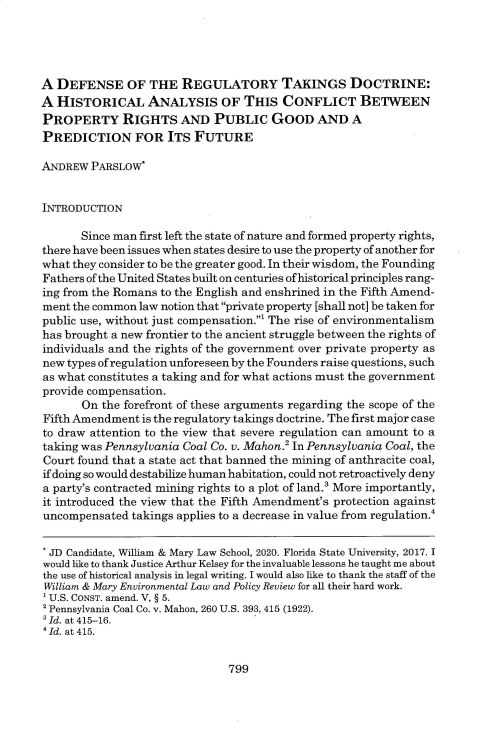
Parslow article

I must say that am pretty chuffed that one of my (now former) William and Mary Law students published a law review article, and he wrote about…takings. And Blackstone, and history.

Read it: Andrew Parslow, A Defense of the Regulatory Takings Doctrine: A Historical Analysis of This Conflict Between Property Rights and Public Good and A Prediction for Its Future, 44 Wm & Mary Environ. L. & Pol’y Rev. 799 (2020).

Well done! Continue Reading New Article: “A Defense of the Regulatory Takings Doctrine: A Historical Analysis of This Conflict Between Property Rights and Public Good and A Prediction for Its Future”

Today’s case is a short one, but worth the short bit of your time it takes to read it.

In Borders-Self Storage & Rentals, LLC v. Ky. Transp. Cabinet, No. 2019-CA-000217 (July 2, 2020), the Kentucky Court of Appeals held that the assessed value of property for property tax purposes is admissible if the value was fixed by the property owner, and the condemnor offers it as an admission against interest. But if the landowner offers the same property tax assessed value, it is not admissible.

The Court of Appeals didn’t make up this uneven rule, but was merely applying a long-standing rule in Kentucky, first adopted by the Kentucky Supreme Court in Culver v. Commonwealth, Department of Highways, 459 S.W.2d 595, 597-98 (Ky. 1970). And the Court of Appeals has to follow Supreme Court precedent.

After Borders upgraded the property, it commissioned an appraisal which, in accordance

Continue Reading Kentucky App Ct: Even Though We Don’t Agree, Tax Assessment Is Admissible In Eminent Domain Only By Condemnor Against Property Owner

KingStreet

Breaking! In H.C. Cornuelle, Inc. v. City and Cnty of Honolulu, No. 14068 (Haw. July 17, 1990), the Hawaii Supreme Court held that the City and County of Honolulu inversely condemned a strip of private property in downtown when it prohibited development and use of that land because the City intended to acquire it in the future for a road-widening project.

Wait, what? “Breaking,” you say? This memorandum opinion was issued nearly 30 years ago. What gives? Well, we remember this case from back in the day when we were just starting out, but had long forgotten about it. Plus, the same case resulted in one of the first post-Williamson County Ninth Circuit opinions, because the landowners originally sued for the taking in federal court, but were bounced out for ripeness. So they tried the takings case in a Hawaii state court. The Hawaii Supreme Court’s opinion

Continue Reading HAWSCT: City’s Prohibiting Use Of Property Pending City Acquisition Is Land Banking Taking

Here’s the amicus brief filed yesterday in a Virginia Supreme Court case we’ve been following.

This is a case at the intersection of property and takings law, and environmental protection. Several Nansemond River oystermen own a lease from the state for the riverbed, which among other things, allows them to harvest some of the oysters that Virginia is so well known for. But they were forced to bring an inverse condemnation claim in state court, asserting that the City’s dumping of wastewater in the river — and prohibiting the harvesting of oysters during those times — was a taking under the Virginia Constitution’s taking or damaging clause (article I, § 11).

The trial court sustained the City’s demurrer, accepting the City’s argument that it has the right to pollute the river, based in part on the U.S. Supreme Court’s decision in Darling v. City of Newport News, 249

Continue Reading Amicus Brief In Virginia Oyster Takings Case: City’s Purposeful Pollution Of River Is A Taking Under The Virginia Constitution


Here’s the recording of last month’s Federalist Society’s Environmental Law & Property Rights Practice Group teleforum, “Just Compensation: A Suggestion or a Requirement?

Can states unilaterally decide not to pay takings judgments? Some states think so. Louisiana and Florida have laws that say no takings judgment can be paid unless money is specially appropriated to do so—and then they never get around to appropriating the money to pay. These laws are currently being challenged in the Fifth Circuit and the Florida Supreme Court. Please join us for an interesting discussion of this litigation.

Featuring:

Robert McNamara, Senior Attorney, Institute for Justice

Daniel Woislaw, Attorney, Pacific Legal Foundation

Stream above, or download it here.Continue Reading What If Govt Is Obligated To Pay … But Doesn’t? Podcast: “Just Compensation: A Suggestion or a Requirement?”

A private pipeline company obtained a certificate of public convenience from FERC. Under the Natural Gas Act, FERC may issue such certificates conditioned on the applicant meeting the Clean Water Act’s requirement of obtaining state environmental check off on the project. The pipeline needed an easement across Schuecker’s land, and began the condemnation process under New York law. It attached to its condemnation petition the conditional FERC certificate. 

Schuecker objected, asserting that the FERC certificate was no good, because the pipeline had not met the condition: it had not certified to FERC that it had received all state approvals (as required by the federal Natural Gas Act). Indeed, the New York Department of Environmental Conservation had denied the pipeline’s water quality certification. The pipeline responded that it was seeking reconsideration with FERC, and that the NYDEC could not deny water quality certification because it was too late to do so.

Continue Reading NY Takes Eminent Domain Law From Worse To Worse* – Conditional FERC Certificate Only Prohibits Construction, Not Eminent Domain

A new, must-add-to-your-reading-list article from takings and expropriations law scholar Professor Shai Stern.

In “Pandemic Takings: Compensating for Public Health Emergency Regulation,” Professor Stern dives into a question a lot of us have been pondering lately, namely whether the pandemic-related shutdown orders might trigger the Just Compensation imperative in the Fifth Amendment’s Takings Clause.

Takings arguments have been raised in may of the legal challenges to coronavirus shut-down orders that have been filed nationwide (see here, here, here, here, here, here, here, here, here, here, here, here and here, for a sampling). But do these claims have any chance of succeeding? Read the article and find out. (Our thoughts on the takings aspects of the shutdowns orders: Evaluating Emergency Takings: Flattening The Economic Curve.) 

Here’s the Abstract:

The COVID-19 pandemic led all states

Continue Reading New Must-Read Article: “Pandemic Takings: Compensating for Public Health Emergency Regulation” (Prof. Shai Stern)