You know how the process is supposed to work. A condemnor exercises its eminent domain power and files a lawsuit to take property for public use. If the owner believes the condemnor’s price is too low, the court adjudicates the just compensation that must be paid. As we know, the point of that lawsuit is to establish the price. If the price eventually adjudicated is too dear (from the condemnor’s perspective), it isn’t required to acquire the property (unless, in some jurisdictions, it has taken advantage of the quick-take or immediate possession process). But if the condemnor wants the property, it must pay the adjudicated compensation. So far, so good.   

But what about those cases where the court adjudicates the price the condemnor must pay to acquire the property, and the condemnor actually takes the property — but the condemnor does not actually pay the compensation adjudicated by the
Continue Reading Does A Property Owner Have A § 1983 Claim If A Condemnor Doesn’t Pay A Just Comp Judgment In A Reasonable Time?

Profcorner.jpf

Please mark your calendars and join us next Tuesday, February 11, 2020 at 12:30pm ET for the free (for members of the ABA’s Real Property, Trust and Estate Section) webinar, the monthly “Professors’ Corner.”

This one will be on the aftermath of Knick v. Township of Scott, 139 S. Ct. 2162 (2019), in which the Supreme Court formally overruled the “state procedures” ripeness requirement in federal regulatory takings cases. 

We shall be speaking about the case and what’s next along with Professors Stewart Sterk and Michael Pollack (moderated by Professor Shelby D. Green). Here’s the summary of the webinar from the ABA website:

Last term, in Knick v. Township of Scott, the Supreme Court overruled the long-standing requirement that state takings claims first be litigated in state courts. The Court held that a property owner has an actionable takings claim when the government takes property without paying for

Continue Reading Tuesday Feb 11, 2020: Professors’ Corner – The Supreme Shift in Takings Litigation – Knick v. Township of Scott

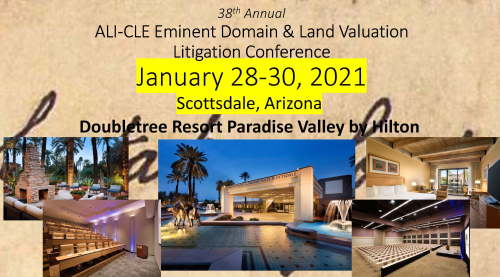
As we briefly mentioned in the “National Eminent Domain Update” at the recent ALI-CLE Eminent Domain and Land Valuation Litigation Conference in Nashville, the U.S. Court of Appeals for the Eleventh Circuit in Sabal Trail Transmission, LLC v. 3.921 Acres, No.18-11836 (Jan. 22, 2020), recently held that it isn’t an abuse of discretion for a trial court to allow a property owner to testify about value if she meets the standards in Federal Rule of Evidence 701.

Two interesting aspects to this case:

1.    The owner’s opinion of value was higher than the owner’s appraiser’s opinion of value. 

2. The owner testified about severance damages. 

The district court allowed the testimony because the property owner had direct experience with the property and sales of other parcels the company owned, even though she lacked experience with the particular use for which this parcel was taken (a

Continue Reading CA11: Owner May Provide Opinion Of Value, Including Severance Damages

Netflix just released the first season (or should we say “series” since this is a UK-based production?) of “The Stranger,” a thriller based on Harlan Coben’s novel, about “the lives of suburban families whose secrets and lies are made public by the appearance of a stranger.”

Why we’re posting notice here that you should watch it is because the main character is Adam Price, and the backdrop to the thriller is that he’s a lawyer who is fighting expropriation (what we Yanks call “takings”), and is knee-deep in a case involving the threatened taking of a retired police officer’s supposedly blighted home for the local council’s redevelopment project. We just started watching. 

What makes this story line especially compelling is that the legal aspects of the story are based on a real case in which our New Jersey colleague Tony Della Pelle represented the property owner. In that

Continue Reading Netflix And Take: Expropriation And Redevelopment UK Style In “The Stranger”

IMG_20200123_070935

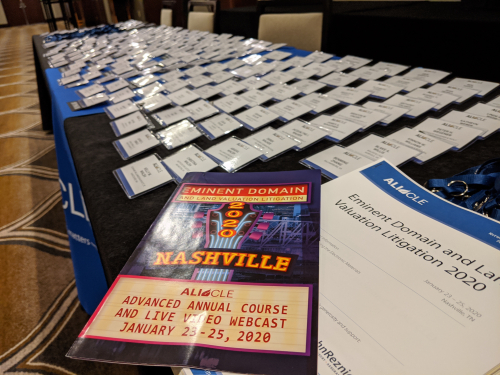
We’re in Nashville for the next three days, where we have record attendance (see above for the name-tag matrix), with nearly 300 attendees spread out over three rooms. 

IMG_20200123_070704

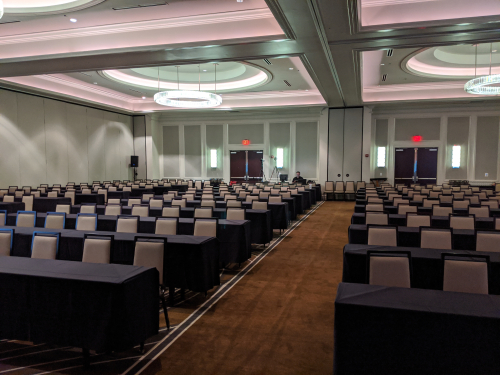
The Big Room, before. 

PANO_20200123_090701.vr

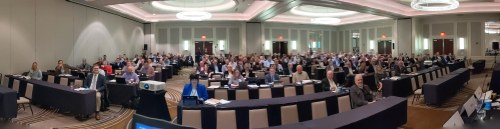
The Big Room, during. Like we said, record attendance. 

IMG_20200123_070830

Thanks to the generosity of our sponsors, we have very good social events. Like the lunch, below.

IMG_20200123_122053

IMG_20200123_125822

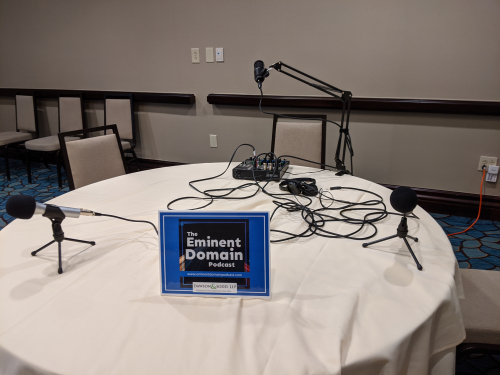
Clint Schumacher brought his Eminent Domain Podcast studio to Nashville to record future episodes.Continue Reading Greetings From The 37th Annual ALI-CLE Eminent Domain & Land Valuation Litigation Conference, Nashville

The Virginia Supreme Court is set to consider a case that asks whether less than a total loss of access to a parcel is a taking, and is the government’s mere invocation of a “police power” rationale to cut off access is enough to insulate it from the payment of compensation. 

When Hooked proposed to develop its property, the City of Chesapeake closed Callison Drive, the street adjacent to Hooked’s property after the neighbors complained. This cut off Hooked’s direct access to Callison Drive, even though it still had access from its property from another street.

The trial court dismissed (demurred) Hooked’s inverse condemnation claim, concluding that the City was exercising its police power when it closed the street, and thus there was no taking as a matter of law. Hooked argued that Virginia property owners have a property right for direct access to adjacent roads, especially after the Virginia

Continue Reading Virginia Supreme Court Asks: Must A Parcel Be Completely Cut Off For Loss Of Access To Be A Taking?

EOGnEv8W4AAoKnI

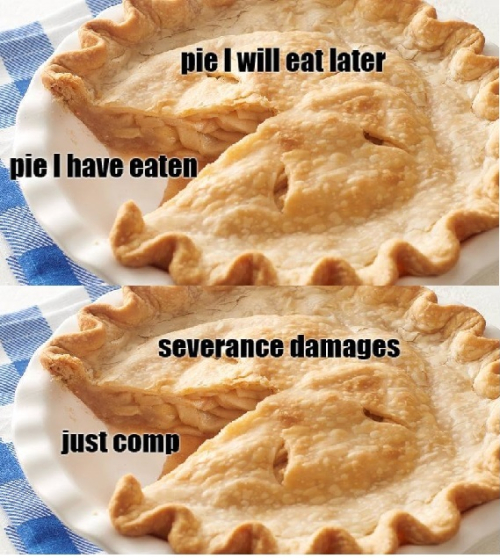
Picture 1: how normal people see pie.

Picture 2: how you see pie if you’re coming to the
ALI-CLE Eminent Domain Conference. 

If you get the above, you probably are already set to join us next week for the 37th Annual ALI-CLE Eminent Domain and Land Valuation Litigation Conference in Nashville. (If not, shame on you!).

And having just reviewed the latest registration list, I can report that we have an all-time record attendance.  But there’s still room for those of you still not committed. Register here. Don’t miss out. There will be pie. Continue Reading Record Attendance (But There’s Still Time For You Last-Minute Filers) At Nashville ALI-CLE Eminent Domain Conference

Is a property owner entitled to compensation if the DOT closes off an intersection by which drivers entered a fast-food restaurant, and now can only get to the restaurant by circuitous access? In other words, if a public project limits access, but does not cut it off entirely? And is the answer the same if the state had in 1961, taken with compensation an easement from the current owner’s predecessor, and the former owner had agreed the compensation was for “all the land taken and resulting damages?” 

That’s the issue the Ohio Supreme Court split 4-3 on in State ex rel. New Wen, Inc. v. Marchbanks, No. 2020-Ohio-63 (Jan. 15, 2020):

{¶ 6} ODOT’s work did not directly affect the entrance to the Wendy’s parking lot from C.R. 128. But as a practical matter, the changes require drivers to travel a longer distance to access the Wendy’s from S.R.

Continue Reading Ohio: DOT Partially Cutting Off Access Is A Taking – Prior Condemnation Did Not Take Right To Direct Access To Highway

ELHy3bhUYAAdM4B

If there’s one downside to the law school experience from the teacher’s side of the lectern, it’s grading. Especially at a law school like William and Mary that has a pretty strict mandatory curve.

In an upper-division course like “Eminent Domain and Property Rights Law,” where we’re dealing with some very high-level stuff and the quality of the students is uniformly excellent, that makes for some hard choices at this time of year. But we’ve wrapped up grading, and have submitted the official scores.

Although I cannot share with you all the papers themselves, I don’t think my students would mind if I give you a sampling of the topics and titles, just so you can see how the next generation of lawyers is thinking about this area of law: 

  • One Man’s Castle is Another Man’s Parking Lot: A Homeowner’s Theory of Eminent Domain
  • Native Title: Concept and


Continue Reading The Circle Is Now Complete: A Sampling Of Final Paper Topics From William and Mary Law’s Eminent Domain & Property Rights Course