We’re meeting some deadlines today, so we don’t have much time to digest in detail the closely split decision by the Pennsylvania Commonwealth Court in In re Condemnation by Sunoco Pipeline, L.P., No. 1979 C.D. 2015 (July 14, 2016). 

The short story is that the majority upheld the power of Sunoco to take private property for a natural gas pipeline against challenges that Sunoco lacked the power to condemn, was not a public PUC-regulated utility, and that the pipeline is interstate and not intrastate. 

The court rejected the property owners’ arguments that Sunoco’s pipeline is interstate, and because the Pa PUC can only regulate intrastate commerce, the pipeline takings are not for public use. Yes, the pipeline itself goes through Ohio and West Virginia, in addition to Pennsylvania, but originally, there were no Pennsylvania “offramps” on the pipeline, and Sunoco’s plans initially were for interstate service only. But after

Continue Reading The Polar Vortex Made Us Do It: Pa Appeals Court Approves Pipeline Taking
Wilson-road

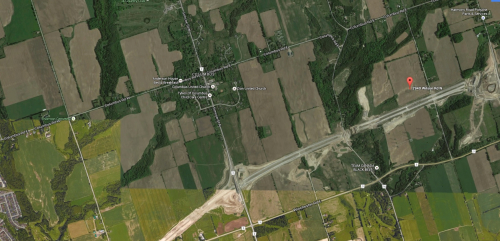
With apologies to Professor Kanner (who regularly features a “Lowball Watch” on his blog), we offer this report of Down v. Ministry of Transportation, No. LC140038 (May 12, 2016), a trial-level property owner victory by our Toronto colleague Shane Rayman (last seen in the pages of this blog winning a great case in the Supreme Court of Canada). We’ve been meaning to post the decision for a while, but got caught up in other things. We probably should have waited at least another couple of days for Canada Day, but oh well.

But before we get into today’s case, we want to digress a bit with this bit of Canadiana. Or at least our one story about that True North strong and free, that played into every one of our preconceptions.

Many years ago, while living in New York City, we got the bright idea one dark

Continue Reading Lowball Watch: That’s A Lot Of Bucks, Even If They’re Canadian Dollars

The power company needed an easement across Hylton’s land for a transmission line. It made him an offer, backed by an appraisal. But that appraisal didn’t account for Hylton’s mineral rights, although it acknowledged that the property did contain two coal deposits, at least according to Hylton.

The parties “signed an agreement granting [the utility] the right to enter Hylton’s property and construct the transmission line.” But the following month, the utility filed an eminent domain action to condemn the easement, which alleged that it had fulfilled its “statutory obligation” and made a “bona fide offer to purchase,” one of the prerequisites to its filing of the condemnation action.  

Not quite, countered Hylton. The offer wasn’t sufficient — those coal deposits were rendered worthless as a result of the taking — so the offer which was based on an appraisal which didn’t account for the mineral rights wasn’t “bona

Continue Reading Virginia: An Unacceptably Low Offer Of Compensation Is Still A “Bona Fide” Offer

20160529_124542

As we noted last week, the expanding costs of the Honolulu Rail project has forced Honolulu’s mayor to ask whether construction should be delayed or stopped entirely, short of its planned terminus at Ala Moana shopping center. “Middle Street” became the new rail watchword, even though stopping it there would omit — temporarily or permanently — the most densely populated, and therefore the most useful, portion of the route. 

Middle Street is somewhat of a nondescript, dare we say it, “blah” street; more of a demarcation between the airport area and the more industrialized Dillingham corridor. A place you generally go by on your way elsewhere, not consider a destination. Frankly, it doesn’t have much of a reputation for anything exciting. In our minds, it is most notable as the border between “town” and “country,” at least psychically. 

  • Civil Beat‘s Chad Blair, however, sees it differently. In a tongue-in-cheek


Continue Reading Rail: Building To The Nowhere Of Middle?

20160616_151731

As readers know, from time to time, we undertake what might be called “eminent domain tourism” — visiting the sites of famous and infamous cases when we’re in the neighborhood. Hadacheck, Kaiser Aetna, Nollan, Dolan, and PruneYard, for example.

Perhaps the best illustration of the “holdout” comes from Seattle (see this 2008 story from the New York Times for the backstory), and during a recent trip there, we went by the semi-famous “Up House” formerly owned by the late Edith Macefield, so named because in 2009, “Disney publicists attached balloons to the roof of Macefield’s house, as a promotional tie-in to their film, Up, in which an aging widower (voiced by Ed Asner)’s home is similarly surrounded by looming development.” 

There’s still some balloons tied to the fence, but the house has definitely seen better days. The Wikipedia entry tells

Continue Reading Holdouts And Regrades, Seattle Style

20160529_124542

In a surprise move, Honolulu Mayor Kirk Caldwell today announced that he supports suspending the Honolulu rail project at Middle Street, at least until there’s more money in the coffers. See “Mayor, Council chairman say rail should end at Middle Street for now” from Marcel Honore at the Star-Advertiser.

We think the key words in that headline are “for now,” and this is not the end of the project, necessarily. Notwithstanding that, as the story notes, this could be a “seismic shift” for the project, which has been plagued by massive cost overruns and other embarrassments since its inception, such as having its financially-savvy Board chairman resign and be replaced by a career politician, only to see her set her cap for Congress and abandon ship when one of Hawaii’s two House seats unexpectedly became available. What started off as a project projected to cost a bit more than $3

Continue Reading Honolulu To Truncate Rail … For Now?

This just in: the North Carolina Supreme Court has issued an opinion in an important case we’ve been following for a long time, Kirby v. North Carolina Dep’t of Transportation.

This is the case about the “Map Act,” a statute which designates private property for future highway use, and  “restricted plaintiffs’ fundamental rights to improve, develop, and subdivide their property for an unlimited period of time.” Slip op. at 1.  The court concluded that “[t]hese restraints, coupled with their indefinite nature, constitute a taking of plaintiffs’ elemental property rights by eminent domain.” Id.  

The North Carolina Court of Appeals earlier held the Act was a taking, and this resulted in a lot of shouting and gnashing of teeth that making the DOT actually pay just compensation would crash the system and cost the state a lot of money, so we were not terribly surprised when the DOT sought review

Continue Reading NC: “Map Act,” Which Designates Property For Future Highway Acquisition — And Prohibits Development In The Interim — Is A Taking

20160609_095451

A very good crowd for today’s Oregon Eminent Domain Conference in Portland. 

Here are the links to the cases and other materials that we spoke about today in our session “Inverse Condemnation and Regulatory Takings – Issues and Trends.”  

Our thanks to Planning Chairs Jill Geleneau and Paul Sundermier for putting together a great program, and for inviting us to speak. 


Continue Reading Links From Today’s Oregon Eminent Domain Conference

We won’t go into the West Virginia Supreme Court of Appeals’ opinion in Gomez v. Kanawha County Comm’n, No. 15-0342 (June 3, 2016) — it’s well-written and easily digested (all citations are in footnotes) — but point out these highlights:

  • The condemnation took Gomez’ property for use as a dump site for debris from construction to improve an airport by removing the top of a hill that the FAA said interfered with take offs and landings. 
  • The stated public use was “improving, maintaining, and operating Yeager Airport.”
  • Gomez objected, arguing that using her property as a dump didn’t qualify, and that a jury — not the judge — could make that determination.
  • The Supreme Court disagreed: public use is a question of law, and one which the judge determines.
  • The court also rejected Gomez’ argument that the project influence rule was not applicable. She claimed the valuation must include the


Continue Reading W Va: Condemnee Acting Badly Isn’t Reason Enough For Summary Judgment

20160603_075340

As we head into the weekend, one more reminder about two worthwhile eventss being staged next week: 

  • Monday, June 6, 2016:Airbnb & Zoning: A Planner & Lawyer’s Guide to Short-Term Rentals,” with our ABA and Owners’ Counsel colleague Dwight Merriam, FAICP. From the Planning and Law Division of the American Planning Association. Details here. If issues about the “sharing economy” like AirBnB, Uber, Lyft, and similar operations, and how they work in the regulatory environment are of interest, you might want to consider joining us at the ABA: we’ve just formally launched a new group within the Section of State and Local Government Law dedicated to these pressing legal questions. Stay tuned here for a separate post on how to join us.  
  • Thursday & Friday, June 9-10, 2016: Oregon Eminent Domain Conference, Portland. We’ll be speaking at that one. The focus is on Oregon


Continue Reading Seminar Reminder: Oregon Eminent Domain; Sharing Economy Issues