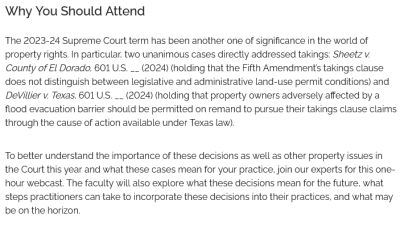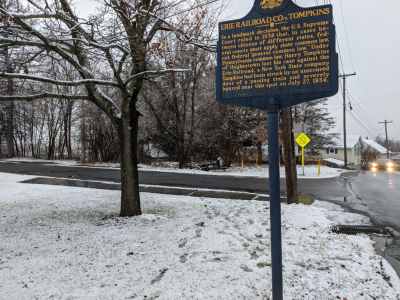
Erie
The site of the Erie incident, just a mile away from Mahon’s home.

Here’s an unusual, and kind of interesting one, from a U.S. District Court (Hawaii) in an eminent domain case brought by the County of Maui against the owner of Maui property which is needed for a solid waste disposal site for debris from the recent Maui wildfire.

First unusual point: the owner, a citizen of a state other than Hawaii, removed the case to federal court, asserting diversity jurisdiction. A state eminent domain action in federal court? Don’t see that every day, do you? (The County has not challenged federal court jurisdiction.)

Second unusual point: when the County deposited its estimate of just compensation and sought immediate possession under Hawaii’s eminent domain procedures (Hawaii does not have a true “quick take” procedure, but merely immediate possession where title does not transfer to the condemnor
Continue Reading Federal Court In Removed Eminent Domain Case: Quick-Take/Immediate Possession Is Erie Procedural, So Does Not Apply

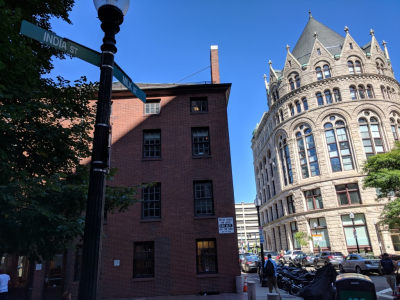
IMG_20180719_154523
The famous corner of India and Milk, Boston
(at least for takings nerds)

Today, along with our friend and colleague Hawaii eminent domain lawyer Mark M. Murakami, we filed this Application for a Writ of Certiorari* in a condemnation case that has been pending for more than a decade (including more than five years in the court of appeals). We posted about the case — including an aerial video of the property, located on Maui’s south shore — here.

The Question Presented:

May a jury determining just compensation consider evidence of the influence of the condemnation on the fair market value of property being taken?

You eminent domain types know the answer to this: No.

Indeed, no way! If you thought the “project influence” rule is a baseline requirement of the Fifth Amendment, a rule applied by courts nationwide, and for ages has held that “any

Continue Reading New (State Court) “Project Influence” Cert Petition* – Inadmissibility Of Evidence Of Use & Value Of Property As Condemned

We were all set to write up the Wisconsin Supreme Court’s recent opinion in Sojenhomer LLC v. Village of Egg Harbor, No. 2021AP1589 (June 19, 2024) — after all, we were already following the case — when Lawprof Ilya Somin beat us to the punch: “Wisconsin Supreme Court Rules Sidewalks are not “Pedestrian Ways” – thus Allowing Local Governments to Use Eminent Domain to Take Property to Build Them.”

Short story is that a Wisconsin statute prohibits using eminent domain to take property for a “pedestrian way,” and the Village instituted a condemnation action to take Sojenhomer’s property for a sidewalk. No way, you say?

Yes way held the Wisconsin court. The key was that pedestrian way was a defined statutory term, and thus not subject to common meanings (which would seem to include a sidewalk as a pedestrian way). The court concluded that the sidewalk did

Continue Reading When Is A Sidewalk Not — You Know — A “Pedestrian Way”? Wisconsin Supreme Court Clues Us In

This is a short one, and the title of this post pretty much sums up the Minnesota Supreme Court’s opinion in State of Minnesota v. Schaffer, No. A23-0036 (June 20, 2024).

The case addressed a frequently-occurring issue in jurisdictions which permit some kind of fee recovery in eminent domain cases. Where a statute permits a property owner to recover “reasonable” attorney fees, how is the recovery calculated? By the usual “lodestar” formula (reasonable time x reasonable fee), or is it limited by the actual contractual arrangement between the property owner and her lawyer (in this case a contingency fee that resulted in a fee less than a lodestar-determined fee). 

The court held rejected MDOT’s argument fee recovery under the statute “cannot exceed the amount owed to the landowner’s attorney in a contingency fee agreement[.]” Slip op. at 2. The court held:

We reiterate what we held in Cameron: the

Continue Reading Statutory Fee Recovery In Minnesota Condemnations Not Limited By Contingency Fee Agreement

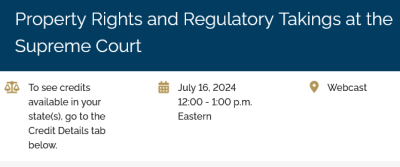
Screenshot 2024-06-12 at 13-31-02 Property Rights and Regulatory Takings at the Supreme Court ALI CLE

Mark your calendars and register now for the upcoming American Law Institute-CLE webinar “Property Rights and Regulatory Takings at the Supreme Court.” The focus of this program is a summary and analysis (including “what’s next?”) of the two big property and eminent domain cases decided by the U.S. Supreme Court, Sheetz (exactions), and Devillier (just compensation remedy).

We’ve brought together counsel for the property owners in the cases, as well as a legal scholar to provide an academic view of the cases and issues.

The faculty:

Screenshot 2024-06-12 at 13-31-26 Property Rights and Regulatory Takings at the Supreme Court ALI CLEDetails:

  • Date: July 16, 2024
  • Time: 12n – 1pm Eastern Time
  • Format: webinar, with audience questions
  • CLE credits: ALI-CLE programs are approved for CLE credits in most jurisdictions

Come Continue Reading Register Now! ALI-CLE Webinar “Property Rights and Regulatory Takings at the Supreme Court” (With Counsel For Sheetz & Devillier) – July 16, 2024

Here’s the latest in a case we’ve been following.

Our friends at the Institute for Justice have filed this cert petition asking the Supreme Court to take up the case where a New York town eminent domained the Brinkmann property for a public park.

What’s wrong with that, you ask…isn’t a public park a “classic” public use? Yes. But the twist here is there was also a showing that what actually motivated the taking wasn’t some need for another public park in the town, but rather the public’s dislike of the use the Brinkmanns intended for their land.

These are what we call “spite takings,” where the main purpose behind a condemnation isn’t really to do something public with the land, but to stop a disfavored use. Are these ok under the Public Use requirement because — as the Second Circuit panel majority held — that who

Continue Reading New “Spite Taking” Cert Petition: Can Govt Take Property To Stop Owner From Making An Allowed – But Disfavored – Use?

This one is about Robert Moses. Yeah, that guy. You may think you know the story, but even if you do, it will be worth your time to listen to this episode of Dave and Kristen’s Infrastructure Junkies podcast. You will probably learn something new like me.

Here’s the pod’s description of the episode:

The best way to understand why we have our standard eminent domain laws and procedures may be to learn through a good story.

Houston attorney Bobby Debelak of the law firm McDowell Hetherington joins Infrastructure Junkies to tell the story of Robert Moses, who amassed incredible power despite never being elected to a public office. Morris utilized eminent domain to accomplish some of the most amazing infrastructure projects in New York. During his amazing reign, virtually all of the City, State and Federal infrastructure spending in New York flowed through Moses. Hear more about his

Continue Reading (Another) Must-Listen Podcast: Infrastructure Junkies’ “The Greatest Eminent Domain Story That You’ve Never Heard!”

This is a must-listen, the latest episode of John Ross’s Bound by Oath podcast. This season is covering property rights, and this episode details Berman v. Parker, which may be the first case in what we’ll call the “modern era” where the Supreme Court set the judicial hands-off tone for public use challenges.

The guest this episode is our friend and colleague Amy Lavine, who wrote what we think is the seminal article deconstructing Berman (we include it as required reading in our William and Mary Eminent Domain course).

This episode is a great companion piece to BBO’s episodes on Euclid (zoning), and Pennsylvania Coal (reg takings).

On this episode: Berman v. Parker, the Supreme Court’s decision in 1954 to abandon previous constitutional limits on the government’s power to take property from Person A to give it to Person B. The decision greenlit the era of urban

Continue Reading New Bound by Oath Episode: Berman, Public Use, And Urban Renewal

Here’s the latest in an issue we’ve been following.

In SCS Carbon Transport LLC v. Malloy, No. 20230149 (May 30, 2024), the North Dakota Supreme Court held that that’s state’s statute which allows prospective condemnors to enter land to conduct surveys and the like before instituting eminent domain without liability is not unconstitutional, either on its face or as applied to SCS’s entries.

SCS is building a CO2 pipeline and decided it needed an interest in Malloy’s land. It asked if could enter to take a survey, but Malloy said no. So SCS sued, asserting its power under the statute, asserting it was planning on restoring the property to its “pre-examination” condition, and it was willing to pay compensation for any damage it caused:

In all cases when land is required for public use, the person or corporation, or the person’s or corporation’s agents, in charge of


Continue Reading ND: “Minimally Invasive” Precondemnation Entries Are Not Unconstitutional

Please be sure to check this out: a new animated film, “Love of the Land,” which “highlights [the] tragic story of Vermont farmer Romaine Tenney.”

You remember Mr. Tenney, who was one of those classic Vermonters. He tragically entered the pages of history more than fifty years ago when, in reaction to the taking of his farm for Interstate 91, he burned his house and farm buildings down, and shot himself. He had nowhere else to go. An informal memorial to Mr. Tenney — a maple tree (how Vermont) — stood on the site of his former property near Exit 8, until the tree was too diseased to remain and was removed.

We learned more about Mr. Tenney when we spoke with Howard Mansfield Howard Mansfield about his book “The Habit of Turning the World Upside Down – Our Belief in Property and the

Continue Reading Must Watch: “Love of the Land” – Romain Tenney’s Eminent Domain Protest