In a case that uses terms that might reasonably lead you to think it was lifted from the script for the next stoner comedy, the U.S. Court of Appeals for the Federal Circuit, in Gadsden Indus. Park, LLC v. United States, No. 18-2132 (Apr. 22, 2020), held that an owner of land on which the byproduct of milling steel was dumped possessed a property interest in some of the “slag,” but not as much of it as the owner claimed. The court also held that the property owner did not introduce evidence of its loss of use of the “kish” or the “scrap.” 

Before we go any further, here’s your daily dose of learning:

Slag, a byproduct of steel manufacturing, is “a non-ferrous material that separates during smelting.” Gadsden Indus. Park, LLC v. United States, 138 Fed. Cl. 79, 92 (2018) (Decision). Kish is “a ferrous byproduct

Continue Reading Fed Cir Bummer: Govt Bogarted None Of Your Kish, Slag, Or Scrap
Like that old radio bit “Chicken Man” (“He’s everywhere! He’s everywhere!“), it looks like the robed ones down at 1 First Street NE are, like us, seeing takings lurking in cases where takings may not be the first thing on the menu. 

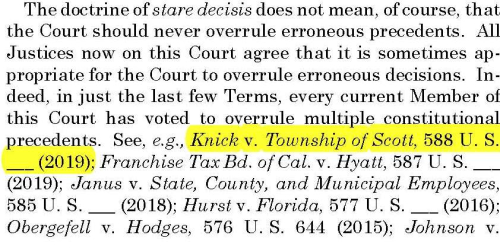
For example, in yesterday’s opinions about whether the Sixth Amendment requires unanimous criminal juries (yes), Justice Kavanaugh, commenting on the Court’s overruling of earlier decisions — the whole stare decisis debate — wrote this:

Knick reference

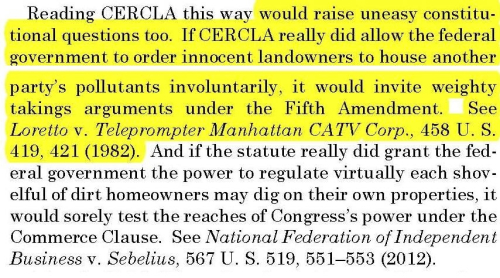
In the Montana CERCLA case we’ve been following (we attended arguments back in December), Justice Gorsuch noted the same takings vibe we noted. See “Shades Of Presault In Big SCOTUS Superfund Arguments” — that, like rails-to-trails cases, the feds may have the power to infringe on property rights, but that then raises the takings question:

CERCLA

We raised the same “storage of government’s stuff” on your property/Loretto

Continue Reading Shades Of Takings In Both Of Yesterday’s SCOTUS Opinions

Here’s the latest in a case we’ve been following. We even visited the site with our class last year. 

Today, the Virginia Supreme Court heard argument on the petition for appeal (streaming above from the webstream, or download the mp3 here) in what we call the oyster case because it involves the property rights of Nansemond River oystermen, whose oyster beds were polluted by sewage from the City of Suffolk.

Bottom line from today’s argument: no decision yet. These arguments are short (10 minutes), only the petitioner is allowed to argue, and today’s argument did not elicit any questions from the three-Justice panel. So we wait. 

Some background, since this is a case at the intersection of property and takings law, and environmental protection. The oystermen own a lease from the state for the riverbed, which among other things, allows them to harvest some of the oysters that Virginia

Continue Reading SCOVA Oral Argument: Does A City Have The Right To Pollute Chesapeake Bay?

As long-time readers know, we often kvetch about the way many courts ignore the Palazzolo rule that simply because someone obtains property subject to preexisting restrictions on use does not preclude them automatically from raising takings claims. See here, here, here, and here, for example. More about the Palazzolo case here, including video.

But not all courts get it wrong, however. Now you can add to the plus-column the Florida District Court of Appeal (Second District)’s decision in Jamieson v. Town of Fort Myers Beach, No. 2D19-238 (Mar. 25, 2020).

The court held that a property owner who purchased land that earlier had been designated as 100% “wetlands” on the Town’s land use map was not prohibited from pursuing takings (and since this is Florida, Bert Harris Act) claims. The case is a two-fer, because the court also concluded that the claims were ripe

Continue Reading Talkin’ ‘Bout My Palazzolo: Takings Claim Not Precluded Because Owner Purchased Land Already Subject To Wetlands Regs

Missed out on the 2021 ALI-CLE Eminent Domain and Land Valuation Litigation Conference swag?

Well fear not: here’s your chance to get your high-class reminder — a kit of road warrior essentials — to save the Conference date on your calendar. We’re already underway with planning the agenda and faculty, so it’s never too soon to block it off (January 28-30, 2021, at the 4-Diamond DoubleTree Resort, Scottsdale, Arizona). 

If you were not able to get your swag in Nashville, send us a note (rht@hawaiilawyer.com) and we shall gladly drop one or two in the mail to you.

While supplies last!  Continue Reading Unboxing The 2021 (Scottsdale) ALI-CLE Eminent Domain Conference Swag: Get Yours Today!

Complaint front page

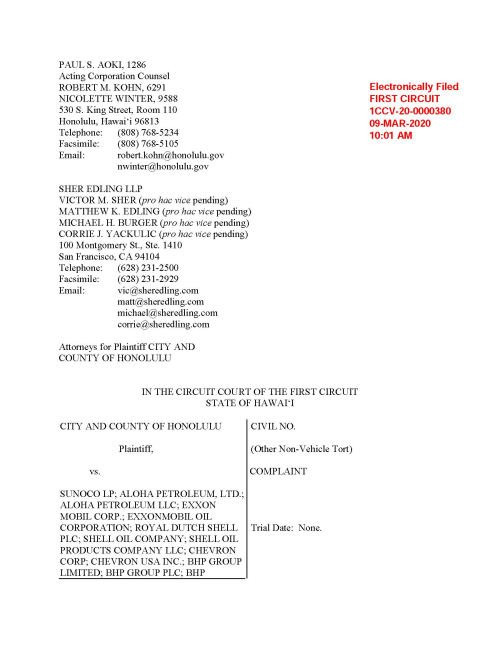
Make what you will of this 205-paragraph, 114 page (including 128 footnotes) Complaint, filed yesterday by the Acting Corporation Counsel for the City and County of Honolulu and a battery of outside lawyers against gasoline producers, alleging that they are responsible to pay the costs of sea-level rise and other symptoms of what the complaint calls the “climate crisis.”  

It’s a challenging read, but the fun part is in the claims for relief (fast forward to page 99), which include (for you property mavens) nuisance, private nuisance, and trespass (by flooding), as well as affirmative and negligent failure to warn of the dangers of fossil fuel products. 

Will this lawsuit go anywhere? Is a big municipal payday in the cards? Will it get to a local jury? Your guess is as good as ours. But we’ll be following along, for sure.  

Complaint, City and County of Honolulu v. Sunoco

Continue Reading Complaint: Honolulu Sues Gas Companies (For Nuisance) To Recover The Cost Of Sea-Level Rise

IMG_20200303_191820

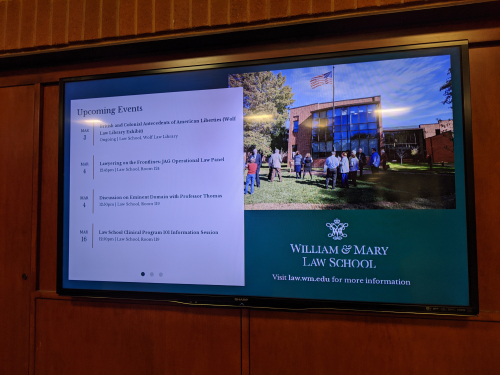
We just completed a fun hour-long talk with the students in the William and Mary Law School’s American Constitution Society, the Native American Law Society, and the Society on Environmental and Animal Law about the various pipeline cases that are ongoing nationwide. (If our tech worked, we shall post the audio recording in a future post.)

The theme of our talk was that these cases are an excellent illustration of the need for lawyers to think outside their usual lanes when it comes to addressing and solving their clients’ problems, because they present a smorgasbord of legal issues that range from property and eminent domain law, to administrative law, constitutional law, state and local government law, environmental law, federal courts, and civil procedure. 

The lawyers who are litigating these cases have done a good job of not being bound by convention and thinking creatively. They are thankfully analyzing the cases

Continue Reading Cases And Materials From Today’s WM Law ACS Talk: “Pipelines at the Intersection of Environmental, Administrative, and Property Law: How Divergent Interests Joined Forces To Challenge Big Energy”

We were all set to take a deeper dive into the Court of Federal Claims’s recent opinion in the “downstream” Harvey flooding cases (we could not do so at the time the opinion was issued last week because we were tied up doing real lawyer stuff), when our Reno, Nevada colleague Steve Silva (who most recently was on the faculty at the ALI-CLE Conference in Nashville) beat us to the punch.

On his Taking Nevada blog, Steve has posted “Major flood decision in Texas turns on Divine Intervention” —

Analyzing and comparing tort to taking is difficult. A tort is generally seen as something wrongful. A private injury committed by one person against another. A classic “taking” by exercising the power of eminent domain in direct condemnation to acquire land and pay compensation is not a wrongful act. It merely is.

Further complicating things, the clearest

Continue Reading Steve Silva (Taking Nevada) On Flood Takings, Torts, And Tortes

Openthefloodgates

We’re doing lawyer things this week, so can’t do much blogging, so we’re going to just leave this here, the Court of Federal Claims’s Opinion and Order in the case seeking compensation for a taking by the “downstream” owners whose lands were flooded by the U.S. Army Corps of Engineers in the aftermath of Hurricane Harvey. 

Short story: no property, no taking. 

How does the following square with the same court’s (but a different judge’s) ruling about the “upstream” owners?

Two questions must be asked. First, what property did the government take? Second, how did the government take that property? The answers to these questions go to the heart of the Constitution’s taking clause. The waters that actually caused the invasion came from the unprecedented floodwaters from Hurricane Harvey when it stalled over Houston for four days, dumping approximately thirty-five inches of water on Harris County. See Plaintiffs’ Appendix (hereinafter

Continue Reading CFC: God Forced Corps Of Engineers To Open Floodgates

EOGnEv8W4AAoKnI

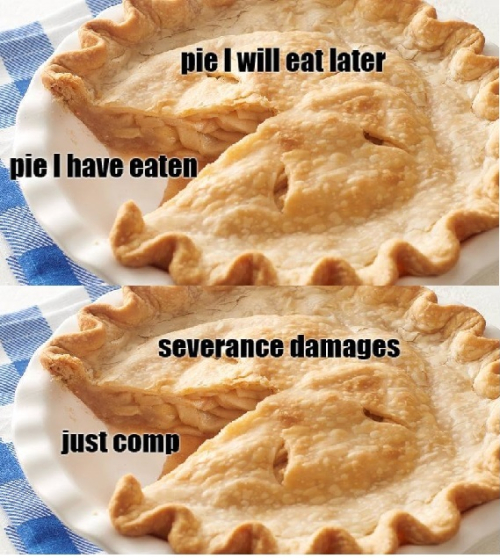
Picture 1: how normal people see pie.

Picture 2: how you see pie if you’re coming to the
ALI-CLE Eminent Domain Conference. 

If you get the above, you probably are already set to join us next week for the 37th Annual ALI-CLE Eminent Domain and Land Valuation Litigation Conference in Nashville. (If not, shame on you!).

And having just reviewed the latest registration list, I can report that we have an all-time record attendance.  But there’s still room for those of you still not committed. Register here. Don’t miss out. There will be pie. Continue Reading Record Attendance (But There’s Still Time For You Last-Minute Filers) At Nashville ALI-CLE Eminent Domain Conference