ELHy3bhUYAAdM4B

If there’s one downside to the law school experience from the teacher’s side of the lectern, it’s grading. Especially at a law school like William and Mary that has a pretty strict mandatory curve.

In an upper-division course like “Eminent Domain and Property Rights Law,” where we’re dealing with some very high-level stuff and the quality of the students is uniformly excellent, that makes for some hard choices at this time of year. But we’ve wrapped up grading, and have submitted the official scores.

Although I cannot share with you all the papers themselves, I don’t think my students would mind if I give you a sampling of the topics and titles, just so you can see how the next generation of lawyers is thinking about this area of law: 

  • One Man’s Castle is Another Man’s Parking Lot: A Homeowner’s Theory of Eminent Domain
  • Native Title: Concept and


Continue Reading The Circle Is Now Complete: A Sampling Of Final Paper Topics From William and Mary Law’s Eminent Domain & Property Rights Course

Planet-of-the-apes-statue-of-liberty-blu-ray-disc-screencap-hd-1080p-05

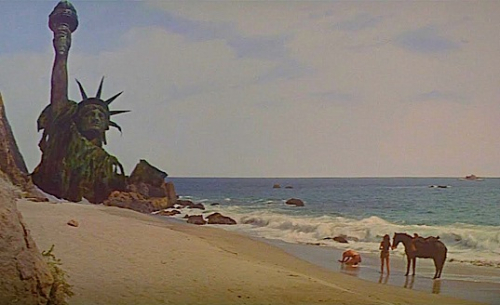
We gave up long ago expecting rationality and straight-up-the-middle narratives when it comes to cases about beaches and beach access. People get kind of nuts about that for some reason. We get why. Who doesn’t love a beach? Even a beach that could serve as the location if Planet of the Apes is re-made again. Don’t believe us? See this recent video. Or this story with a picture from the 1980s. 

But we overcame our usual reluctance to dive into these stories for the latest in a case we’ve been following, as it wound the way from California’s trial and appeals courts, to the U.S. Supreme Court on a (denied) judicial takings cert petition, to the California legislature which was threatening to condemn and buy the property, to a recent unreported California appellate decision affirming a finding of no public easement, and now this, a recently-filed complaint against

Continue Reading California Coastal Comm’n: We’re Suing Evil Rich Guy Who Is Blocking Access To The Forbidden Zone (Even Though Court Just Ruled The Other Way On The Same Issues In A Similar Case)

One does not simply walk to nashville

You can also fly, drive, or bike to the upcoming 37th Annual ALI-CLE Eminent Domain & Land Valuation Litigation Conference. in Nashville. Limited space still available, so don’t delay further and register now. We’re on track to record attendance, so you don’t want to miss the best nationally-focused three-day program on our area of law.

Takings, Knick, compensation, appraisals … and a bit of fun thrown in. We have many new attendees, and many new speakers, too.  Continue Reading (Nearly) Last Chance To Join Us In Nashville For ALI-CLE’s Eminent Domain Conference

Here are some of the stories and analysis about yesterday’s ruling by the Court of Federal Claims holding the federal government liable for a taking for the flooding following Hurricane Harvey in the Houston area:

As we wrote yesterday, this one isn’t over by a long shot, so stay tuned.Continue Reading Harvey Flood Takings Round-Up

We won’t go into the details of the Court of Federal Claims’ opinion and order in In re Upstream Addicks and Barker (Texas) Flood Control Reservoirs, No. 17-9001L (Dec. 17, 2019), since it is 46 single-spaced pages long. You can (and should) read the entire thing. But we shall highlight of a few of the highlights, since this is definitely a case to watch, especially as it progresses to the (inevitable) appeal to the Federal Circuit. 

This is the case in which Texas owners whose property upstream of two government created and maintained dams was intentionally flooded by the Corps of Engineers after Hurricane Harvey sued the feds for just compensation for a taking. The government sought dismissal, but after a 10-day trial, the CFC held the government is “liable for a taking on a flowage easement on the [thirteen test] properties.” Slip op. at 3. 

The court summarized

Continue Reading CFC: “Calculated” Hurricane Harvey Flooding Is A Taking – But Will Decision Survive Federal Circuit Review?

Yesterday, our friends and colleagues at the Institute for Justice (Diana Simpson and Bob McNamara) welcomed us to their studios to record an episode of the Short Circuit” podcast.

We talked property, takings, Virginia oysters, the cert petition about Colorado eminent domain abuse, and how the Supreme Court of the Republic of the Philippines would handle cases like Berman v. Parker and Hawaii Housing Authority v. Midkiff

Listen in, and subscribe to the podcast (we don’t miss an ep). 

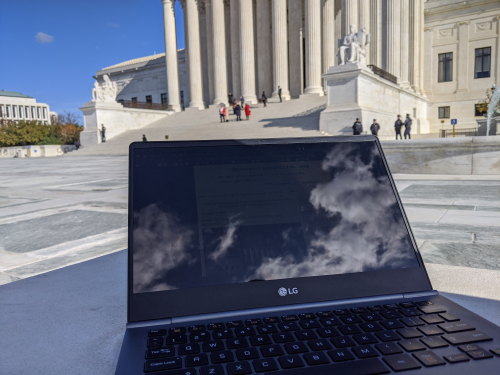
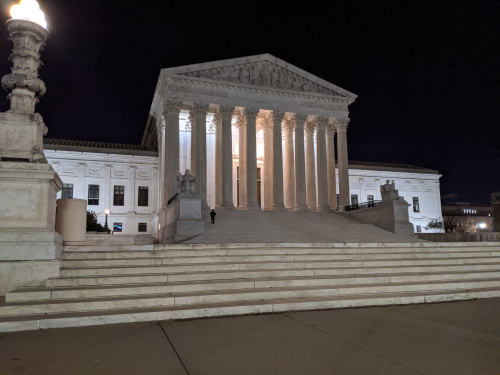
And yes, we really did write up yesterday’s blog post from the Supreme Court steps. Proof:

IMG_20191203_125502 (1)Continue Reading We Join IJ’s “Short Circuit” Podcast To Talk Virginia Oyster Takings, Colorado Wild Eminent Domain Abuse Cert Petition, And Berman International

IMG_20191203_055735

We are noted for our ability to find takings and property issues nearly anywhere, and two cases argued today at the Supreme Court — where we had the pole position in the Bar line as the above photo proves — are no exception, even though the first was a case about a tax refund, and the second was about the Superfund statute. 

The tax case was a bit of a stretch, we admit. But there was a brief colloquy about how a taxpayer has property rights to any refund. When we heard that, we sure perked up. There was more to glom onto in the second case on CERCLA (Superfund) where the issue is whether the federal statute allows property owners whose land is contaminated to sue the contaminator under state tort and property law to clean it up. 

As we understand the issues, Atlantic Richfield is such a contaminator

Continue Reading Shades Of Preseault In Big SCOTUS Superfund Arguments

Following up on the petition, filed last Friday, asking the Virginia Supreme Court to review a trial court’s demurrer which failed to recognize that the owners of a state lease to harvest oysters in the Nansemond River have a property interest . The court concluded that the city and santitation district possess a superior right to pollute the river with sewage.

The case arose when the city and sanitation district declared the oysterbeds “condemned” during certain times of the year because they put sewage into the river. They denied compensation, and the trial court held that Darling v. City of Newport News, 249 U.S. 540 (1919) subjected the lease owners to the city’s superior right to pollute.

We paid a visit to the site a couple of weeks ago to see the pollution source, and how the oysters are harvested in the river. The above video is from that

Continue Reading Videos: Oyster Takings On The Nansemond River