MVIMG_20191108_125325

Just filed: this Petition for Appeal in a case which our William and Mary Law class has a special interest in.

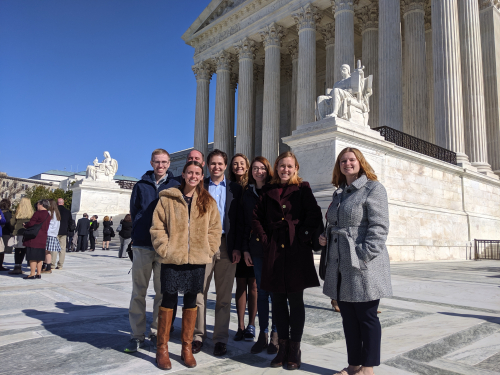
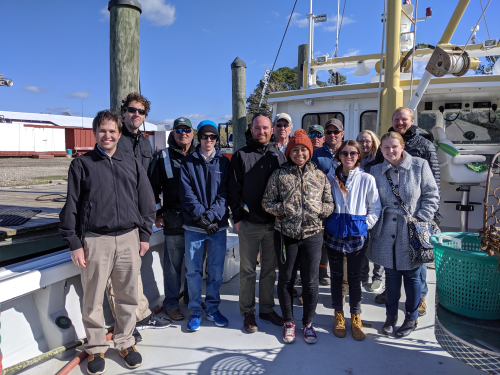
The above photo was taken a couple of weeks ago, when we paid a visit to the property owner/plaintiffs, the owners of a long-standing oyster business operating out of the City of Suffolk, Virginia. The oystermen own a lease from the state for the riverbed, which among other things, allows them to harvest some of the oysters that Virginia is so well known for. But they were forced to bring an inverse condemnation claim in state court, asserting that the City’s dumping of wastewater in the river — and prohibiting the harvesting of oysters during those times — was a taking under both the U.S. Constitution, and Virginia’s taking or damaging clause.

The trial court sustained the City’s demurrer, accepting the City’s argument that it has the right
Continue Reading City: We Have The Right To Pollute – Virginia Oystermen’s Petition Asserting A Taking

We were not as creative as our colleague Paul Henry (see below), but our Planning Co-Chair Joe Waldo and I wanted to personally invite you to join the “big guns” in our area of law at the 37th Annual ALI-CLE Eminent Domain and Land Valuation Litigation Conference, January 23-25, 2020, in Nashville, Tennessee.

We’ve assembled an excellent faculty, and an agenda that covers the hot topics of the day. Go here to view the complete faculty list and agenda. Water rights, Knick, appraisal, ethics, civil rights, and a whole lot more in three days of the longest (and we think best) conference in our area of law. Also, for those new to the field, Andy Brigham and Jack Sperber are again leading their “Eminent Domain 101” program. A great way to learn the topic, or for experienced lawyers to get a quick refresher on the basics. Your registration

Continue Reading Don’t Miss Out: Join The “Big Guns” And Secure Your Space At ALI-CLE’s Upcoming Eminent Domain & Land Valuation Litigation Conference (Jan 23-25, 2020, Nashville)

20170918_185734_Richtone(HDR)

Here’s the latest in a case we’ve been following for a while, Smyth v. Conservation Comm’n of Falmouth, No. 19-223 (cert. petition filed Aug. 16, 2019). 

The petition seeks review of a Massachusetts decision which held that a judge, not a jury, determines Penn Central takings questions, and also that the owner lost anyhow because, you know, Penn Central. The petition asks the Supreme Court to review these Questions Presented:

  1. Whether the loss of all developmental use of property and a 91.5% decline in its value is a sufficient “economic impact” to support a regulatory takings claim under Penn Central.
  2. Whether a person who acquires land in a developed area, prior to regulation, has a legitimate “expectation” of building and, if so, whether that interest can be defeated by a lack of investment in construction?
  3. Whether the Court should excise the “character” factor from Penn Central regulatory


Continue Reading Latest In SCOTUS Penn Central Cert Petition

IMG_20170726_181554

You may recall that last October, we attended the first round of Supreme Court oral arguments in the Knick case with our William and Mary law class (Law 608: Eminent Domain and Property Rights).  

And even though there’s not a takings case on the Court’s current docket, we figured that the Maui Clean Water Act case was close enough. So we road-tripped it from Williamsburg to DC last Wednesday. And to make sure the six-plus hour round trip was not filled with awkward silence, like last year we asked each attendee to supply at least two songs for our playlist: one song a good “driving” song; the other a song that could be somehow connected to either our class topic (property rights, eminent domain, land use, and similar), or the day’s Clean Water Act and environmental issues. Well done, class, for being creative. 

Here’s what we came up with:

Continue Reading Law 608’s [Continuing] Playlist: More Takings And Related Road Trip Music

IMG_20191106_112246

Protip for the public line for SCOTUS arguments: you have to get there really early. As in really early. Before 5 am early. Because that’s the time that we, along with some of our William and Mary Law students (pictured above, after the arguments), arrived at 1 First Street NE to take up our place in line yesterday for the arguments in the Maui Clean Water Act case. And we were — literally — the very last allowed in for the full arguments. We roadtripped it from Williamsburg (more on that in a future post), meaning that we awoke long before 5am, leaving the law school at an ungodly hour. It would have been a shame to have taken all that effort, only to not get in. So heads-up line standers: get there early.

Why all this effort, you may ask? After all, you can read the transcript the same

Continue Reading Hot Take On The Maui Clean Water Act Arguments (Protip: ARRIVE EARLY)

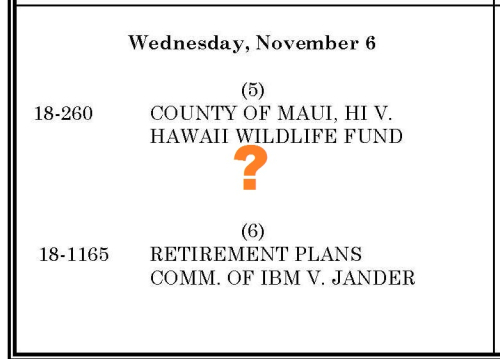
We’re on the road early tomorrow for another visit to SCOTUS with our William and Mary Law School class. We hope to get in for the arguments in the Maui Clean Water Act case. Last year, we attended the first Knick arguments in October, and we wanted to repeat the experience for this year’s students.

Yeah, we know that technically, the CWA case does not involve property or takings. But come on, it’s all we’ve got on the docket right now, and the case is very important to property owners who — if Earthjustice’s arguments are accepted by the Court — will only know if they are liable under the Clean Water Act for not getting a permit after they don’t get a permit. As we see it, the linkage test the respondent has advanced means that if a connection between a no-permit point source of pollution and waters

Continue Reading Road Trip SCOTUS: Maui Clean Water Act Oral Arguments (11/6/2019)

Registration underway, so come join us! Agenda full of hot topics in takings and appraisal law! The best national faculty! Renew friendships, and make new colleagues! And Nashville! 

Download the brochure and make your plans for January. (Don’t wait, we’ve sold out the past three years.)Continue Reading Register Now! ALI-CLE Eminent Domain And Land Valuation Litigation Conference (Nashville, Jan 23-25, 2020)

Here’s the other shoe that we’ve been waiting to drop.

Recall that in our last post on the pending Clean Water Act case (SCOTUS oral arguments scheduled for November 6, 2019 – yeah, as in one week from tomorrow), we suspected that a declaratory judgment action would be filed in a Hawaii state court to resolve the internal dispute between the various branches of the Maui County government about which branch(es)’s approval is needed to settle the case. On one side, the Mayor claims that the settlement of the CWA case needs his approval (which he isn’t giving). The Corporation Counsel’s analysis backs his argument up. On the other side, the County Council — which, by a one-member margin voted to settle the case because the CWA plaintiff’s lawyers are terrified of what the Supreme Court might do with the case — who assert that they alone have

Continue Reading Citizens Sue Maui Mayor (Finally) To Force Him To Settle SCOTUS Clean Water Act Case – But Is It Too Late To Scuttle The Arguments?

With the ongoing wildfire dramas ongoing across California, several of you have asked us to collect the posts we have done about inverse condemnation liability in one place. So here you go:

As you can see from the above video, this one isn’t over. Stay tuned.Continue Reading All Of Our Past California Wildfires And Inverse Condemnation Posts

MonthlyArgumentCalNovember2019

We’ve been following the ongoing efforts to settle the Clean Water Act case involving the County of Maui with some amusement. 

Why, you ask? Part of it is that we like municipal law. (Perhaps sad, but true.) But we’re amused mostly because the case’s current posture illustrates the dual principles of “be careful what you ask for,” and the legal corollary of one of Murphy’s Rule of Combat (“No plan ever survives first contact”): that you may be able to start a lawsuit on your own terms, but you may not always be able to end it the same way. 

The plan here seemed pretty good. Sue the County for violating the CWA for its injection wells, asserting it should have obtained a CWA permit. Yes, the line between a “point source” and a “nonpoint source” was not settled law, but the case seemed like a very good bet. The

Continue Reading Who Is In Charge At The County Of Maui? SCOTUS OA Hinges On Internal Dispute Over Who Can Settle