Another invasion-by-sewage claim, another opportunity for bad punning.

What do you do when a municipality’s wastewater system malfunctions and “strew[s] [your] yard with condoms, toilet paper, raw sewage, and feminine hygiene products and force[s] [you] to endure ‘horrendous odors.'””

According to the U.S. Court of Appeals for the Fifth Circuit in Stringer v. Town of Jonesboro, No.20-30192 (Jan. 18, 2020), you don’t “seek help from the Town and its Mayor,” you sue for inverse condemnation. Don’t wait, go to court now.

All this started back in 2013, and continued until 2019, when Stringer sued in federal court for a taking (42 U.S.C. § 1983), and a citizen suit for violations of the Clean Water Act. The District Court dismissed the takings claim for being raised after the one-year statute of limitations, and the CWA claim because the Louisiana Department of Health had commenced enforcement of the state’s Sanitary
Continue Reading CA5: Property Owner SOL For Sewage Takings Claim: Continuous Invasion Becomes Constitutional Simply Because The Govt Does It For A Long Time

There are two main rationales supporting the Pennsylvania Commonwealth Court’s opinion in Pileggi v. Newton Township, No. 1279 CD 2019 (Jan. 5, 2021), holding that the Township’s denial of a permit was not a taking. The first, in our view, is simply wrong. The second is perhaps more supportable, but still troubling.

This is a case about a gong. No, not the brass instrument gong, but the other type. Pennsylvania law requires the Township to have a waste plan. Under the plan, a landowner can make proposals for how she can develop in accordance with the plan, or if she can show that the plan doesn’t meet the property’s needs she may submit a private request to the state’s Department of Environmental Protection, or in some circumstances an owner may request a permit to build a sewage disposal facility on site.

Starting back in 2003, the property owners

Continue Reading The PA Gong Show: No Taking When Gov’t Exercising Police Power (Say What?)

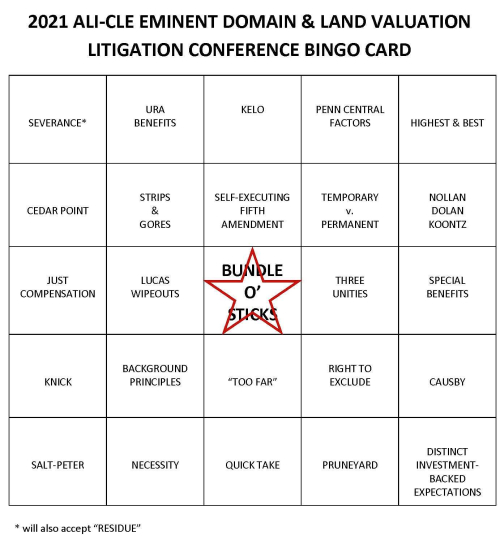
ALI-CLE 2021 Bingo card

If you “get” this, you should be registered for the 38th Annual Eminent Domain & Land Valuation Litigation Conference, to be held remotely on Thursday and Friday, January 28-29, 2021.

The list is growing rapidly, and you need to join us!

This is the “big one” where the nation’s best practitioners, scholars, jurists, and other industry professionals gather to talk shop about the subjects we know and love. We’re having programs with intriguing subjects such as “Planning to Win: Practical Strategies for a Successful Inverse Condemnation Case,” “How Do I Keep My Firm’s Doors Open When the Courthouse Doors Are Closed? Making Your Practice More Efficient When You Can’t Try Cases,” “Where Is the Supreme Court Headed on Takings Cases? Regulatory Takings Update and Cedar Point Preview,” “No Show and All Tell: Breaking News in Property Rights and Takings,” “More Than the Fifth Amendment: Other Tools for Upholding

Continue Reading Your 2021 ALI-CLE Eminent Domain & Land Valuation Litigation Conference (Jan 28-29, Remote) BINGO Card

1o 11 ALI-CLE

Are you a law student interested in takings, eminent domain, land use, environmental, and other dirt-lawyering related topics? If so, good news: thanks to the generosity of ALI-CLE, you can register gratis (free!) for the upcoming 38th Annual Eminent Domain & Land Valuation Litigation Conference, to be held remotely on Thursday and Friday, January 28-29, 2021.

This is the “big one” where the nation’s best practitioners, scholars, jurists, and other industry professionals gather to talk shop about the subjects we know and love. We’re having programs with intriguing subjects such as “Planning to Win: Practical Strategies for a Successful Inverse Condemnation Case,” “How Do I Keep My Firm’s Doors Open When the Courthouse Doors Are Closed? Making Your Practice More Efficient When You Can’t Try Cases,” “Where Is the Supreme Court Headed on Takings Cases? Regulatory Takings Update and Cedar Point Preview,” “No Show and All Tell:

Continue Reading Law Students: Register Free For The 38th Annual ALI-CLE Eminent Domain & Land Valuation Litigation Conference (Jan 28-29, 2021)

Our thanks to Clint Schumacher for having us on his program to talk about the upcoming Conference. We’re “remote” this year, but that means a different approach to our presentations (and a very modest tuition!).

We’re having programs with intriguing subjects such as “Planning to Win: Practical Strategies for a Successful Inverse Condemnation Case,” “How Do I Keep My Firm’s Doors Open When the Courthouse Doors Are Closed? Making Your Practice More Efficient When You Can’t Try Cases,” “Where Is the Supreme Court Headed on Takings Cases? Regulatory Takings Update and Cedar Point Preview,” “No Show and All Tell: Breaking News in Property Rights and Takings,” “More Than the Fifth Amendment: Other Tools for Upholding Property Rights,” “Evaluating Lockdown, Moratorium, and Emergency Claims,” and more (including Ethics for those of you in MCLE jurisdictions). We’ll have a post with more details. 

Register now!Continue Reading Eminent Domain Podcast’s Preview Of The Upcoming ALI-CLE Eminent Domain & Land Valuation Litigation Conference

Often, the dispositive question in many takings cases tuns on whether the plaintiff owns “property,” and if so, what rights does that recognize. If you define the property in such a way that ipse dixit excludes the “stick” the owner claims was taken, then the answer is always going to be no property, no taking. To us, this is largely a question of definitions and policy: is this interest, in a judge’s view, worthy of constitutional protection?

And that’s the wrong approach, because this analysis often seems more like a semantic exercise, undertaken by the wrong party. Instead of concluding, for example, that the property in a case is a lease (a recognized property interest) and then going on to ask whether there’s been a sufficient interference with an owner’s distinct investment-backed expectations, the question shifts from what we think is the proper focus (a fact question of the impact

Continue Reading Surf And Turf (Our Beef With The Virginia Oyster Takings Case): Although Leases Are “Property,” They Don’t Confer A Right To Exclude Government Sewage

We listened live last week, but the court has now made the recording available in Johnson v. City of Suffolk.

This is what we call the “oyster takings” case in which Nansemond River oystermen claim that their property was taken when the City of Suffolk and the Sanitation District dumped sewage into the river and declared a “condemnation zone” (i.e., no oyster harvesting).

This is a case at the intersection of property and takings law, and environmental protection. And the public trust concept of jus publicum. The oystermen own a lease from the State of Virginia for the riverbed, which among other things, allows them to harvest some of the oysters that Virginia is so well known for. But they were forced to bring an inverse condemnation claim in state court, asserting that the City’s dumping of wastewater in the river — and prohibiting the

Continue Reading Recording Now Available In Virginia Supreme Court Oral Arguments In Takings, Property, And Public Trust Case

Here’s the latest in a case we’ve been following even before its inception (last semester, our William and Mary class visited the site and witnessed the oyster operation affected – see video above), Johnson v. City of Suffolk.

This morning, the Virginia Supreme Court heard oral arguments in the case, and we livestreamed it during our class. (We can’t post the audio recording just yet; those are released on Fridays, so hold on just a bit longer if you missed the live event.)

This is what we call the “oyster takings” case in which Nansemond River oystermen claim that their property was taken when the City of Suffolk and the Sanitation District dumped sewage into the river and declared a “condemnation zone” (i.e., no oyster harvesting).

This is a case at the intersection of property and takings law, and environmental protection. And the public trust concept of

Continue Reading Virginia Supreme Court Oral Arguments In Takings, Property, And Public Trust Case

Bk_2020_02_475

In case you missed any part of it: the recordings of the recent 2020 Brigham-Kanner Property Rights Conference are now available.

Go here for the descriptions of the panels, speakers, and links to the recorded sessions.

This year’s conference, held on October 1-2, opened with the Brigham-Kanner Property Rights Prize being awarded to Professor Henry E. Smith of Harvard Law School. The prize is named in honor of the lifetime contributions of Toby Prince Brigham, founding partner of Brigham Moore, LLP, and Gideon Kanner, professor of law emeritus at Loyola Law School in Los Angeles, and is presented annually to a scholar, practitioner or jurist whose work affirms the fundamental importance of property rights.

Topics covered: “Where Theory Meets Practice: A Tribute to Henry E. Smith,” “The Housing Crisis,” “Emerging Issues in Takings and Eminent Domain Law,” “The Reach of Government’s Confiscatory Powers over Exigencies and Emergencies,” and “The

Continue Reading Brigham-Kanner Property Rights Conference Videos Now Available