25 Years of PASH_Schedule

Mention the term “PASH” to any dirt lawyer in the 50th State, and they’ll nod in understanding. It’s an 808 shibboleth — a kind of local property password — that signals that you’ve been around the block and know your stuff.

On one hand, it is simply an acronym for Public Access Shoreline Hawaii, the plaintiff/petitioner in the (in)famous case Public Access Shoreline Hawaii v. Hawaii Cnty. Planning Comm’n, 903 P.2d 1246 (Haw. 1995). On the other, however, it has evolved into shorthand for a number of things: from the technically accurate – native Hawaiian customary and traditional rights and practices under the Hawaii Constitution (“I was chasing a pua’a on private property, so I cannot be convicted of trespass because I was exercising my PASH rights”); to generically and cheekily – the ability to access the beach and shoreline (“Surf’s up today, let’s go practice some PASH rights!”)

Continue Reading PASH Bash: U. Hawaii Law Review Symposium – “25 Years of PASH” (Feb. 5, 2021)
Another invasion-by-sewage claim, another opportunity for bad punning.

What do you do when a municipality’s wastewater system malfunctions and “strew[s] [your] yard with condoms, toilet paper, raw sewage, and feminine hygiene products and force[s] [you] to endure ‘horrendous odors.'””

According to the U.S. Court of Appeals for the Fifth Circuit in Stringer v. Town of Jonesboro, No.20-30192 (Jan. 18, 2020), you don’t “seek help from the Town and its Mayor,” you sue for inverse condemnation. Don’t wait, go to court now.

All this started back in 2013, and continued until 2019, when Stringer sued in federal court for a taking (42 U.S.C. § 1983), and a citizen suit for violations of the Clean Water Act. The District Court dismissed the takings claim for being raised after the one-year statute of limitations, and the CWA claim because the Louisiana Department of Health had commenced enforcement of the state’s Sanitary

Continue Reading CA5: Property Owner SOL For Sewage Takings Claim: Continuous Invasion Becomes Constitutional Simply Because The Govt Does It For A Long Time

There are two main rationales supporting the Pennsylvania Commonwealth Court’s opinion in Pileggi v. Newton Township, No. 1279 CD 2019 (Jan. 5, 2021), holding that the Township’s denial of a permit was not a taking. The first, in our view, is simply wrong. The second is perhaps more supportable, but still troubling.

This is a case about a gong. No, not the brass instrument gong, but the other type. Pennsylvania law requires the Township to have a waste plan. Under the plan, a landowner can make proposals for how she can develop in accordance with the plan, or if she can show that the plan doesn’t meet the property’s needs she may submit a private request to the state’s Department of Environmental Protection, or in some circumstances an owner may request a permit to build a sewage disposal facility on site.

Starting back in 2003, the property owners

Continue Reading The PA Gong Show: No Taking When Gov’t Exercising Police Power (Say What?)

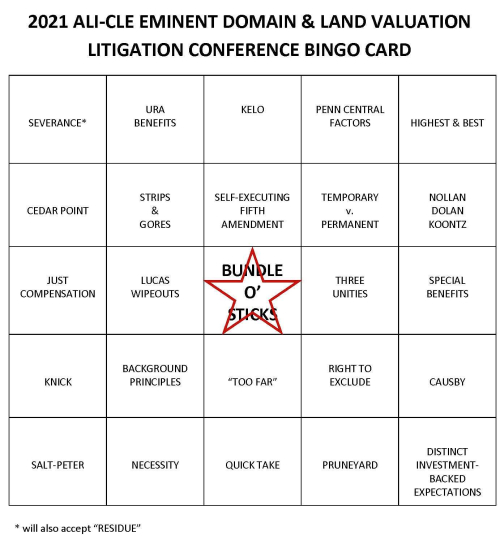
ALI-CLE 2021 Bingo card

If you “get” this, you should be registered for the 38th Annual Eminent Domain & Land Valuation Litigation Conference, to be held remotely on Thursday and Friday, January 28-29, 2021.

The list is growing rapidly, and you need to join us!

This is the “big one” where the nation’s best practitioners, scholars, jurists, and other industry professionals gather to talk shop about the subjects we know and love. We’re having programs with intriguing subjects such as “Planning to Win: Practical Strategies for a Successful Inverse Condemnation Case,” “How Do I Keep My Firm’s Doors Open When the Courthouse Doors Are Closed? Making Your Practice More Efficient When You Can’t Try Cases,” “Where Is the Supreme Court Headed on Takings Cases? Regulatory Takings Update and Cedar Point Preview,” “No Show and All Tell: Breaking News in Property Rights and Takings,” “More Than the Fifth Amendment: Other Tools for Upholding

Continue Reading Your 2021 ALI-CLE Eminent Domain & Land Valuation Litigation Conference (Jan 28-29, Remote) BINGO Card

If you are lacking good things to read, fear not: thanks to amici curiae, you now have boocoo merits-stage friend-of-the-court briefs (16!) on your plate.

This is the case in which the U.S. Supreme Court is considering the nature of physical invasion takings, and how permanent a permanent intrusion must be in order to qualify for Loretto and Kaiser Aetna-ish per se treatment. In Cedar Point Nursery v. Shiroma, 923 F.3d 524 (May 8, 2019), a 2-1 panel of the Ninth Circuit affirmed the dismissal of a complaint for failure to plausibly state a takings claim under Twombly/Iqbal. At issue was a regulation adopted by California’s Agricultural Labor Relations Board which requires agricultural employees to open their land to labor union organizers. The regulation is framed as protecting the rights of ag employees to “access by union organizers to the premises of an agricultural

Continue Reading No Shortage Of Amicus Briefs In SCOTUS Physical Invasion Takings Case

1o 11 ALI-CLE

Are you a law student interested in takings, eminent domain, land use, environmental, and other dirt-lawyering related topics? If so, good news: thanks to the generosity of ALI-CLE, you can register gratis (free!) for the upcoming 38th Annual Eminent Domain & Land Valuation Litigation Conference, to be held remotely on Thursday and Friday, January 28-29, 2021.

This is the “big one” where the nation’s best practitioners, scholars, jurists, and other industry professionals gather to talk shop about the subjects we know and love. We’re having programs with intriguing subjects such as “Planning to Win: Practical Strategies for a Successful Inverse Condemnation Case,” “How Do I Keep My Firm’s Doors Open When the Courthouse Doors Are Closed? Making Your Practice More Efficient When You Can’t Try Cases,” “Where Is the Supreme Court Headed on Takings Cases? Regulatory Takings Update and Cedar Point Preview,” “No Show and All Tell:

Continue Reading Law Students: Register Free For The 38th Annual ALI-CLE Eminent Domain & Land Valuation Litigation Conference (Jan 28-29, 2021)

As we surmised when the Supreme Court in Knick reopened the door to the federal courthouse for federal takings claims, those of us who do this stuff would be wise to dust off the Federal Courts treatises that we’d put on the high shelf on the bookshelf since Williamson County.

The Sixth Circuit’s opinion in CHKRS, LLC v. City of Dublin, No. 20-3435 (Jan. 4, 2021) focused on the difference between whether the plaintiff alleged Article III standing, and whether it alleged a property interest protected by the Takings Clause. CHKRS’s federal complaint claimed the city violated the Takings Clause “when it tore out a property’s driveway and replaced it with a defective driveway without paying compensation.” Slip op. at 2. At the time of the city’s conduct, CHKRS possessed a lease in the land, and by the time of the federal lawsuit, it had exercised its

Continue Reading CA6: It’s Property, Not Standing, In Federal Takings Cases

Our thanks to Clint Schumacher for having us on his program to talk about the upcoming Conference. We’re “remote” this year, but that means a different approach to our presentations (and a very modest tuition!).

We’re having programs with intriguing subjects such as “Planning to Win: Practical Strategies for a Successful Inverse Condemnation Case,” “How Do I Keep My Firm’s Doors Open When the Courthouse Doors Are Closed? Making Your Practice More Efficient When You Can’t Try Cases,” “Where Is the Supreme Court Headed on Takings Cases? Regulatory Takings Update and Cedar Point Preview,” “No Show and All Tell: Breaking News in Property Rights and Takings,” “More Than the Fifth Amendment: Other Tools for Upholding Property Rights,” “Evaluating Lockdown, Moratorium, and Emergency Claims,” and more (including Ethics for those of you in MCLE jurisdictions). We’ll have a post with more details. 

Register now!Continue Reading Eminent Domain Podcast’s Preview Of The Upcoming ALI-CLE Eminent Domain & Land Valuation Litigation Conference

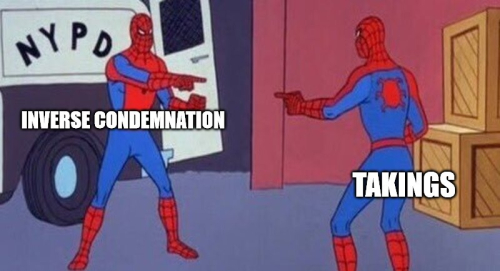
Inverse vs takings

In case you weren’t already aware, Georgia law apparently distinguishes between “inverse condemnation” claims and “takings” claims.

That was not the dispositive point the Georgia Court of Appeals made in its recent opinion in HBC2018, LLC v. Paulding County School District, No. A20A1993 (Dec. 21, 2020), but we thought we’d highlight here, just because:

As a threshold matter, we note that the Bank appears to conflate an inverse condemnation claim with a takings claim. See City of Tybee Island, Ga. v. Live Oak Group, 324 Ga. App. 476, 479 (751 SE2d 123) (2013) (concluding that appellants had failed to raise an inverse condemnation claim and declining to address whether a constitutional taking claim had been raised). An inverse condemnation claim ordinarily involves affirmative government action that causes a nuisance or a trespass, which diminishes the value of private property. See Id. (no inverse condemnation claim where there was

Continue Reading No Good Deed Goes Unpunished: Bank Has No Takings Claim Because School District Had No Obligation To Cover Borrower’s Loan