Check this out, the latest episode of the Pendulum Land Podcast, in which we briefly return to chat about what’s on the Thanksgiving menu (hint: Spam® and oysters).

Spam® because we 808 people like that stuff, and oysters because the Virginia Supreme Court recently heard oral arguments in an important inverse condemnation case involving…oysters. More on that case here, including the briefs.

Stream the episode above, or download it here.
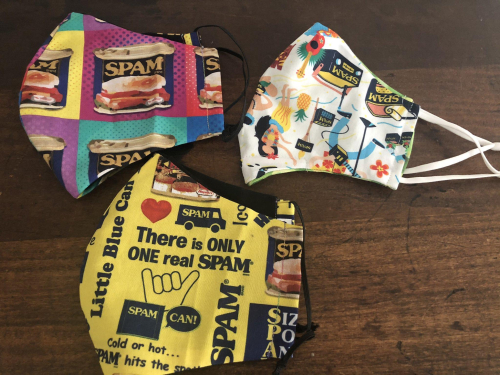
SPAM masks

Haiku was also on the menu. (We apologize in advance.)

Tabasco Spam® is
the best Spam® – no demurrer.
Exceptions overruled!

Darling, what is on
the court’s Thanksgiving menu?
Dare I say oysters?

Condemnor’s cocktail –
Care to imbibe a highball?
Regrets: lowballs only.

Kelo: very wrong.
With Barrett now in D.C.,
time to revisit?

Been relocated?
Right-of-way bumming your trip?
Pendulum swoops in.

Clint and Pendulum:
Podcasts together, in Continue Reading Spam® For Thanksgiving? Mais Oui!
Check this out, the Complaint we filed a couple of weeks ago in the U.S. District Court for the Western District of Virginia, in Grano v. Rappahannock Elec. Coop., No. 3:20-cv-00065-NKM (W.D. Va. Oct. 28, 2020).

It’s not a true “takings” case because the claims for relief are limited to due process and Contract Clause and the plaintiffs are not seeking just compensation, but there’s a takings flavor, because the due process problem alleged is failure to condemn and also provide for compensation.

We’re not going to comment in depth because it’s our case, and we’d rather just let the complaint speak for itself at this point. But the short story is that recently, the Virginia General Assembly adopted a statute directing that all existing easements in which the servient estate owner granted a right to use property for electrical distribution now include the right of the dominant estate

Continue Reading Is Virginia’s Legislative Rewriting Of Existing Electric Easements To Permit Fiber Optic Use Unconstitutional?

DSCF3357

Today, Friday, November 13, 2020, is the day that the Supreme Court is scheduled to decide whether to decide a case we’ve been following for a long time (and one in which we filed an amicus brief urging the Court to take up the case).

In Cedar Point Nursery v. Shiroma, 923 F.3d 524 (May 8, 2019), a 2-1 panel of the Ninth Circuit affirmed the dismissal of a complaint for failure to plausibly state a takings claim under Twombly/Iqbal. At issue was a regulation adopted by California’s Agricultural Labor Relations Board which requires agricultural employees to open their land to labor union organizers. The regulation is framed as protecting the rights of ag employees to “access by union organizers to the premises of an agricultural employer for the purpose of meeting and talking with employees and soliciting their support.”

The Ninth Circuit panel

Continue Reading It’s Conference Day For Case Asking How “Permanent” A Loretto Permanent Physical Invasion Taking Must Be

We listened live last week, but the court has now made the recording available in Johnson v. City of Suffolk.

This is what we call the “oyster takings” case in which Nansemond River oystermen claim that their property was taken when the City of Suffolk and the Sanitation District dumped sewage into the river and declared a “condemnation zone” (i.e., no oyster harvesting).

This is a case at the intersection of property and takings law, and environmental protection. And the public trust concept of jus publicum. The oystermen own a lease from the State of Virginia for the riverbed, which among other things, allows them to harvest some of the oysters that Virginia is so well known for. But they were forced to bring an inverse condemnation claim in state court, asserting that the City’s dumping of wastewater in the river — and prohibiting the

Continue Reading Recording Now Available In Virginia Supreme Court Oral Arguments In Takings, Property, And Public Trust Case

Screenshot_2020-11-05 Legal challenges regarding COVID-19 emergency orders

Join us next Tuesday, November 10, 2020 at 3pm ET (12 noon Pacific) for the free webinar “Shutdowns, Closures, Moratoria, and Bans,” produced by Pacific Legal Foundation and Owners’ Counsel of America.

Along with my colleagues Leslie Fields (Executive Director, OCA), and Jim Burling (PLF), I’ll be talking about the legal foundations for objections, some of the cases that have made their way to decision, and what the future might look like. To register (did I mention it was free?) go here.

Here’s the program description:

Governors and state legislatures across the country have implemented an array of policies in an attempt to contain the virus and its socioeconomic impacts. Many of these policies broadened the scope of government power while placing a heavy burden on property owners and businesses already struggling with the pandemic.

Join representatives from Pacific Legal Foundation and Owners’ Counsel of America as

Continue Reading Join Us: Tuesday, Nov. 10, 2020 (3pm ET, 12n PT) For Free (!) Webinar: “Shutdowns, Closures, Moratoria, and Bans”

Here’s the latest in a case we’ve been following even before its inception (last semester, our William and Mary class visited the site and witnessed the oyster operation affected – see video above), Johnson v. City of Suffolk.

This morning, the Virginia Supreme Court heard oral arguments in the case, and we livestreamed it during our class. (We can’t post the audio recording just yet; those are released on Fridays, so hold on just a bit longer if you missed the live event.)

This is what we call the “oyster takings” case in which Nansemond River oystermen claim that their property was taken when the City of Suffolk and the Sanitation District dumped sewage into the river and declared a “condemnation zone” (i.e., no oyster harvesting).

This is a case at the intersection of property and takings law, and environmental protection. And the public trust concept of

Continue Reading Virginia Supreme Court Oral Arguments In Takings, Property, And Public Trust Case

This semester, we’re teaching two courses at the William and Mary Law School: the usual Eminent Domain & Property Rights (our regularly-scheduled fall semester course), and Land Use. If we were to try and create a hypothetical for the final exam in either class, we couldn’t do better than the actual fact pattern and arguments presented to the Texas Court of Appeals in City of Dickinson v. Stefan, No. 14-18-00778-CV (Oct. 27, 2020). That case involved a use of property alleged to have been started before the city adopted a zoning code, and claims of vested rights, “grandfathering,” and related.

We won’t recount the entire fact pattern here (we suggest reviewing the entire opinion yourself; it is a decent read), and only note that it covers a range of land use and takings topics, including the aforementioned nonconforming use arguments, exhaustion of admin remedies, and the like. In all

Continue Reading Your Land Use/Takings Exam Hypo: Tex App Considers Nonconforming Uses, Vested Rights, Zoning, Admin Appeals, And Takings

Bk_2020_02_475

In case you missed any part of it: the recordings of the recent 2020 Brigham-Kanner Property Rights Conference are now available.

Go here for the descriptions of the panels, speakers, and links to the recorded sessions.

This year’s conference, held on October 1-2, opened with the Brigham-Kanner Property Rights Prize being awarded to Professor Henry E. Smith of Harvard Law School. The prize is named in honor of the lifetime contributions of Toby Prince Brigham, founding partner of Brigham Moore, LLP, and Gideon Kanner, professor of law emeritus at Loyola Law School in Los Angeles, and is presented annually to a scholar, practitioner or jurist whose work affirms the fundamental importance of property rights.

Topics covered: “Where Theory Meets Practice: A Tribute to Henry E. Smith,” “The Housing Crisis,” “Emerging Issues in Takings and Eminent Domain Law,” “The Reach of Government’s Confiscatory Powers over Exigencies and Emergencies,” and “The

Continue Reading Brigham-Kanner Property Rights Conference Videos Now Available

After Knick knocked out the “state procedures” requirement of the Williamson County ripeness doctrine, we predicted that owners’ lawyers better dust off their Federal Courts treatises that have been sitting on our bookshelves for the last three decades.

We said that because we suspected the game was still afoot, and Knick alone would not overcome that old trope of federal judges: “we are the big leagues and not super zoning boards of appealssuper monkey selfie determiners, but heaven forbid they address so “local” a topic as property. That is why it seems that the federal courts go out of their way to dodge takings and property questions.

Thus, abstention in its many forms is becoming the new Williamson County. If that doesn’t ring your bell, remember that under Pullman, a federal court will hold off on exercising its jurisdiction because the resolution of unsettled questions of state law

Continue Reading Abstention, Pullman And Otherwise: The New Williamson County