Callies Book Launch Invitation Announcement_Page_1

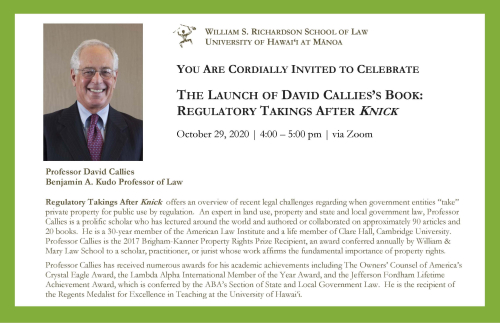
Come join us for the book party for Professor David Callies’ recently published (by the ABA State and Local Government Law Section) book, “Regulatory Takings After Knick.”

We’re online (of course), so you don’t have to come to Honolulu – we’re on Zoom:

Date: Thursday, October 29, 2020

Time: 4-5pm Hawaii Time

RSVP: No need to RSVP, just follow the Zoom link on the flyer below.

Is joining at 4pm Hawaii Time too late in the day in your time zone? We will be scheduling a “pre-event” on Zoom where you can record your video congratulations for Professor Callies. Details to be posted here shortly, or email us.

And yes, buy this book. As the back cover blurb notes:

The problem with so much regulatory takings scholarship — like the Supreme Court’s takings doctrine itself — is that it is muddled and murky, and casts shadow
Continue Reading You’re Invited: Book Launch For “Regulatory Takings After Knick” (David Callies), Oct. 29, 2020

We all know that despite the heightened Twombly/Iqbal federal pleadings standard, that it doesn’t mean a whole lot if a complaint survives a 12(b)(6) motion to dismiss. All this means that the court thinks it is plausible that the complaint states a claim. And that the plaintiff gets to keep going. That’s it.

But when takings claims are involved, we also know that courts can be dismissive, and a property owner surviving a motion to dismiss can be kind of a big deal.

In Hunters Capital LLC v. City of Seattle, No. C20-983 (Oct. 16, 2020), the U.S. District Court for the Western District of Washington dismissed the plaintiffs’ equal protection claims, but held that the procedural and substantive due process, and takings claims survived. This is the case on which we posted earlier, in which property owners in the part of Seattle known as CHOP (or

Continue Reading Federal Court: If It’s True That Seattle Provided Material Support To CHOP/CHAZ, That Could Be A Taking

Check this out, a recent case on the Uniform Relocation Act from the Ohio Supreme Court. Does it conflict with a decision that goes the other way from the West Virginia Supreme Court, or is it consistent with a South Dakota decision (cert. denied in that one, by the way)? Read on and find out.

In State ex rel. New Wen Inc. v. Marchbanks, No. 2017-0813 (Oct. 14, 2020), the property owner prevailed on an inverse condemnation case in the Ohio Supreme Court. (Well, not technically an “inverse condemnation” case because Ohio doesn’t recognize such a claim when a government action has de facto taken property; instead, the property owner applies to the Supreme Court to issue a writ of mandamus to compel the government to institute eminent domain.) But no matter – the property owner (a Wendy’s restaurant) won its takings case in the Ohio Supreme

Continue Reading Ohio: Uniform Relocation Act Doesn’t Require Fee-Shifting For Inverse Cases (Lower Court Split Alert?)

Untitled Extract Pages

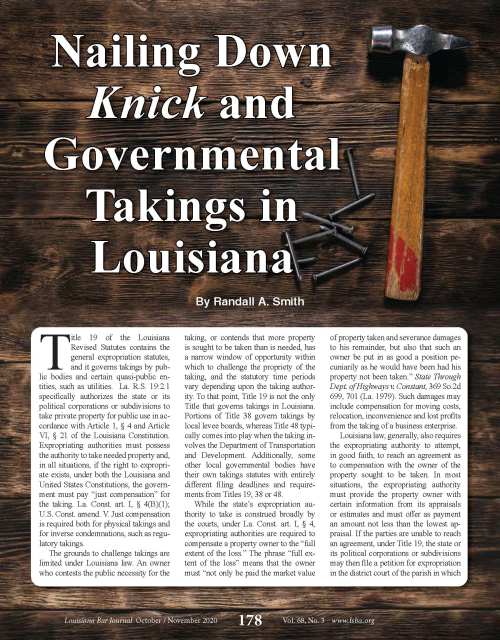
Check this out, a quick read from our New Orleans colleague Randy Smith, his article from the current edition of the Louisiana Bar Journal, “Nailing Down Knick and Governmental Takings in Louisiana.

Therein, he tells the story (inter alia) of Violet Dock Port (see here and here for two of our many posts on the case), and the efforts of the owner to secure compensation. The latest twist is that although the Louisiana courts adjudicated the amount of compensation owed (based on replacement cost), the condemnor (the Port of St. Bernard) didn’t pay up as ordered, and the U.S. District Court dismissed the owner’s § 1983 claim for a violation of the Fifth and Fourteenth Amendments.

Here’s how the article concludes:

Although Knick does not offer specific guidance regarding whether a property owners’ federal takings claim could take precedence over a previously-filed state court

Continue Reading Randy Smith: “Nailing Down Knick and Governmental Takings in Louisiana”

EjqLrfkWAAAB5QF

In between talking about eminent domain-y songs, the goofy cult film “Snakes on a Plane” (yes, we really do have a cast-signed poster of that film in our office), and other fun stuff, we returned to the Pendulum Land Podcast for part II of our guest spot, where we also discussed Virginia Uranium, Inc. v. Commonwealth, No. CL15-623 (July 30, 2020), a recent decision from a Virginia trial court about regulatory takings and “damagings.” 

[Stream the podcast above, or better yet, subscribe and become a regular listener. The podcast is both entertaining and informative.]

The Virginia Uranium case involves a long-standing — but “temporary” — moratorium on uranium mining, and the court’s order analyzes Palazollo, the Salt-peter case (Lord Coke alert!), Penn Central, and Lucas.

The court concluded that the inability to mine uranium was a damaging under the Virginia Constitution because it “directly

Continue Reading In Which We Return To The Pendulum Land Podcast To Talk “Snakes on a Plane,” Eminent Domain Songs, And What Might Be Virginia’s First True Regulatory Takings Case

Here’s the latest in a case we’ve been following.

In Berry v. City of Chicago, No. 124999 (Sep. 24, 2020), the Illinois Supreme Court avoided the analysis that split the court of appeals, and upheld the dismissal of a very “torty” inverse condemnation claim. The plaintiffs alleged that the City of Chicago’s program to replace old water meters, water mains, and lead pipes had taken their property because it made the service lines “more dangerous” by using copper and galvanized iron, which leads the lead pipes to corrode (the lede is that copper leads lead pipes to corrode). In addition to tort damages, the plaintiffs sought compensation for the taking. 

No deal, held the court, and its ruling is pretty straightforward. The court didn’t really see the arguments the same way as the court of appeals, which split on the question of how the “public” is defined for

Continue Reading Burying The Lead: No Taking When City’s Water Pipe Replacement Program Alleged To Result In More Danger To Owners’ Properties

We were honored to be a guest on an episode of the Pendulum Land Podcast. Here’s the description from the show notes:

Hawaii inverse condemnation lawyer and William and Mary Law School adjunct professor Rob Thomas joins your hosts to discuss recording his classic single “Smooth” with Carlos Santana, whether the COVID moratoriums on evictions constitute a taking, and his favorite flavor of SPAM! (Don’t act like you don’t love SPAM.) This is the first of two episodes with the publisher of the popular eminent domain blog inversecondemnation.com.

We had to bring our “A game” because the hosts were full of rapid-fire questions, wit, and nerd trivia. It was hard to keep up at times. But we did our best (and yes, we did talk about our favorite flavors of SPAM). We also chatted about the coronavirus related takings claims, and an interesting takings case working its way up

Continue Reading In Which We Go Over To The Dark Side: Our Guest Appearance On The Pendulum Land Podcast (SPAM, Takings, Star Trek/Wars, and More!)

Here’s the latest development in a case out of Maryland that we’ve been following for a while.

This is the one where Maryland Reclamation Association bought land back in 1990 to operate a rubble landfill. But after the purchase, the County changed its regs to prohibit (guess what) … rubble landfills. Mesne litigation ensued in various tribunals over the years. Eventually, MRA filed a regulatory takings claim under the Maryland Constitution’s takings clause in 2013, and the jury awarded a whopping $45 million in just compensation and interest. Hartford County asserted that MRA should have exhausted its administrative remedies by seeking a variance, and the claim was barred by the three-year statute of limitations because the takings claim accrued in 2007 when the Board of Appeals administratively denied MRA’s variance request.

The Maryland Court of Special Appeals concluded that the “final decision” for purposes of both ripeness and statutes

Continue Reading Cert Petition: Can A State Agency Decide Whether There’s Been A Taking?

IMG_20190925_175845

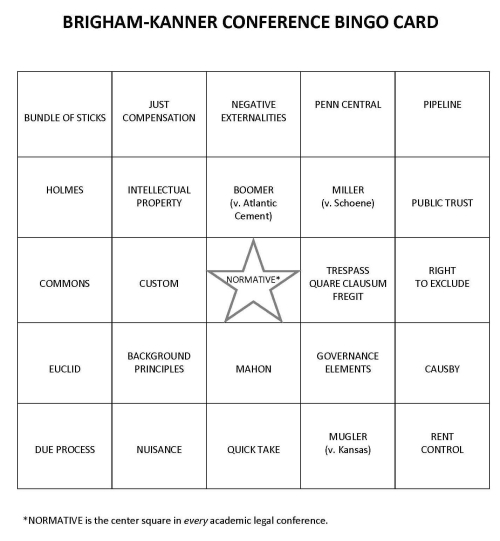
Although it is set to launch this Friday, October 2, 2020, there’s still more than enough time to register (and room at the inn) for you to join us for the 17th Annual Brigham-Kanner Property Rights Conference at the William and Mary Law School.

Like everything else this season, the Conference is online (register here), and although we would have preferred to gather in-person of course, the online format has some advantages: the number of attendees isn’t limited by the classroom size (this year’s registrations are at record levels), you don’t need to travel to Williamsburg, and the Conference is free if you don’t want Virginia CLE credit for attending. What a deal.

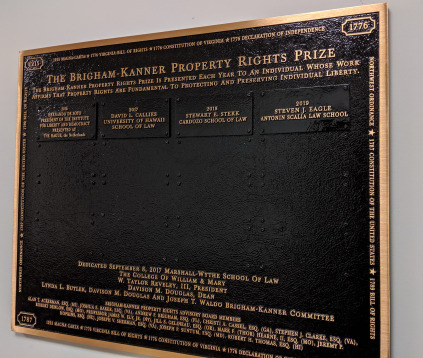
In our opinion, this is the best legal academy/practicing bar conference on property law. This year, the Conference honors the Brigham-Kanner Prizewinner, Harvard Law School Professor Henry Smith.

Here are the panel topics

Continue Reading There’s Still Room: Join Us For The 17th Annual Brigham-Kanner Property Rights Conference (Online, Free!)