


Here’s the amicus brief filed yesterday by the National Federation of Independent Business Small Business Legal Center, joined by Owners’ Counsel of America, in a case we’ve been following.

This case asks the Court to resolve a big outstanding issue: are legislatively-imposed exactions (however that term is defined) subject to the same high level of scrutiny under the NollanDolanKoontz test as are administratively-imposed exactions? 

Our brief argues:

The Respondent, City of West Hollywood (“City”), forces property owners into the same unconstitutional dilemma which faced James and Marilyn Nollan, Florence Dolan, and Coy Koontz. Nollan v. California Coastal Comm’n., 483 U.S. 825 (1987); Dolan v. City of Tigard, 512 U.S. 374 (1994); Koontz v. St. Johns River Water Management District, 133 S. Ct. 2586 (2013). Specifically, the Petitioners were forced to choose between their fundamental rights to either (a) obtain just
Continue Reading SCOTUS Amicus Brief: Lawless Legislatures Should Be Treated The Same As Lawless Zoning Boards

The Indiana Court of Appeals’ recent opinion in Town of Clear Lake v. Hoagland Family Ltd. P’ship, No. 76A05-1606-PL-1241 (Apr. 6, 2017), doesn’t really involve inverse condemnation, except in the background. But we found it interesting nonetheless, because of the way the opinion finishes up, with a plethora of potty puns.

The case involved the town’s attempt to convince a local property owner to abandon his septic system, and connect to the town’s sewer system. At first the town tried cajoling, bargaining, and trying to entice hook up. It laid down pipes beneath the land, it passed ordinances requiring connection. But the owner, for whatever reason, said no. Indeed (and here’s the inverse condemnation connection), he sued the town for inverse condemnation when it put the pipes beneath his property (they eventually settled). Finally, the town sued those who had not connected to the sewer system, including Hoagland, and

Continue Reading Indiana App: Hook Up To City’s Sewer System…Or Else! (Warning, Toilet Puns)

Here’s the recording of the March 20, 2017 oral arguments in Murr v. Wisconsin, the e “larger parcel” or “denominator” case.

The printed transcript is posted here, and our summary of the arguments is posted here. Our preview of the arguments, which includes link to the briefs, is here.

Continue Reading Murr Oral Argument Recording

Here’s the third amicus brief filed in support of our cert petition in Bay Point Properties, Inc. v. Mississippi Transportation Commission, a case asking whether the Just Compensation Clause prohibits a court from instructing an inverse condemnation jury that it must value taken property as if it was burdened by a highway easement which the jury found as a matter of fact had been abandoned. 

This brief was submitted by a stellar group of public interest organizations and legal scholars: Cato Institute, the NFIB Small Business Legal Center, Reason Foundation, Southwest Legal Foundation, NARPO (the National Association of Reversionary Property Owners), the Property Rights Foundation of America, and Professor James Ely (property and easement expert), Shelley Ross Saxer (land use and takings), and Ilya Somin (eminent domain, among other subjects).

The brief, authored by Thor Hearne and his Federal Takings team, Cato’s Ilya Shapiro, and

Continue Reading SCOTUS Amicus Brief: Forcing The Jury To Pretend A Terminated Easement Still Encumbered Land Violated Just Comp Clause

It’s flashback to Property I class today, folks.

Yesterday’s opinion from the U.S. Court of Appeals for the Eighth Circuit in Barfield v. Sho-Me Power Elec. Coop., No. 15-2964 (Mar. 29, 2017) was about easements, and there wasn’t really a takings issue presented, but we thought we would post it anyway since it is a good reminder of your traditional “Blackacre” property law principles, and because we have had easements on the brain lately, due to that topic being at the center of a cert petition we recently filed

As the caption of the case might inform you, this was a case about Missouri law, in federal court presumably under diversity jurisdiction. The plaintiffs had granted Sho-Me, a rural electric cooperative, easements which gave it “the right to construct and operate an electric transmission line. Some grant the right to construct appurtenances or do things ‘necessary and useful to

Continue Reading 8th Circuit: Not Using Easement For Granted Purpose = Trespass And Inverse Condemnation, But Not Unjust Enrichment

Another one (short) from the Kansas Supreme Court, this time a straight takings case, and not inverse condemnation

In Pener v. King, No. 114850 (Mar. 24, 2017), the court tackled several issues in a case involving KDOT’s taking of land for highway project. Part of the taking required KDOT to take down the owner’s fences. The owner argued that he should be separately compensated for the cost to replace the fencing. The Supreme Court held that the just comp award included the fencing, and that it wasn’t a separately value taking. The “unit rule” means that property is valued as a whole, not piece by piece. 

The court also rejected the owner’s argument that the just compensation verdict wasn’t supported by the evidence (we will let you read that on your own, if interested), and then concluded by affirming the trial court’s denial of an award of attorneys’

Continue Reading Kansas: Cost Of Replacing Fence On Condemned Property Isn’t Separate, But Part Of Just Comp Award

A noteworthy decision from the Kansas Supreme Court in Creegan v. State of Kansas, No. 111082 (Mar. 24, 2017).

The facts of the case are pretty simple. Kansas DOT purchased land in a subdivision subject to restrictive covenants (CC&R’s) which required all property within the subdivision to be used for single-family residential only. KDOT didn’t use the land it bought for residential purposes, but “placed trailers on these lots and, in subsequent years, used the lots for various construction activities. Eventually, KDOT constructed permanent bridges and pavements on a number of the lots.” Slip op. at 3. Other lot owners brought an inverse condemnation suit.

The trial court dismissed because violation of the restrictive covenants was not a physical taking, but the Court of Appeals reversed. The plaintiffs’ property wasn’t damaged nor was it physically invaded. It held that that the covenants are real property and that KDOT’s use of

Continue Reading Kansas – “Property” Or “Contract” Makes No Difference: State Violating Restrictive Covenant Is Inverse Condemnation

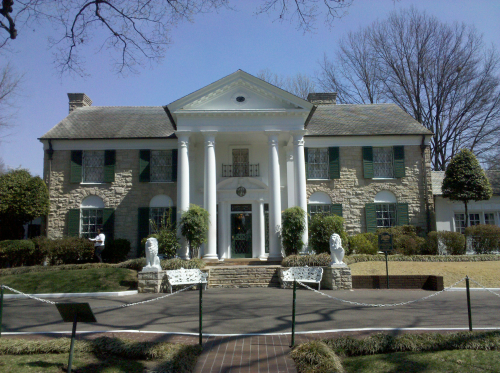
2010-03-19 13.36.36
No, this isn’t the Supreme Court, it’s Graceland,
purchased by Elvis in March 1957.

(We’re just checking whether you are paying attention.) 

Appellate oral argument, as they say, is supposed to be a “conversation” between the bench and counsel. But the overall impression we were left with after reviewing the transcript of yesterday’s Supreme Court oral arguments in Murr v. Wisconsin, the case about the “larger parcel” or “denominator” in regulatory takings cases, was that just about everyone in the courtroom was talking on different wavelengths. 

Don’t get us wrong — arguing counsel for all the parties and amicus did a pretty good job, in our view. They are advocates, after all, and their job is to champion their clients’ position, not to solve the Court’s confusion, and problems that appear entirely self-inflicted.

Two of the parties (the Murrs and the State of Wisconsin) urged the Court to adopt

Continue Reading Affirmed By An Equally Confused Court? Some Thoughts On The Oral Arguments In The “Larger Parcel” Case

As takings mavens are no doubt already aware, next Monday, the 8-Justice Supreme Court will hear arguments in Murr v. Wisconsin, the regulatory takings case which asks whether the county can avoid application of the Lucas wipeout standard on one parcel by taking advantage of the fact that the plaintiffs also own the adjacent parcel. Thus, the county argues, both parcels should be combined to determine how the regulation has impacted the property. 

Others have done a better job at previewing the issues than we could hope to (see SCOTUSblog, the National Constitution Center, and the Federalist Society), so we won’t do a big summary here, but will limit ourselves to pointing out what we think will be the key areas of contention. Go read the voluminous briefing as well. And with the Court one-Justice-down for this case, we’re certainly not going to even venture

Continue Reading SCOTUS Argument Preview: Does Fee Simple Absolute Mean Anything? The “Larger Parcel” Issue In Regulatory Takings

Here’s what we’re reading this Monday:

  • Preview of SCOTUS oral arguments in Murr v. Wisconsin. This is the “larger parcel” case which will be heard next Monday, March 20. The Cato Institute is having a session on it at its DC facility, “Rethinking Regulatory Takings.” If you can’t be there in-person, it will be live streamed. More here. We’ll have our own preview later this week. 
  • Our colleagues at the Massachusetts Land Use Monitor comes this report (“Regulatory Taking, Anyone?“) about a recent jury verdict which concluded that denial of a variance resulted in a loss of all beneficial use of property. And you know what that means, don’t you? 
  • Professor Ilya Somin writes about the “Potential pitfalls of building Trump’s Great Wall of eminent domain” in the Washington Post
  • Professor Gerald S. Dickinson adds his thoughts on the Wall:


Continue Reading Monday Links: Murr SCOTUS Preview, Mass. Reg Takings Verdict, Great Wall Of America, Train Takings