


Here’s a good one from the Ohio Court of Appeals to start off your 2016.

In State ex rel Greenacres Foundation v. City of Cincinnati, No. C-150038 (Dec. 30, 2015), the court agreed that the City’s failure to issue a demolition permit for the “Gamble House,” which the City claimed was a property worthy of historic preservation but had not yet so designated, was a taking. 

The Gamble House was built by the “Gamble” in Proctor & Gamble, the guy who invented Ivory Soap. But over the years, the house “had been uninhabited since 1961, had suffered extensive water and termite damage, and was infested by mice, birds, raccoons, squirrels, and bats.” So the current owners asked the city for a demolition permit so they could redevelop the property. 

The city said no, and ran the owners through a maze, with several appeals through the usual administrative procedures.
Continue Reading City’s Prohibiting Demolition Of Uninhabitable House So City Could Designate It As Historic, Is A Taking

Another short one that’s been in the hopper for a while, Sorrells v. City of Macomb, No. 3-13-0763 (Ill. App. Oct. 23, 2015), involving a claim for inverse condemnation that was a result of flooding.

The inundation of the plaintiffs’ property came from a street that was developed privately, but later dedicated to the city. The court of appeals concluded that this was not sufficient to state a claim for inverse condemnation:

In this case, the plaintiffs alleged that the streets were constructed by DK Linde and “dedicated” to the City. According to plaintiffs’ allegations, the City had taken the plaintiffs’ property in the form of a “drainage easement” for the drainage of its streets. “It is well established that the government may not take an easement without just compensation.” Ridge Line, Inc. v. United States, 346 F.3d 1346, 1352-53 (Fed. Cir. 2003) (quoting United States v. Dickinson

Continue Reading Illinois App: Allegation Of Flooding Caused By Street Developed Privately, But Dedicated To City, Not Sufficient To State Inverse Condemnation Claim

ALI-CLE-2016-masthead

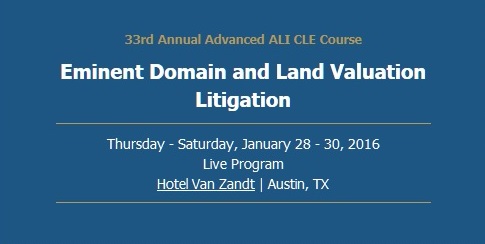
Here’s our second day of highlights from the upcoming American Law Institute-CLE Eminent Domain and Land Valuation Litigation / Condemnation 101 Conference, which will be held in Austin, Texas, from January 28-30, 2016.  

This is the first time the conference has been to Austin, and we’re hoping for a good turnout. Here’s the full agenda for the program. 

  • We especially focused on the ethics component this year, and are looking forward to the session on “Ethics: Tips and Traps for the Eminent Domain Practitioner” at the first plenary session on the second day, taught by Jamila A. Johnson (Schwabe, Williamson & Wyatt, Seattle), Robert B. Neblett, (Jackson Walker L.L.P., Austin). and Joseph V. Sherman (Waldo & Lyle, P.C., Norfolk, Virginia). 
  • Pipeline takings are a huge issue, and we’ve got the lawyers on the very tip of the spear on these cases. “Pipelines and Energy


Continue Reading More On The Upcoming ALI-CLE Eminent Domain Conference (Austin, Jan 28-30, 2016)

ALI-CLE-2016-masthead

We’re exactly one month away from the 2016 Eminent Domain and Land Valuation Litigation / Condemnation 101 Conference, which runs from January 28-30, 2016, in Austin, Texas. 

Together with our friends and colleagues Joe Waldo, Jack Sperber, and Andrew Brigham, we think we’re put together a pretty good program that covers a lot of ground. This is the first time the conference has been to Austin, and we’re hoping for a good turnout. 

Here’s the full agenda for the program. 

If you have not already signed up, there is more than enough room, and there’s still time.

If you haven’t yet pulled the trigger, we’d like to convince you to come. So over the next few days, we’re going to be posting highlights from the agenda, featuring our stellar faculty.

  • We’ll start off with a talk welcoming us to the city by Austin Mayor Steve Adler


Continue Reading Counting Down To The ALI-CLE Eminent Domain Conference (Austin, Jan 28-30, 2016)

We have quite a few court decisions in the hopper, and as 2015 draws down we’re going to post them with only minimal analysis, hoping to clear the queue before January.

Here’s the first, a recent opinion from the Indiana Court of Appeals, in which Mr. Kerr objected after noxious odors from a city owned and maintained sewage line entered his house. He brought claims for both tort (for injuries to his health), and for inverse condemnation (the gases eventually forced him to leave the home).  

The court of appeals concluded that his tort claim would have been viable, except that he had not instituted it within the time allowed by the statute of limitations. Kerr admitted he knew of his potential health problems as early as 2005, but didn’t bring the claim for more than 7 years.

However, the court allowed at least part of the inverse

Continue Reading Ind App: Statute Of Limitations On “Continuous” Inverse Condemnation Claim Renews With Each Injury

We always enjoy reading the briefs filed by the Center for Constitutional Jurisprudence because they reference “first principles” and are usually heavy on the history. We like history. 

This amicus brief, filed by CCJ today in support of the cert petition in Arrigoni Ent., LLC v. Town of Durham, No. 15-631 (cert. petition filed Nov. 10, 2015), is no different. It argues that the “state procedures” prong of Williamson County should be overruled, or at least confirmed as a prudential (and not jurisdictional) requirement:

Apart from the procedural trap that Williamson County creates, Amicus Curiae urges this Court to reexamine the state litigation rule because the requirement is not firmly established in the text of the Takings Clause and it represents a significant departure from the original understanding of the right at issue. Stated succinctly, the Fifth Amendment requires that compensation be paid when the government takes property

Continue Reading Amicus Brief: Williamson County’s State Procedures Requirement Is Ahistorical

Here’s one more amici brief supporting the the cert petition in Arrigoni Ent., LLC v. Town of Durham, No. 15-631 (cert. petition filed Nov. 10, 2015). (Here is the first amicus brief filed today, and here’s the second.) 

This one — on behalf of the National Federation of Independent Business Small Business Legal Center, and lawprof Ilya Somin — we assisted on, with the heavy lifting being undertaken by NFIB’s Luke Wake. Our brief takes a slightly different approach than the others, although we too call for the Court to revisit Williamson County:

Thirty years ago, in Williamson County Regional Planning Commission v. Hamilton Bank, 473 U.S. 172 (1985), this Court pronounced a new and unfounded rule that a property owner must sue in state court in order to ripen a federal takings claim. This marked a radical departure from the historic practice. There

Continue Reading One More Amici Brief (Ours): Time To Ditch Williamson County’s State Procedures Requirement

Here’s the second amicus curiae brief supporting the the cert petition in Arrigoni Ent., LLC v. Town of Durham, No. 15-631 (cert. petition filed Nov. 10, 2015). (Here’s the first.) 

This brief was filed by the Institute for Justice, and authored by Supreme Court takings maven Michael Berger:

1. It is time for the Court to reconsider Williamson County’s state court litigation prong, which requires state court confirmation that there is no state remedy for a governmental taking of property. Only then will a 5th Amendment claim be “ripe” for federal court litigation. The premise of that rule goes beyond the plain language and meaning of the 5th Amendment. A municipality’s taking of private property without just compensation is complete when property is taken and compensation is not paid by the government. It does not require a judicial determination to complete, or ripen, the taking.

Continue Reading Amicus Brief: You Guessed It – Reconsider Williamson County

Here’s the first in a series of amicus briefs we’re going to post which urge the Supreme Court to grant the cert petition in Arrigoni Ent., LLC v. Town of Durham, No. 15-631 (cert. petition filed Nov. 10, 2015). 

This amicus brief was filed by the Cato Institute, and like the petition, asks the Court to take the case in order to reconsider Williamson County‘s “state procedures” rule:

This case presents an opportunity for this Court to rectify a significant anomaly in its jurisprudence: the blanket exclusion from federal court of numerous constitutional rights cases arising under the Takings Clause of the Fifth Amendment. Under this Court’s decision in Williamson Cty. Reg’l Planning Comm’n v. Hamilton Bank of Johnson City, 473 U.S. 172 (1985), a property owner’s claim that a state government has taken his property without paying “just compensation,” as required by the Takings

Continue Reading Amicus Brief: Reconsider Williamson County’s “State Procedures” Requirement

Here’s the first in a series of posts we’re going to put up, with the cert petition and the supporting amici briefs (ours included) in Arrigoni, Ent., LLC v. Town of Durham, No. 150631 (petition filed Nov. 10, 2015).

In that case, the Second Circuit in a two-sentence ruling, summarily affirmed the District Court’s dismissal of Arrigoni’s regulatory takings claim under the “state procedures” prong of Williamson County, because the property owner “failed to ‘seek compensation through the procedures the State has provided for doing so.'” Slip op. at 2.

The petition poses these Questions Presented:

1. Whether the Court should reconsider, and then overrule or modify, the portion of Williamson County Regional Planning Commission v. Hamilton Bank of Johnson City, 473 U.S. 172, 194 (1985), barring property owners from filing a federal takings claim in federal court until they exhaust state court remedies, when this rule results

Continue Reading Cert Petition: Overrule Williamson County!