


Programming note: as we noted here, we’ve recently moved our email subscribers to a new service. If you are already subscribed to our email updates you should not need to do anything, except look for the emails coming from Feedblitz, not Feedburner. If you want to sign up for email updates anew, go here. If you experience technical issues, or receive duplicate email notifications, please let me know.

Now back to your regularly scheduled programming…
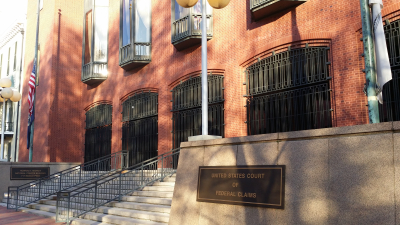
20151205_150106

Check out this Complaint, filed last week which asks the U.S. Court of Federal Claims to award property owners an unspecified amount (noted as $26 billion in the cover sheet) in just compensation for the taking of the plaintiffs’ property by the Center for Disease Control’s order temporarily halting residential evictions.

The Complaint alleges a physical invasion taking because it precludes “property owners from excluding [tenants] and leasing

Continue Reading New Takings Complaint: $26 Billion For CDC’s Eviction Moratorium

All the topics you want to know about, presented by top-notch faculty from across the nation. Sessions include:

  • Property Rights as Civil Rights
  • Eminent Domain National Update
  • Just Relocation: Understanding the Law and Regulations to Ensure Fairness
  • Challenging Public Use: Lessons From a 67-Day Trial
  • COVID Takings
  • Federal Court and the Daubert Challenge: How to Prepare
  • Did the Supreme Court Signal a New Direction in Property Rights in Cedar Point Nursery?
  • How to Position Your Client for the Fallout When Projects Don’t Get Built
  • Rural Broadband and the Emerging Constitutional Challenges
  • Are Precondemnation Entry Statutes Still Valid After Cedar Point Nursery?
  • How Condemnor and Property Owners’ Counsel Prepare the Battlefield
  • How Will the Trillion Dollar Infrastructure Bill Impact Your Practice?
  • Ethics
  • …and more, including a full slate of networking and social events!

We’ve sold out the last few years, so don’t miss out. Room block now taking reservations. Continue Reading Join Us For The 39th Annual ALI-CLE Eminent Domain & Land Valuation Litigation Conference, Jan 26-29, 2022 (Scottsdale, AZ)

The State of New York needed a strip of the owner’s property for a “greenway” for walkers and bikers. The State and the owner agreed that if the owner believed that the advance payment of $300k was not enough, it could ask the Court of Claims for more. But they also agreed that if that court concluded the amount for the taking was less than advance payment, the owner would owe the State the difference, plus interest.

After trial, the claims court concluded that the advance payment exceeded the amount of compensation owed — indeed, was below the range of values testified to by each side’s expert — and the owner thus owed the State in the neighborhood of $18k. 

In Elpa Builders, Inc. v. State of New York, No. D66949 (July 14, 2021), the Appellate Division (Second Department) made typically short work of the owner’s claim that the

Continue Reading NY App Div: If Deposit Exceeds Adjudicated Compensation, Owner May Be Liable To Pay The Difference

We’re not going to pretend that we can actually read what the Supreme Court of Puerto Rico’s opinion in Administración de Terrenos de Puerto Rico v. Ponce Bayland Enterprises, Inc., No. CC-2019-212 (June 29, 2021) says. It’s in Spanish and we don’t know Spanish. Wish we did, truly.

But hey, that’s what Google Translate is for, right? And if that service can be believed, here’s what the summary of the case roughs out to:

Compulsory Expropriation – The Expropriation Chamber of the Court of First Instance has jurisdiction to consider evidence of environmental pollution and the costs of remedying it in forced expropriation lawsuits to determine the market value of the expropriated property at the time of seizure. The admissibility of evidence about contamination and the costs of remedying it is subject to the provisions of the Rules of Evidence.

We’re not posting the case because the opinion raises

Continue Reading El Tribunal Supremo De Puerto Rico: Evidence Of Environmental Contamination Is Admissible In Eminent Domain Valuation

Our thanks to our friends and colleagues at the ABA Section of Real Property, Probate & Trust Section’s Land Use and Environmental Group for inviting us to a discussion of the latest and greatest decisions of interest.

We only had an hour together, so naturally could not cover everything of interest (indeed, we reserved a big discussion of the biggest item, the Supreme Court’s decision in Cedar Point, assuming that the Group will schedule a full session on that decision alone). So here is our curated list of what we think are the most interesting recent decisions in areas of interest to the Group:


Continue Reading Links From Today’s ABA RPTE Session

In which we pay a return visit to Clint Schumacher’s Eminent Domain Podcast to catch up with Clint about our new gig, Cedar Point (briefly, since the opinion came down the day we recorded the podcast), just compensation and attorneys’ fees, assessing severance damages in appraisals supporting jurisdictional offers, public use, and our favorite cool courthouses (let’s just say that they range from historic courtrooms to converted doublewide trailers).

If you are not already a regular listener to the Eminent Domain Podcast, you should be! It’s a great one-stop convenient way to keep current on the latest goings-on in the takings business. Continue Reading We Pay A Return Visit To The Eminent Domain Podcast To Talk Takings

More good takings news, hot off the press.

Before Cedar Point came down last week, we were all set to let you know about the Eleventh Circuit’s opinion in South Grande View Dev. Co., Inc. v City of Alabaster, No. 18-14044 (June 21, 2021), in which the court affirmed a jury verdict that the city’s reduction in the developable density on residential-zoned parcel (from R-7 and R-4) to R-2) was a Penn Central regulatory taking. 

The city appealed on an evidentiary issue, arguing that the jury should not have heard evidence of its reasons for downzoning the property, which were not relevant to the takings question and only went to whether the government acted arbitrarily and capriciously (a due process inquiry). The city also raised a ripeness question: the owner had not sought a variance from application of the new zoning, and indeed had never asked the city

Continue Reading 11th Circuit Affirms Penn Central Jury Verdict For Rezoning Resulting In 86% Loss Of Value

For your Monday reading, Amnon Lehavi, Temporary Eminent Domain, 69 Buff. L. Rev. 683 (2021). From the Abstract:

Times of emergency call for drastic measures. These steps may include the physical takeover of privately-owned assets by the government for a certain period of time and for various purposes, aimed at addressing the state of emergency. When will such acts amount to a taking, and what compensation should be paid to the property owner? How do temporary physical appropriations during times of emergency diverge, if at all, from temporary takeovers in more ordinary times?

The doctrinal and theoretical analysis of potential temporary takings has been done mostly in the context of non-physical government intervention with private property, such as when a local government imposes a temporary moratorium on land development until a certain condition is met. This Article focuses, however, on less investigated scenarios of temporary physical takeovers or other forms of government invasions. It seeks to identify the differences between a temporary invasion and a permanent occupation of property considered a per se taking under the Loretto rule. In so doing, this Article argues that while the alleged distinction between prevention of public harm and promotion of public benefit often proves untenable in evaluating whether a permanent government measure constitutes a taking, it might make more sense in exploring temporary acts.

Temporary eminent domain—referring here to various types of acts amounting to time-limited physical takings, even if not initially recognized as such by the government—may diverge from permanent eminent domain in yet another key element: identifying the basis for just compensation. Under long established (although often criticized) rules, compensation for a permanent taking is based on identifying the “fair market value” of the rights taken, while ignoring the effects that the public use for which the underlying asset is taken might have on the property’s long-term value.

The allegedly parallel metric used in the case of temporary takings,one of “fair rental value,” may often prove inadequate, both practically and normatively. This Article argues that because of unique aspects of temporary physical takings, legal rules on compensation should often seek to identify lost profits or actual damage. Moreover, in some cases, in which there is a direct relation between the pre-appropriation use of the asset and its post-appropriation use by the government, just compensation might also be based on a certain portion of the value of the public use. This is especially so when the time-sensitive value of the asset during such public use is particularly high. On this point, the Article offers an analogy to rules pertaining to compulsory licenses for patents.

Check it out.
Continue Reading New L. Rev. Article: “Temporary Eminent Domain”

Here’s the latest in a case we’ve been following. It’s not exactly a “new” cert petition, but one which we missed when it was filed back in February.

This one comes up via the Court of Federal Claims and the Federal Circuit, with the latter vacating the CFC’s award of partial compensation, concluding that the petitioner did not have a compensable property interest in the entire property it alleged was taken.

The petitioner bought some of a steel mill’s assets in bankruptcy. Those assets included piles of some of what is known as slag, scrap, and kish. EPA later determined that the piles were leaching contaminants. And you know what that means: remediation. EPA reduced the size of some of the piles and left others in place. The owner sued for a taking of the kish, slag, and scrap the EPA recovered from the site. 

After trial

Continue Reading New(ish) Cert Petition: Kish, Scrap, And Slag Takings From Environmental Remediation

You might think that a statute the legislature adopted to allow more recovery than under constitutional takings law, that requires the DOT to pay landowners whose lands abut a change-of-grade project for the value of “any damages to said lands occasioned by such change of grade,” would include the situation where the DOT converted a property owner’s at-grade driveway into a rampless bridge. The DOT refused to include offramps as the owner requested, and as a result, the business tanked and the value of the property dropped precipitously.

If so, you’d be wrong according to the majority of the Wisconsin Supreme Court in United America, LLC v. Wisconsin Dep’t of Transportation, No. 2018AP2383 (May 18, 2021).

There, the court concluded that because the impact was not to “the lands” because the change of grade project did not actually touch or damage “the land” of the owner, only the owner’s

Continue Reading There’s A Difference Between “Land” And “Property” Under Wisconsin’s Change-of-Grade Damages Statute