Our thanks to Clint Schumacher for having us on his program to talk about the upcoming Conference. We’re “remote” this year, but that means a different approach to our presentations (and a very modest tuition!).

We’re having programs with intriguing subjects such as “Planning to Win: Practical Strategies for a Successful Inverse Condemnation Case,” “How Do I Keep My Firm’s Doors Open When the Courthouse Doors Are Closed? Making Your Practice More Efficient When You Can’t Try Cases,” “Where Is the Supreme Court Headed on Takings Cases? Regulatory Takings Update and Cedar Point Preview,” “No Show and All Tell: Breaking News in Property Rights and Takings,” “More Than the Fifth Amendment: Other Tools for Upholding Property Rights,” “Evaluating Lockdown, Moratorium, and Emergency Claims,” and more (including Ethics for those of you in MCLE jurisdictions). We’ll have a post with more details. 

Register now!Continue Reading Eminent Domain Podcast’s Preview Of The Upcoming ALI-CLE Eminent Domain & Land Valuation Litigation Conference
A short one from the Virginia Supreme Court. In Palmyra Associates, LLC v. Comm’r of Highways, No. 191680 (Dec. 17, 2020), the court upheld the exclusion of evidence about a property’s “before” condition in a partial take case, concluding that the proffered evidence of the property’s development potential was too speculative. Or, more accurately, that the trial court did not stray beyond its wide discretion to keep the evidence out.

VDOT needed a portion of Palmyra’s property for a roundabout. The big question was the damage to the remainder (or “residue”) property and its highest and best use. Owner said commercial development; VDOT said existing use.

The owner offered testimony that it intended to develop the property (consistent with the County’s general plan), and had drawn up site plans years ago. But it had not secured entitlements, and further government approvals were needed before those plans could come to

Continue Reading Trial Court Had Discretion To Exclude Unapproved, Conditional, 10-Year-Old Site Plans From “Before” Condition

The docket is pretty crowded today, so we don’t have that much time to digest and summarize the Nebraska Supreme Court’s opinion in Douglas County School Dist. No. 10 v. Tribedo, LLC, No. S-19-986 (Nov. 6, 2020). But we recommend you read it (or at least scan it).

Short story: Tribedo got the better of the School District at an eminent domain valuation trial on a partial taking. Although Tribedo’s appraiser opined to a higher figure, the jury was closer to his number than the District’s expert’s. So the District appealed, arguing the trial court wrongly rejected the District’s jury instruction, and that the jury’s verdict — which included severance damages — was not supported by the evidence because neither party’s expert specifically opined about severance damages.

As we know, both of these are hard hills to climb. And sure enough, the Supreme Court rejected both arguments. First, it

Continue Reading Nebraska: Condemnor Asking To Overturn Jury’s Compensation Verdict For (Alleged) Evidentiary Errors Asks Too Much

Bk_2020_02_475

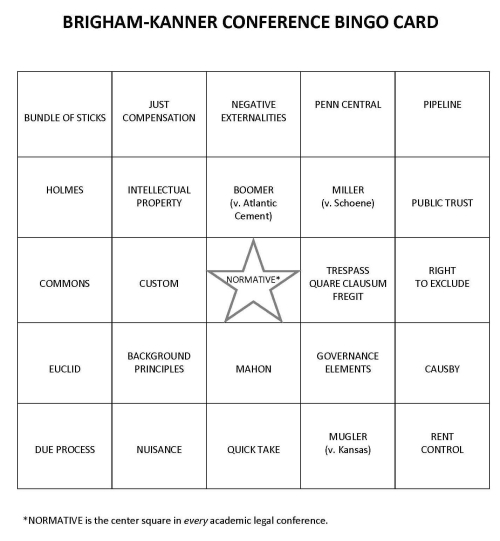
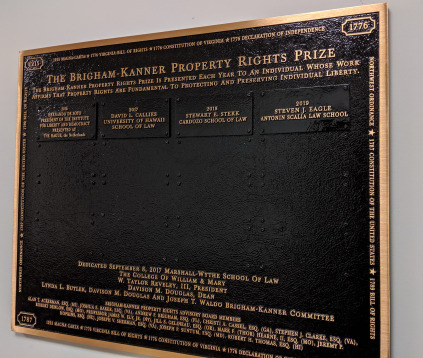
In case you missed any part of it: the recordings of the recent 2020 Brigham-Kanner Property Rights Conference are now available.

Go here for the descriptions of the panels, speakers, and links to the recorded sessions.

This year’s conference, held on October 1-2, opened with the Brigham-Kanner Property Rights Prize being awarded to Professor Henry E. Smith of Harvard Law School. The prize is named in honor of the lifetime contributions of Toby Prince Brigham, founding partner of Brigham Moore, LLP, and Gideon Kanner, professor of law emeritus at Loyola Law School in Los Angeles, and is presented annually to a scholar, practitioner or jurist whose work affirms the fundamental importance of property rights.

Topics covered: “Where Theory Meets Practice: A Tribute to Henry E. Smith,” “The Housing Crisis,” “Emerging Issues in Takings and Eminent Domain Law,” “The Reach of Government’s Confiscatory Powers over Exigencies and Emergencies,” and “The

Continue Reading Brigham-Kanner Property Rights Conference Videos Now Available

Untitled Extract Pages

Check this out, a quick read from our New Orleans colleague Randy Smith, his article from the current edition of the Louisiana Bar Journal, “Nailing Down Knick and Governmental Takings in Louisiana.

Therein, he tells the story (inter alia) of Violet Dock Port (see here and here for two of our many posts on the case), and the efforts of the owner to secure compensation. The latest twist is that although the Louisiana courts adjudicated the amount of compensation owed (based on replacement cost), the condemnor (the Port of St. Bernard) didn’t pay up as ordered, and the U.S. District Court dismissed the owner’s § 1983 claim for a violation of the Fifth and Fourteenth Amendments.

Here’s how the article concludes:

Although Knick does not offer specific guidance regarding whether a property owners’ federal takings claim could take precedence over a previously-filed state court

Continue Reading Randy Smith: “Nailing Down Knick and Governmental Takings in Louisiana”

Here’s the recording of this morning’s oral arguments in an important eminent domain case being considered by the Wisconsin Supreme Court. (We had some trouble with the stream, so if the above video doesn’t work, try this link instead.)

This is a case we’ve been following (court of appeals’ opinion in favor of the property owner here), in which the issue is whether Wisconsin’s eminent domain statute — which requires that a condemnor’s “jurisdictional offer” be “based” upon a “full narrative appraisal” of “all property proposed to be acquired” — allows the Wisconsin DOT to provide an appraisal that omits severance, and then later introduce a new appraisal that includes severance. See Wis. Stat. §§ 32.05(3)(e), 32.05(2)(a)-(b). The property owner successfully argued that allowing the DOT to do this skirts the text of the statute, and its purpose. The jurisdictional offer’s primary function is to

Continue Reading Wisconsin Supreme Court Oral Argument: Can Condemnor Omit Severance From The “Full Narrative Appraisal” Required For The Jurisdictional Offer?

IMG_20190925_175845

Although it is set to launch this Friday, October 2, 2020, there’s still more than enough time to register (and room at the inn) for you to join us for the 17th Annual Brigham-Kanner Property Rights Conference at the William and Mary Law School.

Like everything else this season, the Conference is online (register here), and although we would have preferred to gather in-person of course, the online format has some advantages: the number of attendees isn’t limited by the classroom size (this year’s registrations are at record levels), you don’t need to travel to Williamsburg, and the Conference is free if you don’t want Virginia CLE credit for attending. What a deal.

In our opinion, this is the best legal academy/practicing bar conference on property law. This year, the Conference honors the Brigham-Kanner Prizewinner, Harvard Law School Professor Henry Smith.

Here are the panel topics

Continue Reading There’s Still Room: Join Us For The 17th Annual Brigham-Kanner Property Rights Conference (Online, Free!)

News just in: we’ve just received confirmation that the Conference will not be in-person in Scottsdale in January 2021, and we’re going online.

Not a big surprise, but still a bit disappointing, and it’s a shame that the circumstances won’t allow us to meet in-person to talk shop and to renew our friendships like we do every year. 

But rest assured we’re making lemonade out of these lemons, and we’d appreciate everyone holding the dates on your calendars to join your colleagues from across the nation for the online Conference. And no, we’re not going to do two-and-a-half-days remotely, we’re paring down the agenda and will be focusing on hot topics, and great presenters. The remote format has some advantages, and we’re taking advantage of the circumstances to plan a conference more interactive and a bit different than usual.

This will also be a great program for first-time Conference participants.

Continue Reading Breaking: News About The 2021 ALI-CLE Eminent Domain & Land Valuation Litigation Conference (Jan. 28-29, 2021)