Siouxfalls

Here’s South Dakota v. JB Enterprises, Inc., No. 27176 (Dec. 7, 2016), the second in a series of three recent cases decided by the South Dakota Supreme Court involving a highway renovation project by the SD Department of Transportation. (Here’s the first.)

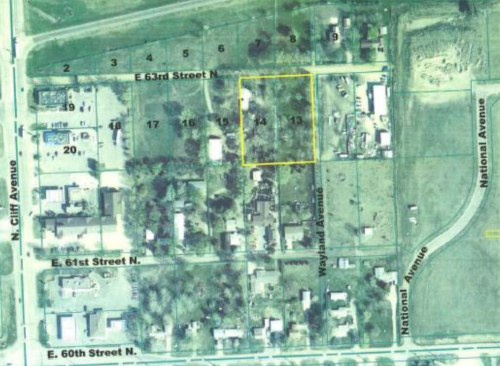
This one involved the DOT’s “quick take” power, and what happens when the state first grabs property — in this case, the right of access — but then partially changes its mind.

The DOT instituted a quick take of the owner’s access rights. But after consultation with federal highway authorities, the scope of the project changed and the state informed the property owner, “There is a very real chance that we won’t need any easements or access rights at all from your clients.” Slip op. at 4. 

Sure enough, that’s what happened, and the DOT informed the property owner that it wouldn’t be taking
Continue Reading South Dakota Takings Trilogy, Part II: You Quick Take It, You Bought It – Standing Down Doesn’t Obviate The Need For Compensation

C0IlPH7UQAA2JsX

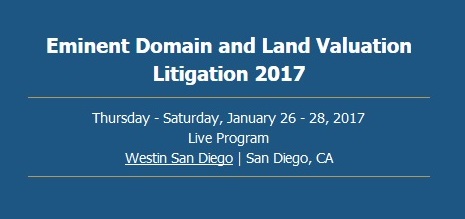
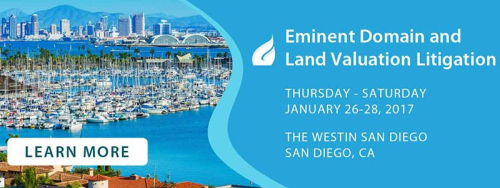
Here’s the final brochure for the upcoming ALI-CLE Eminent Domain and Land Valuation Conference, set for January 26-28, 2017, in San Diego.

Early registration gets you a discount (code CY009MK), as does multiple registrations from one office, so now’s the time to commit to joining us for our annual gathering (the 34th Annual) of the nation’s leading practitioners of eminent domain, condemnation, valuation, and takings law. There are multiple ways to register, including on line

Like in past years, the first day has three tracks: Practice, Substantive, and Condemnation 101. The latter is a one-day course for those new to the field, or as a refresher course for those with more experience. The second day, the 101 attendees will join the advanced course, and we’ll have plenary sessions in the morning, followed by Practice and Substantive tracks in the p.m. As always, attendees are free to move among

Continue Reading ALI-CLE Eminent Domain & Land Valuation Litigation Conference, San Diego, January 26-28, 2017: Final Brochure

IMG_20161020_141639

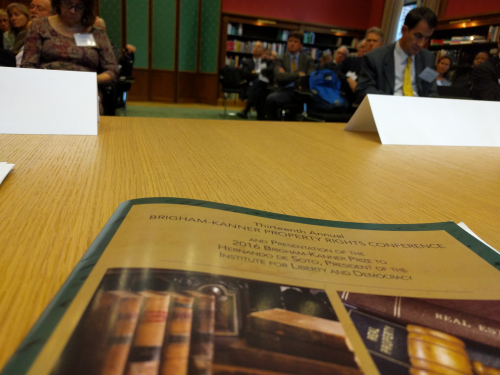
Several years ago, William & Mary Law School’s Brigham-Kanner Property Rights Conference departed its usual Williamsburg, Virginia venue and held the event in Beijing. Holding the conference there allowed U.S. legal scholars and property law practitioners to share ideas and compare our ways with our PRC counterparts. The event was a great success.

IMG_20161020_091110 (3)

Now, W&M has followed up with another international venue for the Conference: the World Court (Peace Palace), in The Hague, Netherlands.

The Conference kicked off last night with a reception honoring this year’s Brigham-Kanner Prize winner, Peruvian economist Hernando de Soto, who opened the Conference this morning with a summary of his work and theories. One of the most intriguing is that the “Arab Spring” was a cry for property and economic rights.Count us as convinced. 

IMG_20161019_203955

The panels began their presentations today. Ours focused on how property rights contribute (or not) to developing nations. My

Continue Reading In Peace And In War: 2016 Brigham-Kanner Property Rights Conference At The World Court

Here’s the amici brief we’re filing in a case which we told you about earlier, involving the way attorneys’ fees get calculated when a statute allows fee shifting. 

This is the afterglow of a rails-to-trails takings case, in which the property owners are entitled under the Uniform Relocation Act to attorneys’ fees. We like. 

What we didn’t like was the way the trial court arbitrarily cut the property owners’ fee request, without ever explaining why. The court simply made an across-the-board percentage reduction from the “lodestar” (a reasonable hourly rate times a reasonable time per task). And the Federal Circuit affirmed. 

So the property owners sought cert review, and now we’ve filed a brief in support. Our brief focuses on the first Question Presented: “Whether trial courts have discretion to make across-the-board percentage adjustments to the lodestar fee and, if so, what “specific proof” or “explanation” must the

Continue Reading SCOTUS Amicus Brief: Court Can’t Arbitrarily Reduce A Lawyer’s “Stock In Trade”

Photo

Tomorrow, Thursday, October 6, 2016, at 10:00 a.m. at Aliiolani Hale, the Hawaii Supreme Court will hear oral arguments in a case we’ve been following (we filed an amicus brief in the case, supporting the property owner on the first Question Presented), County of Kauai v. Hanalei River Holdings, Ltd., No. SCWC-14-0000828. 

The case is a taking by the County of several parcels on the north short of Kauai, but the main issue in the case — do parcels need to physically touch in order for the jury to consider them part of a larger economic parcel — goes well beyond this one case. The Honolulu rail project, probably the biggest eminent domain project in Hawaii’s history, is underway, and the larger parcel issue could arise is more than a few cases there. What we thought was settled doctrine in Hawaii law was thrown into question by the

Continue Reading Oct 6, 2016: HAWSCT Oral Argument In Eminent Domain Case: Do Parcels Need To Touch To Be Part Of A “Larger Parcel”

Here’s the latest in a case we’ve been following, and which earlier resulted in a very good decision from the North Carolina Supreme Court. 

In Kirby v. North Carolina Dep’t of Transportation, No 56PA14-2 (June 10, 2016), the N.C. Supreme Court held that the “Map Act,” a statute by which the DOT designated vast swaths of property for future highway acquisition, was a taking because the act prohibited development of designated properties in the interim. The court concluded that “[t]hese restraints, coupled with their indefinite nature, constitute a taking of plaintiffs’ elemental property rights by eminent domain.” The court remanded the case for a parcel-by-parcel determination of just compensation.

Here’s the trial court’s Order on remand, granting in part the plaintiffs’ motion for partial judgment on the pleadings on inverse condemnation liability, and ordering the NCDOT to “file plats, make deposits with the required statutory interest, and, if any plaintiff

Continue Reading NC Map Act: DOT Ordered To Pay For Designating Property For Future Highway Use (But Then Not Taking It)

ALI2017 - Copy
ALI2017

We’ve teased some of the details on the 2017 ALI-CLE Eminent Domain and Land Valuation Litigation and Condemnation 101 Conference, to be held at the Westin San Diego, January 26-28, 2017, but here are the details you’ve been waiting for.

This is the “big one,” our annual 3-day festival of all things eminent domain, property, takings, inverse condemnation, and just compensation. Truly national in scope, this is the 34th annual edition, and the one conference you must attend. Our 2016 conference in Austin was one of the best in years, and we’re on the way to replicating it in 2017, with a great venue in an exciting city. 

Look for the web and printed brochures to show up in your mailboxes, but in the meantime, here are some of the highlights (we’ll post more in the next few days):

  • Relocation, relocation, relocation: we are featuring two sessions on this


Continue Reading Details: ALI-CLE Eminent Domain And Land Valuation Conference – San Diego, January 26-28, 2017

 IMG_20160929_102807
During. Good crowd.

20160929_074511
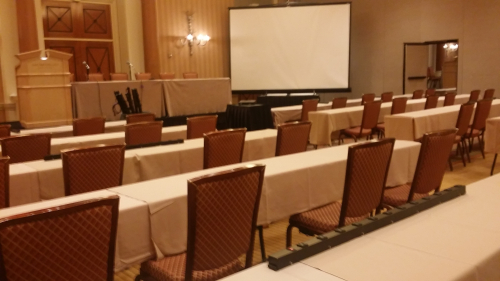
Before. Note the power strips on the tables.
Well played, Caesar’s, well played
.

To supplement your written materials, here are the decisions and other materials which we spoke about this morning at the CLE International Eminent Domain seminar:


Continue Reading Links And Notes From Today’s Las Vegas Eminent Domain Seminar

A new article worth your time by economist William Wade, “Theory and Misuse of Just Compensation for Income-Producing Property in Federal Courts: A View From Above the Forest,” 46 Tex. Envtl L. J. 139 (2016).

Bill is familiar to regular readers, as he has been a frequent guest poster, and a prolific author. This article is his latest, and focuses on how compensation should be calculated in regulatory takings cases, and contrasts how lawyers view economic losses, and how economists view the same thing (not necessarily the same way). 

We are grateful to the Texas Environmental Law Journal and the Environmental and Natural Resources Section of the Texas State Bar for their permission to post the article. Continue Reading New Article: “Theory and Misuse of Just Compensation for Income-Producing Property in Federal Courts: A View From Above the Forest”

2016 BrighamKanner Property Rights Conference Program_Page_01

As we noted here, this year’s Brigham-Kanner Property Rights Conference honoring Hernando de Soto will to be held in The Hague, Netherlands, at the International Court of Justice on October 19-21, 2016.

To push out word, the Owners’ Counsel of America kindly produced a press release announcing our participation in two of the panel discussions, “Property’s Role in the Fundamental Political Structure of Nations,” and “Defining and Protecting Property Rights in Intangible Assets.” 

We mention it here only to note, as this post’s headline states, this may be the only press release (ever?) to mention Hugo Grotius. Left unanswered: how to pronounce “Grotius.”

“I am honored to have been invited to speak at the Brigham-Kanner Conference, especially when the Conference is honoring Hernando de Soto, whose work on property rights has had such international influence,” said Thomas. “I’m also glad the Conference will be held at

Continue Reading Maybe The Only Press Release Ever To Cite Hugo Grotius