


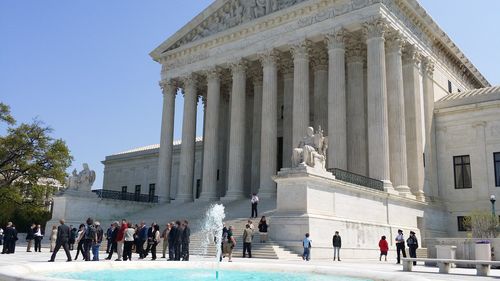
As we predicted, the Supreme Court today held that personal property — here, raisins — is property protected from uncompensated acquisition, and that the USDA’s New Deal regulations pursuant to which the Department fined the Hornes for not turning over to the government a massive percentage of their yearly crop without compensation, is a physical taking under LorettoHorne v. Dep’t of Agriculture, No. 14-275 (June 22, 2015). 

Eight justices rejected the Ninth Circuit’s weird ruling that the regulations did not work a taking because raisins are personal property and not land, holding that “[t]he reserve requirement is a clear physical taking. Actual raisins are transferred from the growers to the Government.” Slip op. at 8. The Court cited [the] Magna Carta, noting it protected certain crops from appropriation:

The Takings Clause provides: “[N]or shall private property be taken for public use, without just compensation.” U. S.

Continue Reading Magna Raisins: 8-1 SCOTUS Says There’s A Taking, But Not All Agree On Remedy
You remember that Ingrid Bergman and Charles Boyer classic “Gaslight,’ in which Bergman’s character is driven by her manipulative husband to doubt her own grip on reality? It gave rise to the term “gaslighting,” which, according to Wikipedia, is “a form of mental abuse in which information is twisted or spun, selectively omitted to favor the abuser, or false information is presented with the intent of making victims doubt their own memory, perception, and sanity.”

Well, yesterday’s New York Times report about the verdict in the AIG bailout takings case, “In A.I.G. Case, Surprise Ruling That Could End All Bailouts,” for a moment had us believing we were being gaslighted, because the Court of Federal Claims had issued a zero verdict for the plaintiffs in their takings case against the federal government, even though the court ruled the government wrongly conditioned

Continue Reading Is The NYT Gaslighting Us? In What Alternate Reality Is The CFC’s Zero Just Comp Award A Victory?

Pic_shot_1429716535697

            “It’s Frank’s world, we just live in it.”

                      – attributed to Dean Martin, about Frank Sinatra

A narrowly drawn opinion from the Supreme Court in Horne v. Dep’t of Agriculture, No. 14-275, argued in April and to be decided by the Court sometime before the Term ends this month, could attract more than the needed five Justices to form a bare majority, and the initial reports from the arguments agree that the Hornes’ takings argument appeared to gain traction with at least a couple of Justices from the Court’s left bloc. Combined with the property-friendly Justices and Justice Kennedy (who appeared to view the government’s arguments with great skepticism), they could put the Hornes well over the top. 

There may be much more at stake, however, if any part of the government’s

Continue Reading Leviathan Shrugged: Oral Arguments In Horne Reveals The Taking, But Remedy Still Open

Third time around for Lost Tree’s takings case against the federal government on this blog.

The first was the Federal Circuit’s decision concluding that a single Florida parcel owned by the plaintiff was the relevant parcel against which the impact of the Corps of Engineers’ denial of a § 404 wetlands dredge and fill permit is to be measured. The court overturned a Court of Federal Claims decision which concluded the relevant parcel was that single plot plus an additional nearby lot, plus “scattered wetlands in the vicinity” also owned by the same owner. 

Second was the Court of Federal Claims, which on remand held that there was a taking, and that, after applying either the Lucas total wipeout or the Penn Central ad hoc test (the diminution in value caused by the denial of the permit was 99.4%), the just compensation owed to Lost Tree was in the neighborhood

Continue Reading Fed Cir: “Economically Beneficial Use” Means More Than Someone Might Buy The Property

California law requires a condemnor to present to the property owner a final pre-trial settlement offer 20 days before trial, and for the property owner to make a final demand. If a court later determines that the condemnor’s final offer was unreasonable and the property owner’s final demand was reasonable, the property owner is entitled to litigation expenses. 

In City and County of San Francisco v. PCF Acquisitionco, LLC, No. A139836 (May 26, 2015), the court concluded that the offer by the city, which “was expressly made ‘contingent on the approval of the Federal Transportation Authority [FTA], the Board of Directors of the San Francisco Municipal Transportation Agency [MTA], and the San Francisco Board of Supervisors [the Board]’,” was unreasonable as a matter of law because it wasn’t a “final offer.” Thus, the trial court wrongly denied the property owner’s request for fees and costs. 

The court held that the

Continue Reading Cal App: Condemnor’s “Final” Pretrial Offer, Contingent On Approvals From Other Agencies, Isn’t Really Final, Is It?

From the Iowa heartland, we offer the headline of the week: “Iowa landowner claims he was offered prostitute by oil pipeline company rep.

And you’re not going to beat this lede any time soon: “A southeast Iowa landowner claims he was offered the services of a prostitute in exchange for allowing a crude oil pipeline to go through his property.” Oh my. 

He says he has the proof, recordings of the alleged multiple offers. “He said his lawyer recommended he not play the recording for the media because it may be used in possible future litigation. He said he would be willing to give them to state investigators if subpoenaed.”

From the steps of the Iowa Capitol he proclaimed, “‘I don’t care if it’s a highway to heaven paved in gold, I don’t want it on our property,’ Tweedy said. ‘And here we go. They came to

Continue Reading Just “Compensation” Just Took On A Whole New Meaning In Iowa Pipeline Dispute

In West Virginia, mineral rights can be owned separately from the surface estate. Not that unusual; something we learned in the first year of law school, in Property I. You might assume that condemning agencies’ lawyers in West Virginia and similar jurisdictions understand this, and counsel their clients accordingly.

Or maybe not, once you read the opinion of the West Virginia Supreme Court of Appeals in West Virginia Dep’t of Transportation v. Newton, No. 14-0428 (May 13, 2015). 

Mr. Butler owned the surface, but Ms. Newton owned the mineral rights. The DOT was building a highway, and asked Mr. Butler whether it could enter his land to test it. He said yes. The DOT condemned and paid him for the land it needed for its highway project. But it also mined and took limestone for the road from the land. Did the DOT assume that Mr. Butler also

Continue Reading West Virginia: DOT Should Not Have Mined Privately Owned Limestone Without Owner’s Permission

If you have plans to be in Wisconsin or environs in June, the Wisconsin chapter of the Appraisal Institute is putting on its 12th annual Condemnation Appraisal Symposium at the Marquette Law School on Wednesday, June 3, 2015.

One of the featured speakers is Mike Berger on “Current National Eminent Domain Issues,” and there will also be presentations about power to take challenges, and thorny appraisal issues, among others.

Here’s the description from the event flyer:

The Condemnation Appraisal Symposium is the go-to event of the year for those real estate and legal professionals who are currently engaged, or who wish to be more involved, in eminent domain matters. This high-level program provides the latest information and open debate on condemnation case law, appraisal techniques and other timely topics presented by attorneys, appraisers, educators, and government officials, while again offering valuable networking opportunities with those practitioners active in this specialty

Continue Reading Upcoming Wisconsin Appraisal And Eminent Domain Law Conference

We’re at a conference with the ABA Section of State and Local Government Law in Philadelphia (talking about eminent domain, public use, just comp, and Horne, inter alia), so we haven’t had the time to read this opinion — issued just a few minutes ago — in detail. But it’s a case we’ve been following keenly, and not just because we filed an amici brief in the case in support of the property owner.

The Texas Supreme Court has issued an opinion in State of Texas v. Clear Channel Outdoor, Inc., No. 13-0053 (Apr. 24, 2015), a case which involves the issue of whether the state DOT took a billboard when it ordered it removed during a road widening project, and if so, how it should be valued. Here’s the bottom line:

Consistent with that case, we conclude that a billboard may be a fixture to be valued

Continue Reading Texas Supreme Court Clarifies Just Compensation For Billboards

Here’s a couple of editorials about the Ramsey case, recently decided by the Virginia Supreme Court. [Disclosure: we filed an amicus brief in support of the Ramseys in that case.]

  • In “Sandbagging, exposed,” the Richmond Times-Dispatch editorial board writes: “Around the country, states that want to take people’s land will sometimes pull an underhanded stunt: If the owners don’t accept the state’s first offer, then the state will produce a second appraisal that claims the property is worth much less.

    That’s exactly what the Virginia Department of Transportation did to James and Janet Ramsey when it exercised eminent domain to take part of their land for an off-ramp. The first appraiser pegged the value of the land at more than $246,000. The Ramseys declined. After the first appraiser retired, VDOT brought in another who said the property was worth only $92,127.”

  • In “High court: VDOT’s


Continue Reading Virginia Papers On The Ramsey Case: VDOT “Bullying” And “Sandbagging” Revealed